
Views: 0 Author: Site Editor Publish Time: 2026-07-03 Origin: Site


A 2026 B2B sourcing guide to custom jewelry packaging wholesale — MOQ tiers, box and pouch structures, materials, finishing, landed cost and EU PPWR compliance. The knowledge map in Section 2 indexes 104 published guides across 11 decision clusters, so a buyer can move from budget check to supplier brief in one place.
TL;DR: Custom jewelry packaging wholesale involves sourcing branded boxes and pouches in bulk (300+ units) directly from manufacturers to minimize costs and ensure brand consistency. For 2026, the key to scaling a jewelry business lies in transitioning from stock retail packaging to factory-direct wholesale, leveraging economies of scale to reduce unit prices by up to 60% while meeting global compliance standards like FSC and EU PPWR.
Key Takeaways:
Wholesale reduces per-unit costs by 20–60% compared to local retail sourcing.
Minimum Order Quantities (MOQs) for custom branding typically range from 300 to 5,000 units.
Rigid boxes offer maximum brand prestige, while microfiber pouches provide high ROI for startups.
Direct factory partnerships offer material traceability and automated QC consistency.
Sustainable materials (FSC paper, water-based coatings) are now a requirement for EU market entry.
This guide is the index to the full library — 11 clusters and 104 deep-dive guides, mapped in Section 2.
Custom jewelry packaging wholesale refers to the large-scale manufacturing and branding of protective containers, such as rigid boxes, fabric pouches, and transport mailers, specifically engineered for the jewelry industry. In 2026, the wholesale market is defined by factory-direct integration, utilizing automated CNC V-grooving and digital quality management to ensure that global brands achieve consistent visual output and maximum logistical ROI across high-volume production cycles.

The Global Supply Hub: A primary manufacturer provides the technical infrastructure and design depth required to support a brand's growth from a local designer to an international house.
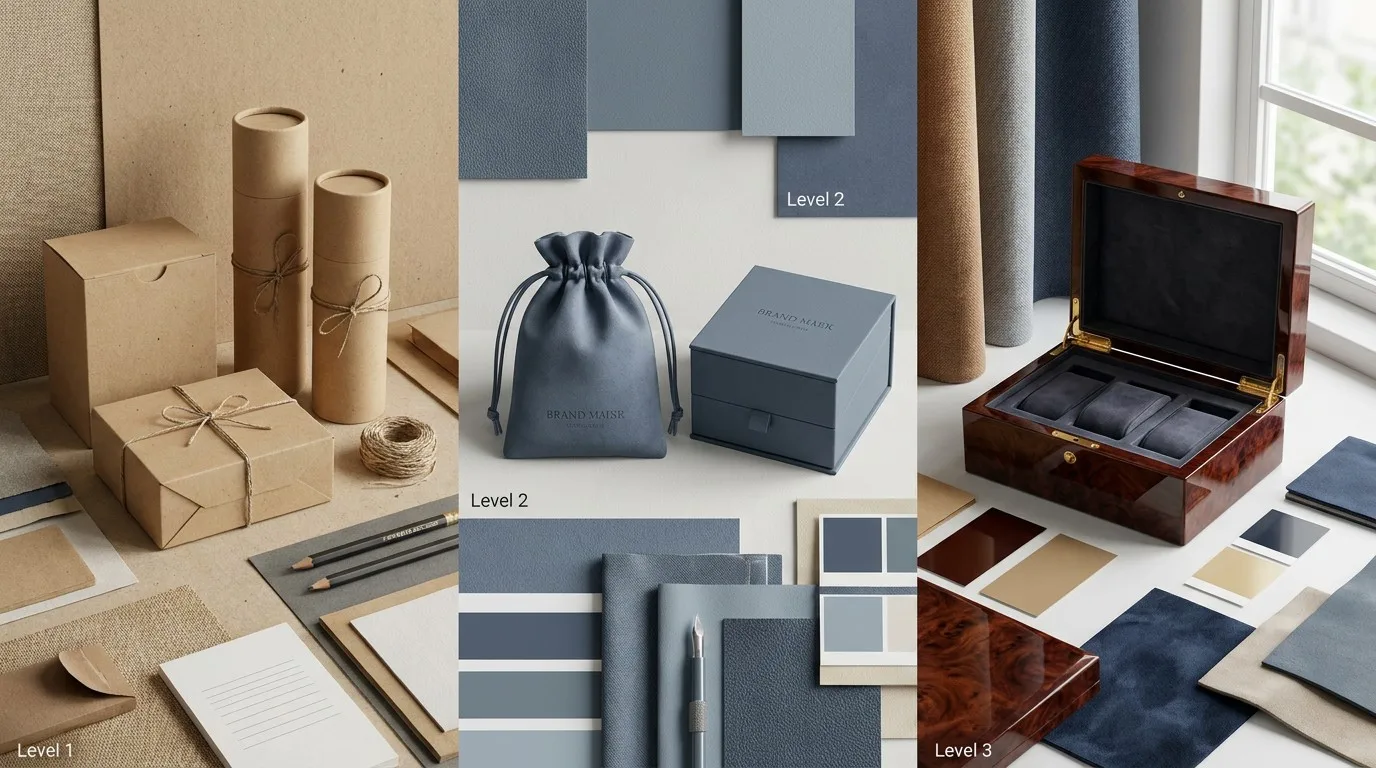
Buyers use the phrase custom jewelry packaging wholesale to describe three different purchases: stock packaging bought in volume, with no branding or a single stamped logo; a stock structure adapted for the brand with a bespoke wrap, foil logo or printed insert card; and engineering, where the structure is designed around a specific piece list with tolerances and finishing specified from the drawing stage.
Unit price rises across those three levels, but rarely in a straight line. The larger jump sits between the first and second, where tooling, print set-up and material minimums enter the quotation; the third is driven less by raw material than by sampling cycles and inspection time.
Wholesale also changes what packaging is. At retail it is a finished good with a fixed shelf price; at wholesale it becomes a line item that can be engineered, where board grade, wrap material, insert construction and pack-out trade against one another.
Three pressures reshaped buying decisions this year. Regulation: European rules push brands toward mono-material, recyclable construction. Traceability: certification claims are increasingly audited, so paper and textile certificates carry weight alongside the price list. Channel: e-commerce returns mean a box must survive a courier network rather than a shop counter, which puts board grammage and corner protection back at the centre of the specification. Sourcing in 2026 is therefore less about the lowest quote than about a partner whose production, documentation and inspection standards can be written into the purchase order.
Wholesale sourcing is not one product decision — it is a system. The map below organises the current Utouch Packaging library into eleven decision clusters, from box structures and pouch materials through sourcing, cost engineering and compliance. Each cluster head is the entry guide; the links beneath it are the deep-dives. Read it as a 2026 sourcing checklist, or drop straight into the cluster that matches your bottleneck.
Focus on rigid construction, closure mechanics and box formats.
Rigid box anatomy — 1,200 GSM industrial cores and why they survive transit.
Magnetic closures — hidden N52 precision and the lid moment.
Cardboard boxes — lightweight flat-pack ROI.
Luxury box positioning — the science of high-end brand positioning.
Velvet boxes — flocked interiors, trays and wholesale tiers.
Leather & PU leather boxes — wrapped surfaces and durability trade-offs.
Drawer & slide boxes — sleeve mechanics and sliding-tray tolerance.
Book-style boxes — hidden book boxes and vintage formats.
Round boxes & pouches — circular tooling and cylinder tolerances.
Mirror boxes — dressing-table formats with a built-in mirror.
Window packaging — open-window boxes that let the product sell itself.
Small boxes bulk — maximising ROI through precision sizing.
Focus on tactile luxury, metal protection and fabric selection.
Velvet pouches — high-GSM selection tips for luxury brands.
Suede pouches — tactile luxury explained.
Microfiber pouches — the ultimate anti-tarnish barrier for sterling silver.
Satin pouches — material selection for wholesale buyers.
Satin vs. velvet — which material protects your inventory better.
Cotton & canvas bags — natural-fibre packaging procurement.
Jute & linen bags — natural fibres for earth-conscious brands.
Flannel pouches — soft cotton protection for delicate pieces.
PVC bags — transparent, durable and anti-tarnish options.
Canvas tote bags — custom shopping bags and branded retail carry.
Organza bags — material selection, cost and application.
Organza drawstring pouch — the sheer pouch for gifting and retail.
Focus on the five-part satin dust bag cluster: definition, size, customisation and wholesale buying.
What is a satin dust bag? — a complete definition guide.
Choosing the right size — how to match bag size to the piece.
Custom satin dust bags — logo, colour and ribbon options.
Wholesale buying guide — how brands buy satin dust bags at scale.
Jewelry roll bags — travel rolls and roll-up organizers.
Paper bags — shopping bags and the branded retail experience.
Focus on substrate selection, lining protection and interior engineering.
Velvet vs. fabric linings — which lining protects your inventory better.
PU leather boxes — material selection, cost and durability.
PVC & EVA — transparent, waterproof and travel-ready solutions.
Foam inserts — custom padding, trays and fitted interiors.
Display cards — custom earring cards and packaging inserts.
Ribbon & trim — finishing elements that elevate brand perception.
Focus on decoration techniques, the design cycle and factory production discipline.
Production process explained — how jewelry packaging is actually made.
Design process — from sketch to production.
Quality control & inspection — the complete B2B QC standard.
Inside the factory — the behind-the-scenes guide to design, production and QC.
Focus on matching format, insert and protection to the piece being sold.
Ring tray vs. ring box — which is best for display and storage.
Earring packaging — box formats, insert design and protection.
Necklace & pendant packaging — chains, pendants and drop pieces.
Bracelet & bangle packaging — cuffs, bangles and flexible chains.
Anklet & body chain packaging — long-chain and body jewelry formats.
Brooch & pin packaging — flat, sharp-edged piece protection.
Hair jewelry & accessories — clips, pins and headpiece formats.
Watch & timepiece packaging — winder, roll and display-box formats.
Pearl packaging — protecting lustrous pieces with the right interior.
Boxes vs. pouches — which one actually sells better.
Gift set & multi-piece packaging — curated sets and coordinated inserts.
Jewelry packaging sets — integrated box-and-pouch programmes.
Jewelry organizer boxes — storage cases, trays and custom solutions.
Travel & portable packaging — protective formats for travel retail.
Focus on choosing, auditing and scaling a packaging supply partner.
Supplier audit checklist — how to choose a custom jewelry packaging supplier.
Sourcing from China — the complete 2026 buyer guide.
How to import from China — a step-by-step B2B guide.
Wholesale strategy — protecting margins and quality.
Modular packaging systems — scaling a wholesale supply chain for global retail.
Lead times — production timelines, sample cycles and peak-season planning.
Custom ring box supplier audit — engineering the “yes” moment.
Custom necklace box wholesale — engineering for perfection.
Boxes with logo wholesale — sourcing branded boxes in bulk.
Upgrade guide — when and how growing brands should re-tool packaging.
Case studies & FAQ — how Utouch helps jewelry brands source custom packaging.
Focus on true landed cost, volume tiers and freight economics.
True per-unit cost — the economics of custom jewelry packaging.
Pricing tiers — how volume pricing works and how to buy at the right tier.
Shipping & logistics cost — the complete cost-optimisation guide.
Corrugated mailers — transit protection and branded delivery.
Typical MOQ — what the average minimum order really is.
Q4 planning — when to order for the holiday season.
Focus on buyer-specific procurement paths from Etsy seller to luxury house.
Small business — affordable custom packaging ideas.
Low MOQ — custom packaging without big minimums.
10 custom packaging ideas — for small brands in 2026.
15 creative ideas — to elevate your brand in 2026.
Etsy sellers — branding versus shipping costs.
Personalized packaging — how Etsy sellers and small brands win gift buyers.
Handmade businesses — protecting one-of-a-kind pieces.
Shopify brands — a DTC procurement guide.
Brand startups — first procurement decisions and budget optimization.
Luxury brands — materials, finishes and the unspoken rules.
Retail-ready packaging — display-ready design for wholesale buyers.
Display boxes — showcase packaging for retail.
Focus on seasonal sourcing calendars and the psychology of the first touch.
Design trends 2026 — what B2B buyers need to know.
2026 trends: 7 shifts — the shifts brands need to know.
Unboxing experience — designing packaging for customer delight and retention.
Luxury packaging for gold jewelry — elevating value through security and materials.
Wedding packaging — bridal boxes, return gifts and engagement presentation.
Christmas packaging — holiday boxes, advent calendars and gift bags.
Valentine’s Day packaging — boxes, gift sets and the sourcing timeline.
Focus on meeting FSC, PPWR and eco-audit requirements before they become a shipment risk.
Eco-friendly supplier audit — how to verify a green packaging supplier.
Sustainable material sourcing — the 2026 sourcing guide.
Mono-material mastery — brand success stories under EU PPWR.
Minimum order quantities exist because of set-up: tooling, print plates, foil dies and the material minimums imposed by upstream mills create a floor below which a run cannot start economically. Most manufacturers publish MOQs in tiers, tied to how much of the product has to be made specifically for that buyer:
Business Stage | MOQ Range | Recommended Strategy |
|---|---|---|
Startup (Launch) | 300 – 1,000 units | Stock colour and size, one logo position, foil or single-colour print. |
Growth Stage | 1,000 – 3,000 units | Custom wrap colour and a bespoke insert; two or three SKUs per run. |
Established Brand | 3,000 – 10,000+ units | Bespoke structure and sizing, scheduled releases, consolidated freight. |
Expert Insight: MOQ and unit price are separate negotiations, and an MOQ can be lowered without weakening the specification — a stock size and colour, one foil logo rather than four print colours, a shared production window, or staged releases against a forecast. The point at which set-up stops dominating unit cost usually sits well above the entry MOQ, which is why consolidating two or three SKUs into one run often lands close to the price of a much larger order.
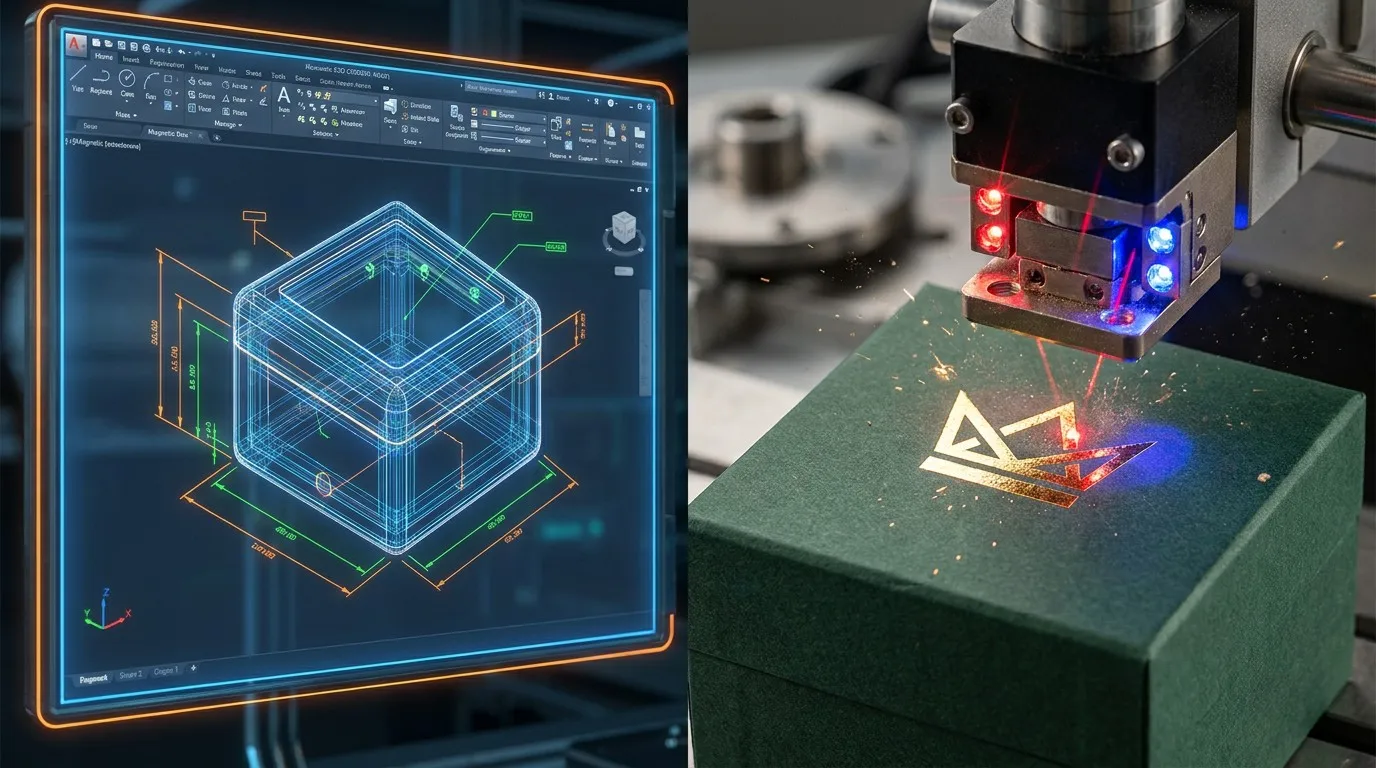
From Blueprint to Brand: a capable wholesale partner integrates 3D structural CAD modelling with automated finishing, so the physical box matches the digital specification on tolerance as well as on appearance.
Total landed cost is driven by material complexity, finishing steps and freight rather than by the box alone. The 2026 wholesale tiers:
Basic solutions (roughly $0.20 – $0.80 per unit): high-GSM paper cards, simple drawstring pouches and lightweight folding boxes — usually the first purchase for a new brand or a low-price-point line.
Mid-range solutions (roughly $0.80 – $2.50): rigid greyboard boxes with a paper or fabric wrap, and premium pouches. This is the decision zone for most growing B2B brands, because the structure carries shelf presence without bespoke tooling.
Luxury solutions (roughly $2.50 – $6.00 and above): magnetic closures, multi-layer inserts, flocked or lined interiors and complex decoration.
Ranges above are 2026 planning estimates (illustrative) — confirm against your own RFQ and specification.
Five variables move a quote more than buyers expect. Board grade sets protection and weight — and weight is paid for again in freight. Wrap material is the largest visual lever: paper is the cheapest and the most recyclable, while fabric and PU lift perceived value at a higher unit and compliance cost. Each extra finishing pass adds a set-up and a rejection rate. Pack-out decides how much air is shipped, because nested flat boxes move several times as many units per carton. Freight mode, duty and eco-modulated fees sit on top.
The distinction matters less at quotation stage than in the fifth month of a programme, when a colour drifts.
Factor | Direct Factory | Trading Company |
|---|---|---|
Unit Price | Lowest (direct cost) | Higher (typically a 15–25% mark-up) |
Lead Time | Stable and priority-controlled | Variable (subject to the queue it buys from) |
Quality Control | In-house inspection and traceable material records | Depends on the supplier behind the order |
Problem Resolution | Corrective action taken at the machine | Escalation through a third party |
Verification can happen before an order: the licence scope should cover production rather than trading, recent production-floor footage beats a showroom photograph, the machine list should match the process quoted, and third-party inspection before cartons are sealed should be agreed in writing.
Almost every quotation traces back to one material choice and one finishing choice. The structure protects and the surface sells: rigid boxes gain rigidity from greyboard grammage and lamination, so upgrading the board is the cheapest way to survive a courier network, while upgrading the wrap changes how the box is perceived. Inside, the lining decides protection and assembly speed — die-cut foam and EVA trays travel well, flocked surfaces mark easily, and moulded paper pulp aligns best with recyclability rules.
On finishing, foil stamping gives the crispest metallic logo but needs a die and a heated pass; embossing adds texture without colour; UV printing carries full-colour artwork in one pass and is usually the most economical route to a multi-colour logo. Decorating the inside lid lifts perceived value at a fraction of the cost of changing the outer structure.
A wholesale programme runs through five stages, and each one has a failure mode that is cheaper to fix before the next begins.
Brief and structural sample. The specification becomes a physical mock-up. Expect one to two weeks, and expect the first sample to expose an unwritten assumption — usually insert fit or lid clearance.
Pre-production sample. The sample that matters: it should use the actual materials and finishing method, because this is the reference both sides will argue from later.
Bulk production. Runs in weeks rather than days. Capacity compresses from late in Q3 as holiday orders fill the floor, so build the calendar around the ship date, not the sell date.
Inspection. Ideally before cartons are sealed: a sampling inspection against the agreed specification, a colour check against a retained approved sample, and a carton test for a shipment that will be stacked and handled.
Freight. Ocean adds a further month or more door to door, and peak-season space is booked early. Air freight is a remedy for a late order, not a plan.
What separates calm programmes from expensive ones is documentation: an approved sample retained by both sides, a written tolerance for colour and size, and an inspection report issued before the container leaves.
Identity. Sable & Stone, a Portland-based jewellery brand founded in 2019 by a former retail buyer, sells through its own site and a handful of wholesale accounts, with packaging volumes still measured in the low thousands per year.
The problem. Orders from three intermediary suppliers arrived looking like different products: the navy wrap drifted noticeably between batches, and transit damage ran in the high single digits as a share of units shipped. A wholesale account photographed two shipments side by side, turning an internal nuisance into a commercial risk.
The trial-and-error. Swapping intermediaries changed the price but not the drift, and specifying a Pantone number alone failed once the wrap supplier changed between runs. Only the third attempt — consolidating boxes, pouches and mailers with a single manufacturer, locking one board grade and one wrap source, and holding an approved physical sample on both sides — brought variation inside a tolerance the brand could defend.
The measurable shift. Over two production cycles, transit damage fell from the high single digits to under one percent of units, and colour moved from visibly different between batches to within a defined tolerance. Sampling lengthened slightly; unit price moved a little rather than materially.
The after-effect. The savings came from not replacing damaged sets and not answering account complaints, and the same specification was extended across the remaining SKUs the following season.
Final production suite: once a single factory-direct supply chain handled every SKU, colour matching became a written specification rather than a hope.
What is the difference between a trading company and a factory for wholesale?
A factory owns the machines and answers technical questions directly. A trading company coordinates production elsewhere, which adds a mark-up and means the actual producer changes when a cheaper option appears — the main reason quality varies between batches.
Should a growing brand buy boxes or pouches first?
Pouches usually come first. A drawstring or dust bag carries a lower unit cost, a lower MOQ and a smaller freight volume, so it protects margin while the brand is still testing sell-through. Add rigid boxes once the piece mix and price point justify the tooling. Cluster 2 covers the pouch decision; Cluster 1 covers the box decision.
Which materials are required for EU PPWR compliance in 2026?
The direction of travel is mono-material and recyclable: FSC-certified paperboard, water-based coatings, and single-substrate construction that separates cleanly at a sorting facility. Mixed PU-wrap plus foam plus solvent-glue construction is the format most exposed to eco-modulated fees. Verify claims with material certificates rather than the label on the sample. Cluster 11 covers the compliance path.
What actually drives the per-unit price of a custom jewelry box?
Five things, in rough order of impact: board grade and grammage, wrap material, the number of finishing steps, insert construction, and pack-out density. Changing the wrap moves price and positioning at the same time; changing pack-out changes freight without touching the box a customer ever sees.
How long does a wholesale packaging order actually take?
Plan on a sampling cycle first (structure, material and logo verification), then bulk production, then freight. Sampling absorbs most of the surprises, and the peak-season calendar compresses capacity from late Q3. Order ahead of the ship date, not the sell date — Cluster 8 covers lead-time and Q4 planning.
The brands that scale on packaging in 2026 treat it as an engineered line item: a structure chosen for transit, a surface chosen for the price point, a documented sample binding both sides, and a knowledge map that shows which decision comes next. Price follows from those choices rather than replacing them.
Sourcing teams preparing a 2026 programme can request a landed-cost review and a specification quote against their own piece list and volumes.
Explore related technical pillars: Jewelry Packaging for Small Business | Jewelry Packaging Ideas | Custom Jewelry Boxes Wholesale | Jewelry Packaging Cost Guide | Inside the Jewelry Packaging Factory | Case Studies & FAQ
Utouch Packaging | Xiamen Yu Touch Imp & Exp Co., Ltd.
Last updated: 11 September 2026 — this knowledge map now links 104 published guides across 11 topic clusters.
