
Views: 0 Author: Site Editor Publish Time: 2026-08-27 Origin: Site


Article Intro: The right satin dust bag size is the difference between a bag that protects and a bag that fights the piece — too large lets jewelry slide, tangle, and read as cheap; too small strains the seam and the closure. This guide covers how satin dust bag sizes are defined, standard sizes for each jewelry type, how to measure a piece for sizing, and how to plan sizes across a full product line.
Size is the most visible quality signal on a satin bag — and the most common source of buyer disappointment. A bag that is too large lets the piece move: a necklace slides, an earring pair knocks together, and the bag loses its protective job. A bag that is too large also reads as sloppy in the customer's hand; the piece looks lost inside it, and the perceived value drops even though the jewelry itself is unchanged.
A bag that is too small is worse in a different way: the piece has to be forced past the drawstring, the seam strains, and after a few uses the closure or the seam can fail. For high-value pieces, the wrong size can even damage what the bag is meant to protect.
The sizing rule is simple: the piece should slide in easily, sit without shifting, and come out without a fight. That leaves just enough room for the drawstring to close over the top — neither a loose pouch around the piece nor a tight squeeze past the opening.
Before choosing a size, it pays to know how bag sizes are actually defined — because the definition is where orders go wrong. A satin dust bag size is normally stated as width × length in centimeters, measured flat: the width across the bag, and the length from the top edge (including the drawstring channel) to the bottom seam. Two definitions cause most of the confusion:
Flat vs. expanded: A bag measured flat lies at half its usable width, so a bag listed at 10 × 14 cm opens to roughly 20 cm around the top. Buyers who picture the expanded width and receive the flat measurement think the bag shrank.
Inner vs. outer dimensions: Some suppliers state the outer size of the bag, others the usable inner space. The difference is the seam allowance and the drawstring channel — small on paper, visible in practice when a piece is a tight fit.
The fix is a written definition at the quotation stage: width × length, flat or expanded, inner or outer. A jewelry brand in South Korea learned the cost of skipping this step on a PVC bag order: the buyer's understanding of the size and the supplier's definition did not match, the mismatch surfaced only after the early samples, and the supplier acknowledged the mistake, re-verified the specifications against the order history, and rebuilt the confirmation process around a written definition. The order — $699.50 — closed with the buyer placing an additional order and signaling a long-term relationship. The same lesson applies to satin dust bags: settle the size definition in writing before production, because the flat-width, expanded-width, and inner-space versions of the same number are three different bags. Satin dust bags and other jewelry dust bags follow the same definition rules, so the written specification that protects a PVC order protects a fabric order identically.
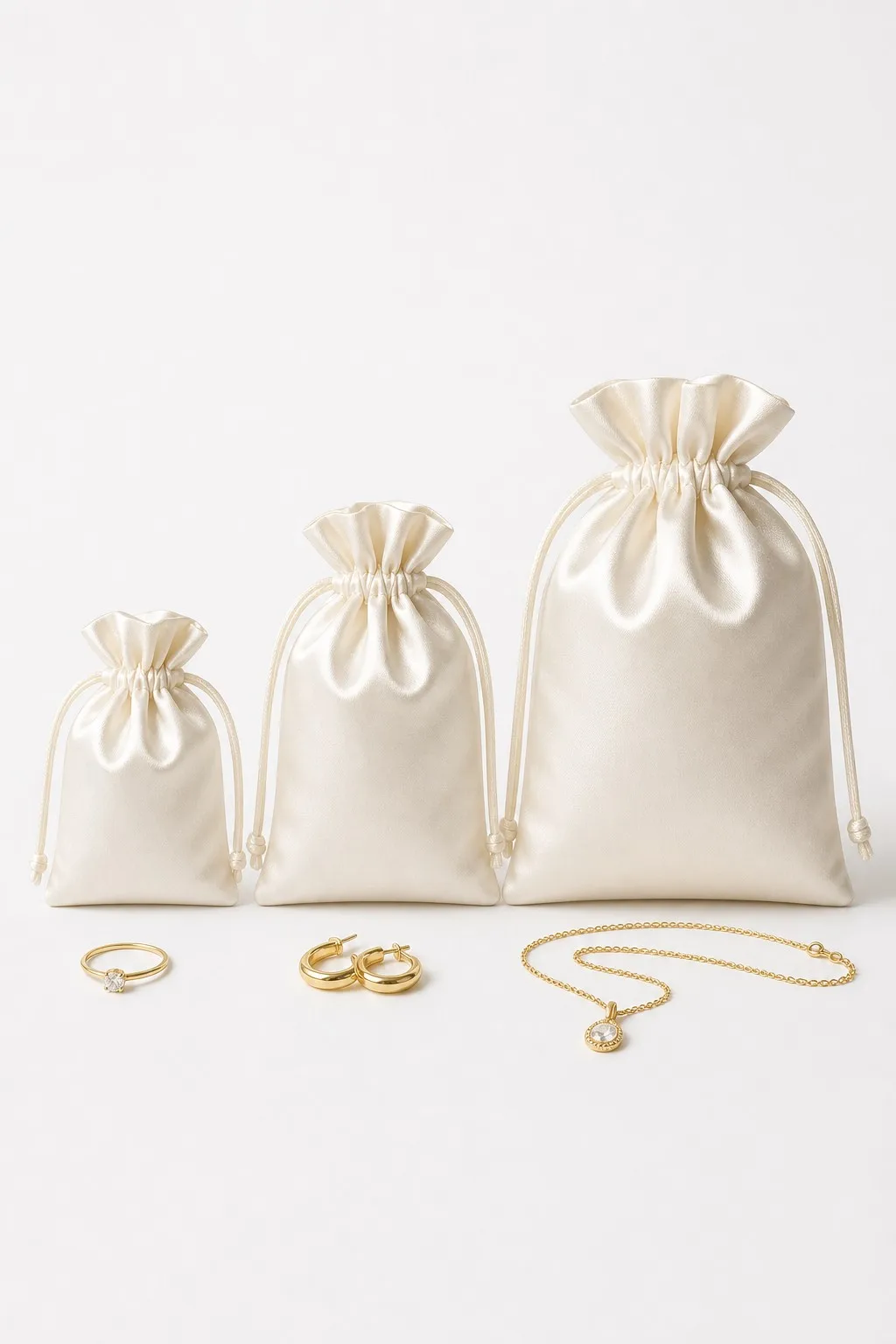
Small, medium, and large satin dust bags — matched to the piece, not the other way around
Most satin jewelry bag orders fall into four size bands. The dimensions below are working references in flat width × length; the exact size should always follow the piece:
Jewelry | Suggested Bag Size | Reference (flat W × L) |
|---|---|---|
Ring | Small | 5 × 6 cm / 6 × 8 cm |
Earrings | Small | 6 × 8 cm / 7 × 9 cm |
Bracelet | Medium | 8 × 10 cm / 9 × 12 cm |
Necklace | Medium / Large | 10 × 12 cm / 12 × 15 cm |
Jewelry Set | Large | 13 × 18 cm / 15 × 20 cm |
These are starting points, not rules. Long chains and chokers run longer than the width bands suggest; bulky cuffs and charm bracelets need extra width; and a set that includes a box needs a bag sized around the box, not the pieces. When a line spans several piece types, most brands standardize on two or three sizes rather than one-per-piece — small, medium, and large cover the overwhelming majority of jewelry. The sizes available, from ring pouches to set bags, are listed on the Satin Bag product page.
To size a bag from a specific piece, take three measurements:
Longest dimension: Lay the piece flat, measure its longest side. For a necklace, measure the full chain laid out; for earrings, the pair laid end to end.
Width of the bulk: Measure the widest part of the piece (a cuff's width, a pendant's span). The bag must clear this, not just the length.
Thickness/volume: High pieces — stacked bangles, a chunky pendant, a set — need a bag that holds volume, not just a flat outline. This is where bag shape matters as much as size.
Then add a comfortable margin: roughly 2-3 cm on the length so the piece sits below the drawstring channel, and 1-2 cm on the width so the piece does not press against both seams. For chains specifically, order up rather than down — a chain that fits exactly will tangle in its own slack. The same measurements serve a satin lined jewelry pouch and a plain satin pouch alike, and a satin jewelry pouch sized to the piece holds it visibly better than a generic bag a size up.
Size and shape work together, and the same width × length can behave very differently across shapes:
Flat envelope pouch: The standard shape — compact, stackable, economical. Best for rings, earrings, and flat pieces.
Round-bottom pouch: A satin round bottom jewelry pouch stands on its own and holds volume, so it suits bracelets, pendants, and pieces with body. It also displays well at retail — and a satin drawstring pouch bag for jewelry with a round bottom is the standard choice when the same bag must both store and present the piece.
Drawstring with gusset: A gusseted base adds usable volume without increasing the flat size — a good option for sets and bulky pieces where a flat pouch would need to be oversized.
The practical rule: if a piece is flat, size the length; if a piece has body, choose a shape that carries volume. A satin pouch for jewelry with a round bottom holds a cuff comfortably at a flat size that would strain an envelope pouch.
When ordering satin dust bags for a full product line, plan sizes the way you plan the line:
Standardize on 2-3 sizes: Small, medium, and large cover most lines; one-per-piece SKUs multiply inventory and minimums for little benefit.
Match the size mix to the line: An earring-heavy line buys mostly small; a necklace-heavy line shifts toward medium and large. The mix can be refined on the reorder once sales data shows what the line actually sells.
Order per-size minimums consciously: Sizes share the same production run, so a 500-piece order across three sizes costs little more per piece than a single-size order — but a tiny fourth size (say, 200 pieces) can drag the economics, so consolidate where possible.
Confirm each size with a sample: One sample per size, with the actual piece inside, beats any specification sheet — and it is the moment the size definition written at quotation gets verified physically. For a custom satin jewelry bag order, those per-size samples are also where the closure and the logo placement get confirmed together with the dimensions.
Size shapes how the customer values what is inside. A bag that fits the piece exactly — the necklace resting in the base, the drawstring closing just above it — signals that the packaging was designed for the product, which is the quietest form of quality. An oversized bag does the opposite: it reads as generic, as if the bag was bought in bulk and reused for everything. The difference costs nothing in production; a size is a spec line, not a premium. But it changes the unboxing in the customer's hand, and it changes the photo, the social post, and the gift moment that follow. Brands that size their bags to the line — not to the nearest convenient stock size — consistently report that the fitted bag reads as the more expensive packaging even when the fabric is identical. The perceived value argument is the practical reason the sizing discipline belongs in the order spec, not just the design brief.
Four mistakes repeat across satin jewelry bag orders:
Ordering up "to be safe": A bag a size too large is not safer — it lets the piece slide and tangle. The margin belongs on the length for chains, not across the whole bag.
Reading only the length: Two bags can share a length and differ by 3 cm in width. Width decides whether a cuff or set fits.
Forgetting the closure margin: The drawstring channel sits above the usable space; a piece sized to the bag's full length will sit in the channel. Leave the 2-3 cm margin.
Skipping the written definition: Flat vs. expanded, inner vs. outer — unwritten, these differences surface as a surprise at the sample stage. Written at quotation, they cost nothing.
Q: What size satin dust bag do I need for a necklace?
A: Medium to large — a 10 × 12 cm bag for standard chains, 12 × 15 cm for long chains and statement pieces. Size up rather than down: chains tangle in a tight fit.
Q: What size satin dust bag is best for earrings?
A: Small — 6 × 8 cm or 7 × 9 cm flat. Pairs slide in easily and stay together; round-bottom versions hold stud boxes.
Q: Are satin dust bag sizes the same across suppliers?
A: No — and that is the point. One supplier's 10 × 14 cm can be flat width, another's expanded, another's inner space. Always confirm the definition in writing at quotation.
Q: Can I order multiple sizes in one batch?
A: Yes — sizes share the production run, so mixing small, medium, and large in one order keeps per-piece pricing efficient. Confirm each size with its own sample.
Q: Does the bag shape affect the size I need?
A: Yes. A round-bottom or gusseted satin pouch for jewelry holds more volume at the same flat size, so bulky pieces can use a smaller flat size in a volume shape than in an envelope pouch.
The right satin dust bag size is the one that lets the piece slide in, sit without shifting, and come out without a fight. Size bags from the piece — longest dimension, bulk width, and volume — then add a 2-3 cm length margin for the closure. Work with flat width × length, confirm flat vs. expanded and inner vs. outer in writing at quotation, standardize the line on small/medium/large, and confirm each size with a sample. For satin jewelry bags, size charts, and custom sizes across a full packaging line, visit Utouch Packaging — and for direct factory quotes on satin bags and complete jewelry packaging, reach Xiamen Yu Touch Imp & Exp Co., Ltd.

