
Views: 0 Author: Site Editor Publish Time: 2026-06-25 Origin: Site


Navigating the economics of brand identity can be the difference between a profitable scale-up and a logistical failure. This 2026 jewelry packaging cost guide provides a technical and financial framework for B2B procurement managers. From raw material inflation and MOQ impact to hidden freight surcharges and the ROI of high-density materials, we analyze the variables that dictate unit pricing. Featuring a deep case study on how "Aurum Collective" reduced total landed costs by 35% using standardized tooling, this analysis provides the transparency needed to budget effectively for the upcoming retail season.
Price Tiers Explained: Strategic packaging procurement starts with matching the material tier to the product's average order value (AOV).
For most emerging jewelry brands, the most frustrating part of the supply chain is the lack of standardized pricing. Why does one supplier quote $0.80 for a box while another quotes $2.50 for what appears to be the same design? This "Transparency Gap" often leads to brands paying a 30% to 50% premium for middleman markups or choosing substandard materials that lead to tarnish and transit damage.
In 2026, as the cost of recycled paperboard and specialized labor continues to rise, successful procurement teams are moving away from "Lowest Quote" sourcing toward Total Landed Cost (TLC) analysis. Understanding the components of a quote — raw materials, surface finishings, internal inserts, and logistics — is the only way to protect your margins without compromising the unboxing experience.
What is the cheapest jewelry packaging for small business? Typically, a combination of a high-density microfiber pouch and a branded paper insert is the most cost-effective way to achieve luxury tactile feedback at a low unit price.
How can I make my jewelry packaging look expensive on a budget? Successful designers focus on "Texture over Shine." Using high-GSM matte papers and deep blind embossing often creates a more premium feel than expensive glossy coatings.
How much does custom logo printing actually add to the cost? For bulk wholesale orders, a custom logo adds approximately $0.05 to $0.15 to the unit price, provided the brand owns its brass or magnesium plates.
How do I reduce international shipping costs for packaging? Transitioning to "Flat-Pack" cardboard structures or ultra-slim pouches can reduce volumetric freight charges by up to 80%.
To accurately budget, B2B buyers must understand the four "Cost Pillars" of a custom packaging quote:
In 2026, the global shift toward EU PPWR compliance has increased the demand for FSC-certified recycled paper.
Standard Cardboard: $0.15 - $0.40 per unit.
Industrial Greyboard (Rigid Core): $0.60 - $1.20 per unit.
Microfiber / Velvet Fabric: $0.30 - $0.80 per unit depending on GSM.
Every custom project requires "Plates" for foil stamping and "Dies" for cutting.
Foil Stamping Plate: $50 - $150 (One-time fee per design).
Die-Cutting Mold: $100 - $300 (One-time fee per size).
This is where "Premiumization" occurs. High-speed automated lines reduce labor cost but require higher MOQs. Manual "hand-wrapping" for complex shapes increases cost by 25-40% but allows for extreme detail.
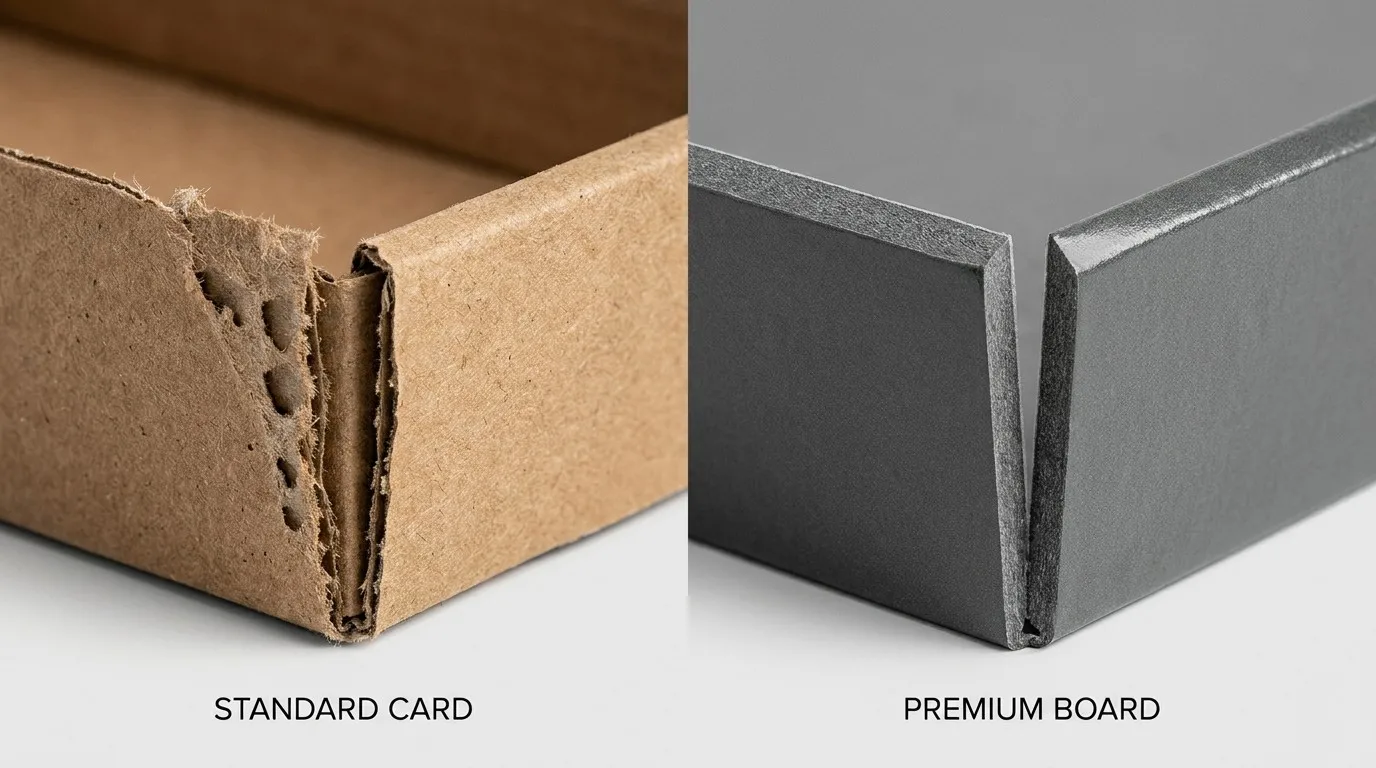
Solution Product Composition: The technical difference in cost often lies in the core density. A 1200 GSM industrial core with precision V-grooving (RIGHT) offers 300% more crush resistance than standard cardstock (LEFT), protecting the jewelry and justifying a 15% higher unit price through reduced return rates.
Industry experts recommend categorizing your packaging needs into three distinct "Budget Tiers" to optimize ROI:
Tier 1: High-Efficiency / Low MOQ (Budget: $0.40 - $1.00)
Focus on Microfiber Pouches or high-GSM paper envelopes. These eliminate the need for expensive rigid molds and minimize shipping weight. Best for fashion jewelry and high-SKU counts.
Tier 2: The E-commerce Standard (Budget: $1.20 - $2.50)
Utilize Rigid Jewelry Boxes made from recycled greyboard. These provide the essential "Lid Moment" required for $100+ items. In 2026, drawer-style boxes with ribbon pulls are the most popular conversion driver.
Tier 3: The Luxury Matrix (Budget: $3.50 - $10.00+)
Multi-layered systems including a outer box, an inner Velvet Pouch, and a customized shopping bag. This tier utilizes 3D foil embossing and specialty papers from boutique mills.
To truly master the jewelry packaging cost guide, you must understand the "Unit-Price Gravity." In B2B manufacturing, unit costs follow a steep curve based on volume tiers. For example, moving from 500 units to 3,000 units typically triggers the shift from manual finishing to semi-automated production, dropping the price by 25%.
By the time a brand reaches the 10,000-unit "Wholesale Tier," the cost of setup labor is spread across so many units that the brand can often upgrade their paper grade or add a hidden magnetic closure for the same total budget they previously spent on lower-quality items at smaller volumes. We recommend that growing brands forecast their 12-month requirements and place a single blanket order with split shipments to secure these high-volume savings without overwhelming their local storage capacity.
Successful manufacturers recommend three "Expert Hacks" to stabilize your packaging budget:
Standardize Your Mold Library: Before requesting a custom size, ask for the factory's "Stock Mold List." Using a pre-existing 6x6cm or 9x9cm mold can save you $300 in tooling fees and lower your MOQ.
Material Aggregation: Order your boxes and pouches in the same material color batch. By grouping your Packaging Set into a single raw-material run, you reduce waste and gain higher leverage on unit pricing.
Sea-Freight Splitting: For large wholesale orders, ship 10% of your stock via air for immediate launch needs and 90% via sea to stabilize your Fully Landed Cost.
Aurum Collective, a growing retail brand specializing in demi-fine gold jewelry, was sourcing their packaging from three different regional wholesalers. Because each item had a slightly different box size, they were paying for 12 different die-cutting molds and four different plate fees. Their average unit cost was $2.45, plus an additional $1.10 in fragmented shipping fees. Their packaging spend was eating 18% of their gross margin.
The brand manager initiated a Packaging Consolidation Audit. Instead of 12 sizes, they mapped their entire collection to just three "Universal Sizes" already available in our factory's stock library. They moved from a multi-colored approach to a single signature "Aurum Champagne" textured paper, allowing for a bulk material buy at wholesale rates. You can verify our manufacturing scale and color libraries at our Alibaba International Shop.
The transition was complete by mid-2026, delivering hard data-backed ROI:
Unit Cost Reduction: The consolidated order of 20,000 units dropped the unit price from $2.45 to $1.58 (a 35% saving).
Tooling Savings: By switching to standardized open-mold sizes, they avoided $3,600 in new mold fees for their holiday launch.
Conversion Metric: Customer feedback on "Packaging Quality" rose by 22%, as the unified color palette made the brand look like a global luxury house.
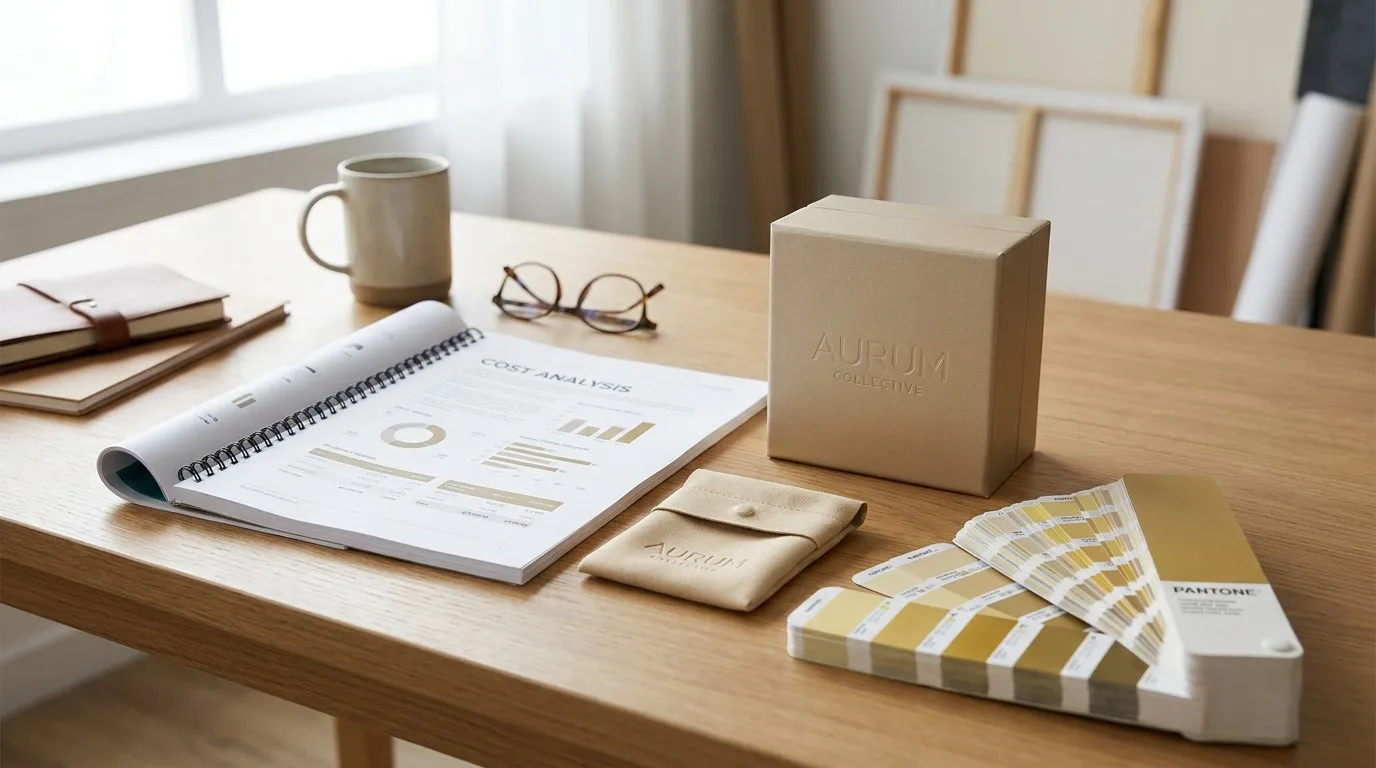
Design Deliverable: The final Aurum Collective suite. By balancing 'Stock Standards' with high-end finishing, the brand achieved a $10 luxury look for a $1.58 wholesale cost.
A microfiber pouch combined with a branded jewelry card is often the most cost-effective solution for startups, balancing protection, branding, and shipping efficiency.
Focus on texture (velvet or microfiber), a layered unboxing experience, and minimal but consistent branding. Deep blind embossing often creates a higher perceived value than shiny gloss.
Flat pouch-based systems are typically the lowest-cost option while still maintaining a premium appearance. They also save up to 80% on international freight costs.
Use lightweight, thin-profile packaging systems such as pouch + card combinations instead of rigid boxes to qualify for 'Large Envelope' shipping tiers.
While many traditional factories require 2,000+ units, direct manufacturers often offer specialized programs where custom logo branding starts at just 300 to 500 units on stock materials.
The jewelry packaging cost guide for 2026 highlights a simple truth: the most expensive packaging is the one that fails. By understanding material tiers, standardizing tooling, and accounting for total landed costs, B2B procurement managers can build a brand that looks like a million dollars without spending it.
Our team of structural engineers and cost-analysts is ready to help you optimize your 2026 budget. Ready to find your 'Sweet Spot' between cost and luxury? Contact our Procurement Division for a TCO Analysis and custom quote today.
