
Views: 0 Author: Site Editor Publish Time: 2026-09-04 Origin: Site


Article Intro: The foam insert is the hidden half of a jewelry box — the padding that holds the ring upright, cushions the necklace, and keeps the set organized, while the customer sees only the velvet. For jewelry brands, the insert decision is about foam type, density, and cut: which padding protects the piece, presents it correctly, and turns a standard box into a custom one. This guide covers foam types, insert styles, fabric wrapping, custom inserts, and the insert-first design logic that makes a box feel made for the piece.
A foam insert is the fitted padding inside a jewelry box that holds the piece in place — a cut block of foam, wrapped in fabric, shaped with grooves, slots, and compartments that match the jewelry it carries. The box provides the structure; the insert provides the fit. When a ring stands upright in a velvet groove or a necklace lies flat in a padded channel, the foam insert underneath is doing the work.
The foam insert is specified in millimeters, not moods: the groove width matches the band, the slot depth matches the chain width, and the compartment grid matches the set's piece count. A foam for jewelry box that fits the pieces correctly is the difference between a box that presents and a box that just contains.
The insert earns its place through four functions:
Protection: Foam absorbs the small shocks of handling and transit — the piece stays cushioned, separated, and still, so stones do not knock and chains do not tangle.
Presentation: The insert holds the piece at the correct angle — a ring upright in a groove, a pendant centered on a pad, a set displayed in its compartments. The presentation angle is designed into the foam, not improvised.
Fit and feel: A box with a proper insert feels substantial when opened — the weight, the resistance of the foam, and the clean seat of the piece read as quality before the customer touches the jewelry.
Custom structure: The insert is where a box becomes custom — the layout, the grooves, and the compartments are cut to the brand's exact pieces, turning a standard box shell into a fitted presentation.
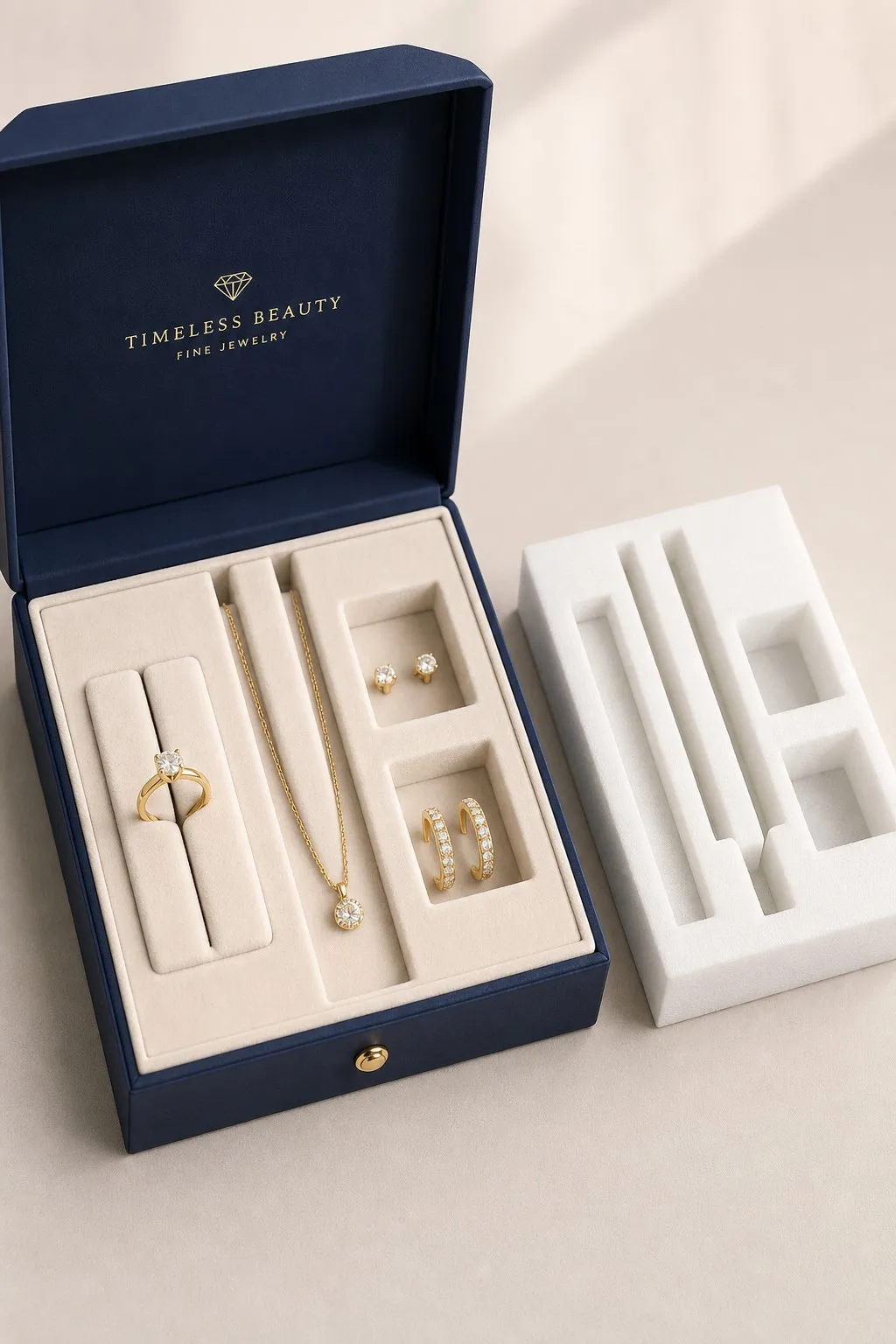
The insert does the holding — velvet-wrapped grooves on the left, the raw cut block on the right
The foam type decides the insert's feel and durability:
Polyurethane foam: The standard insert material — soft, resilient, and easy to cut into precise shapes. Density ranges from soft (light pieces) to firm (heavy cuffs and watches), and the density is specified with the piece weight.
High-density / high-resilience foam: Firmer and longer-wearing — the choice for retail boxes that open and close hundreds of times without the grooves flattening.
EVA foam: Rigid and moisture-resistant — used for travel cases, watch rolls, and structured organizers where shape retention matters more than softness.
PE foam: Lightweight and economical — the cost-efficient layer for e-commerce boxes and volume programs.
Microcell and flocked foam: Fine-cell foams that take a clean groove edge and hold their shape in precision cuts — the base for ring grooves and narrow necklace channels.
The elegant jewelry box with foam reads as premium because the density is matched to the piece: soft under a delicate chain, firm under a heavy ring, and graduated in set boxes where different pieces share one structure. The jewelry box insert foam density is a specification, not an afterthought — a brand that names the density and the piece weight at quotation gets an insert that holds correctly on arrival.
The insert style follows the box and the piece:
Style | Character | Best for |
|---|---|---|
Single-groove block | One cut groove in a padded block | Ring boxes, single pendants |
Channel tray | Parallel channels across the insert | Necklaces, bracelets, chains |
Compartment grid | Divided grid of slots and pads | Earring sets, mixed sets |
Layered / tiered pad | Multiple levels inside one box | Collections, large sets, retail displays |
Flat pad + overlay | Fabric-wrapped pad with a cut overlay | Flexible layouts, mixed SKUs |
The jewelry box insert style is chosen with the piece plan: a ring line needs groove blocks, a chain line needs channel trays, and a set line needs compartment grids. Brands that standardize two or three insert styles cover most of the line without a custom cut per SKU — and a box insert jewelry layout that matches the line can be reordered without redesign, which keeps the second order as clean as the first.
The raw foam is rarely visible — it is wrapped or covered to match the box interior:
Velvet-wrapped foam: The standard pairing — velvet foam inserts jewelry box formats give the soft grip and the premium read, with the foam density underneath the fabric deciding the hold.
Suede and microfiber covers: Softer, finer surfaces for high-end interiors — suede and microfiber wraps read as luxury and hold polished metals gently.
Fabric-matched interiors: The insert cover matched to the box lining — one material across the lid, the walls, and the insert for a seamless interior.
Ribbed and textured covers: Ribbed velvet or textured fabric over the foam adds grip that holds pieces on slanted presentation pads.
Pouches follow the same padding logic: a jewelry pouch with insert pad format layers a small foam pad inside the pouch to keep a ring or pendant centered and upright in transit — the pocket-size version of the box insert, protecting the piece when there is no box structure.
The wrap is specified with the foam: the fabric choice affects the look, and the foam density affects the hold — the two are engineered together, not picked separately. A box with a jewelry box with foam insert structure uses the foam for the fit and the fabric for the finish.
Custom inserts are where the box meets the piece:
Piece-matched cuts: The grooves and channels are cut to the actual pieces — a ring groove sized to the band, a necklace channel sized to the chain width, a pendant pad sized to the silhouette.
Layout design: The insert layout follows the piece plan — single-piece hero boxes get a center stage groove, sets get a compartment grid that displays the full collection.
Density tuning: The foam density is tuned to the piece weight — soft under delicate pieces, firm under heavy ones, graduated where a set mixes both. A jewelry box fixed bracelet insert, for example, uses a firmer density than a pendant pad, because a cuff or bangle carries more weight than a chain.
Logo options: Debossed logos in the insert pad, printed fabric covers, and brand-matched colors extend the branding into the box interior — the logo position that survives the keepsake life.
The custom insert is proven at the sample stage with the actual pieces inside — the groove fit, the upright hold, and the presentation angle are verified with the jewelry, not the drawing. A jewelry box insert approved only on paper is a rework risk; an insert proven with the pieces is a finished product.
The best jewelry boxes are designed insert-first: the piece plan defines the insert, and the insert defines the box. The sequence runs backward from what most buyers expect:
Step 1 — The piece plan: Which pieces, in what sizes, in what combinations, presented at what angle.
Step 2 — The insert: The foam type, density, cuts, and fabric wrap that hold those pieces correctly.
Step 3 — The box shell: The structure sized to the insert — interior depth, hinge position, and exterior proportions follow the insert dimensions.
Step 4 — The finishes: The exterior material, logo, and color that carry the brand.
Boxes designed this way open to a perfect fit — the piece sits exactly where the design intended, because the design started there. The box insert foam decision is the first decision, not the last.
Buying foam inserts and box-with-insert programs wholesale:
MOQ by cut complexity: Simple pads and flat blocks start low; custom multi-groove inserts with fabric wraps carry higher minimums. Ask for the MOQ per insert style with the tier quote.
Sample with the actual pieces: The insert sample is tested with the real jewelry — the groove fit and the presentation angle are verified with the pieces, not the mockup.
Foam and fabric spec in writing: Foam type, density, fabric wrap, groove dimensions, and layout belong in the spec — the written discipline that prevents the "ring rattles" or "necklace sinks" surprise at arrival.
Combine with the box order: Inserts ordered with the box shells ship as one unit and spread the freight. The sourcing fundamentals — minimums, lead times, and supplier qualification — are covered in the 2026 B2B sourcing guide for small and growing brands.
Q: What foam is best for a jewelry box?
A: Polyurethane foam in a density matched to the piece — soft under delicate pieces, firm under heavy rings and cuffs. High-density foam wears longer in retail boxes; EVA suits travel and structured organizers.
Q: What is the difference between a foam insert and a compartment?
A: A foam insert is the padded, cut block that holds the piece; compartments are the box structure. The insert adds the cushioning and the fitted hold that compartments alone cannot provide.
Q: Can I get a custom insert for my exact pieces?
A: Yes — custom inserts are cut to the actual pieces: groove width, channel depth, and layout are specified from the piece plan and proven at the sample stage with the jewelry inside.
Q: Should the insert be wrapped in velvet?
A: Velvet or suede wrapping is the standard for premium boxes — the fabric covers the raw foam and matches the interior. The foam density underneath decides the hold; the fabric decides the look.
Q: What is the MOQ for custom foam inserts?
A: It follows the cut complexity — simple pads start low, custom multi-groove wrapped inserts higher. Ask for the MOQ per insert style with the tier quote.
The foam insert is the hidden half of a jewelry box: foam type and density matched to the piece, insert styles from single grooves to compartment grids, velvet and suede wraps for the premium finish, and custom cuts proven at the sample stage with the actual jewelry. The best boxes are designed insert-first — the piece plan defines the insert, and the insert defines the box. For foam inserts, custom jewelry boxes, and complete packaging lines, visit Utouch Packaging — and for direct factory quotes on inserts and boxes, reach Xiamen Yu Touch Imp & Exp Co., Ltd.
