
Views: 0 Author: Site Editor Publish Time: 2026-05-18 Origin: Site


Most jewelry brands do not need another lecture on why packaging matters. They need to answer one tight question: "What can I actually swap out — without losing the premium feel, blowing my margin, or triggering complaints?"
After supplying packaging for hundreds of jewelry brands, we have seen the same pattern: a sustainable claim usually breaks in one of three places — a hidden plastic insert, a mixed-material box that cannot be recycled, or a pouch that frays after one wear. The brand looks greener on the marketing page, but the actual unboxed object tells a different story.
This guide is built around the packaging system, not single materials. We will walk through what genuinely qualifies as sustainable, the materials that hold up in real shipments, where the cost actually sits, and how to phase the switch without disrupting your launches.
A jewelry package is sustainable when every layer that touches the product — outer box, inner tray, pouch, card, tape, void fill — can be recycled in a normal municipal stream, reused by the customer, or returned to a verified compost flow. The fewer material types you mix in one unit, the truer the claim. Single-material (mono-material) paper systems are the easiest to defend, plant-fiber inserts and certified textile pouches are the next tier, and anything that bonds plastic film, PU leatherette, or velvet flocking to paperboard is — regardless of how it looks — much harder to justify.
Quick test for your own packaging: tear the box apart by hand. If the average customer cannot separate the materials in under 10 seconds, it is not realistically recyclable.
Term | What it means | What it does NOT mean |
|---|---|---|
Recyclable | Can re-enter a municipal recycling stream | Does not mean it will be recycled |
Compostable | Breaks down to biomass under defined conditions | Needs industrial composters usually |
Biodegradable | Will eventually break down by microbial action | No time limit, no end-state requirement |
Reusable | Designed for repeat use by the end customer | A box tossed after unboxing doesn't count |
Mono-material | Built from one material family | A paper box with plastic windows is not |
Material | Best for | Why it works | Where it fails |
|---|---|---|---|
FSC recycled paperboard box | Rings, earrings, pendants | Premium feel, recyclable | Heavy gloss laminate breaks it |
Kraft paper drawstring bag | Lightweight shipping | Low cost, scales easily | Limited premium feel |
Corrugated mailer | DTC shipping | Mono-material, protective | Need to avoid bubble wrap |
Organic cotton pouch | Necklaces, travel storage | Reusable, soft | Source must be verifiable |
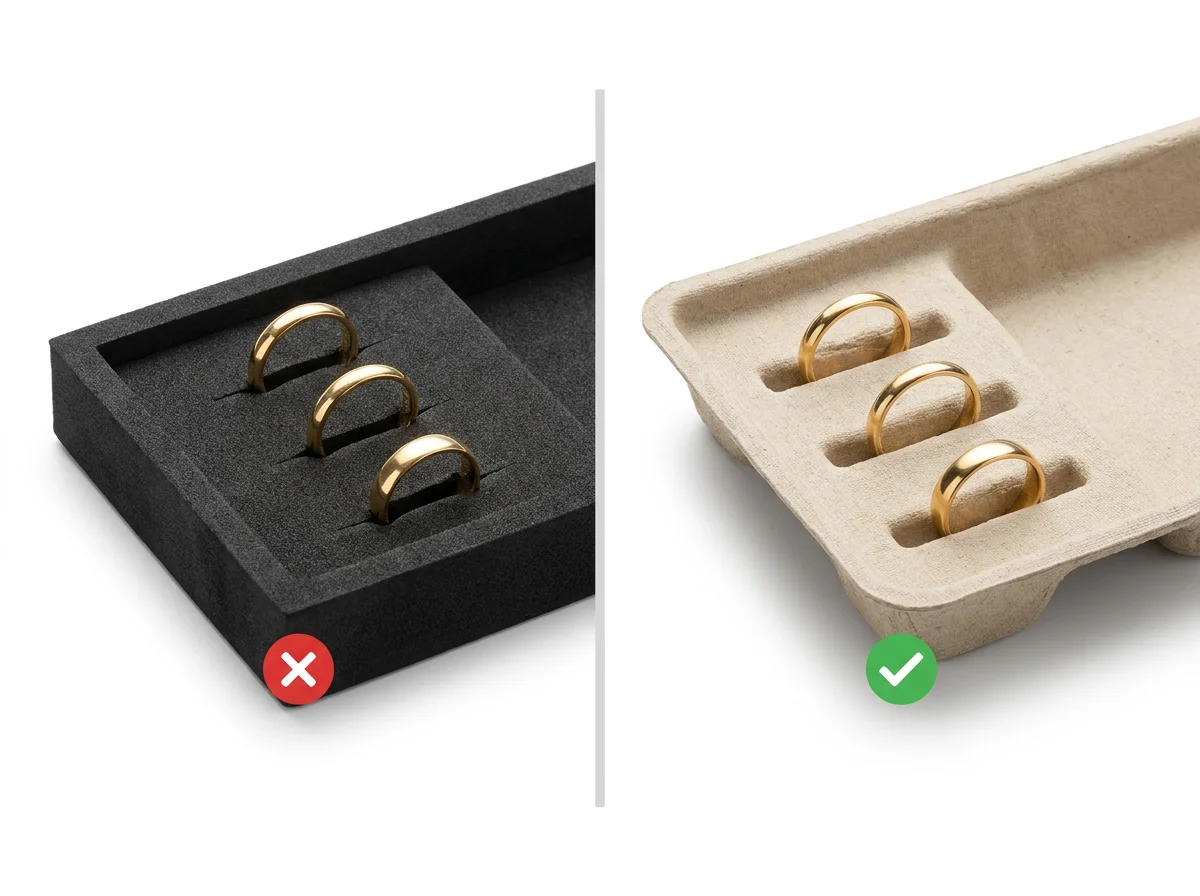
Molded pulp insert | Replaces foam trays | Fully compostable | Mold tooling cost upfront |
Is "biodegradable" jewelry packaging actually better than recycled paper?
Often no. Certified recycled paper boxes that re-enter the curbside stream are typically the cleaner, more verifiable choice.
Can sustainable jewelry packaging still feel luxurious?
Yes — when the design relies on structure, texture, and weight rather than glossy plastic film.
Working with utouchpackaging.com
We have been manufacturing jewelry packaging in Xiamen since 2015. Our sustainability program covers FSC-certified recycled paper, GOTS-traceable cotton pouches, and molded pulp inserts.
