
Views: 0 Author: Site Editor Publish Time: 2026-08-26 Origin: Site


Article Intro: Satin and velvet are the two classic fabrics for jewelry bags, and the choice between them is a decision about feel, function, and price — not a simple preference. This guide compares satin vs velvet jewelry bags across weave, touch, durability, printing, cost, and the jewelry types each suits best, ending with a decision framework buyers can apply to their own line.
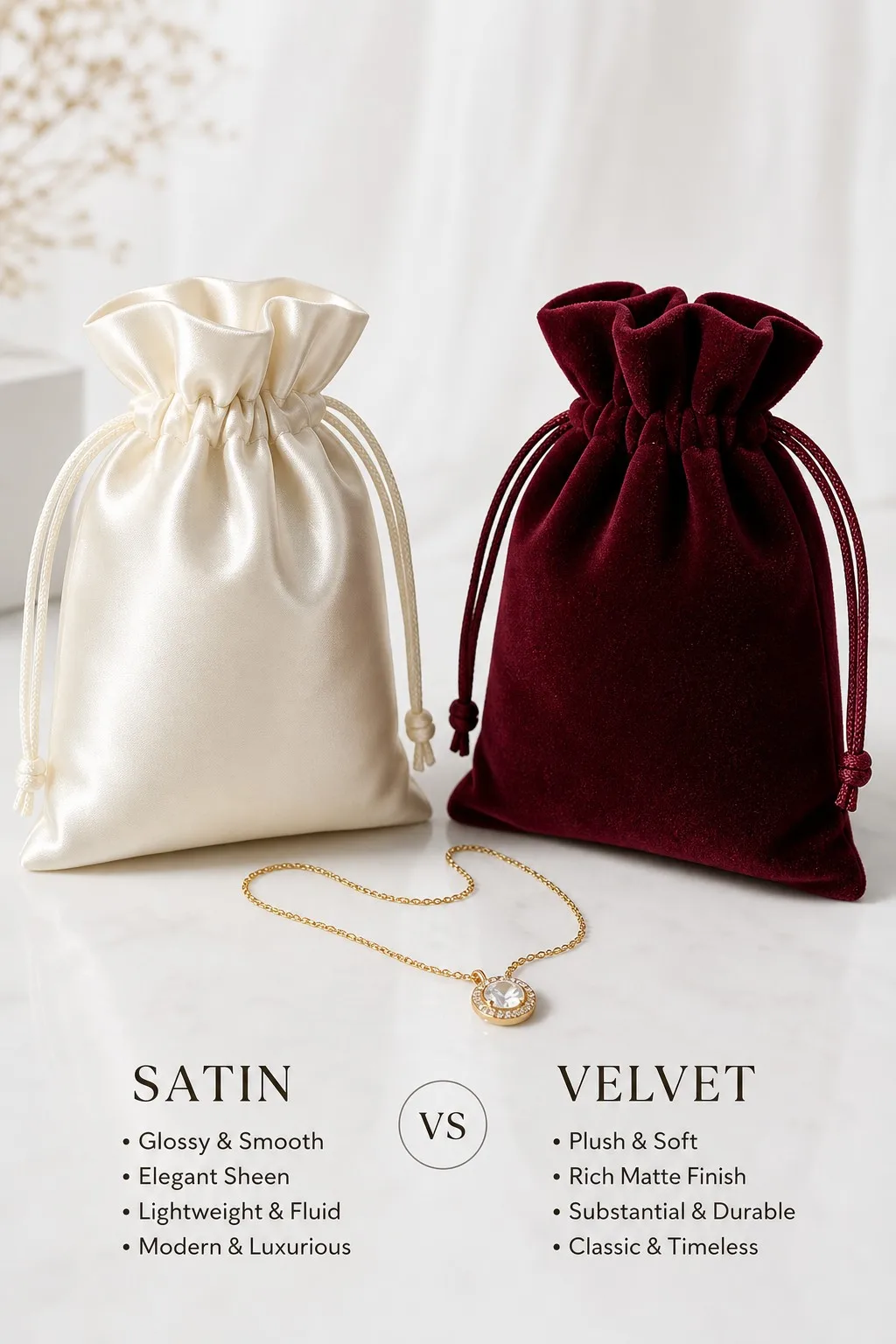
The two fabrics in one frame — glossy satin on the left, plush velvet on the right
The short version of the comparison:
Dimension | Satin | Velvet |
|---|---|---|
Surface feel | Smooth, glossy, sleek | Plush, matte, soft pile |
Weight | Lightweight, folds flat | Weightier, more body |
Protection style | Glides against the piece | Cushions and grips the piece |
Printing | Excellent — crisp, colorfast | Good — pile absorbs detail |
Cost | Lower | Higher |
Best fit | Travel, display, everyday storage | Gifting, high-value pieces, drawers |
Neither fabric is "better" in the abstract — each wins in its own scenario. Satin is the everyday protector and print surface; velvet is the indulgent presentation. The right question is not which fabric is superior, but which scenario the bag serves — and for the satin side of the comparison, the sizes, colors, and logo options available are shown on the Satin Bag product page.
The difference starts in the weave. Satin is a weave with a glossy face and a matte back — the smooth surface comes from long floats of thread that catch light evenly. Most commercial satin is polyester, with silk satin and cotton sateen as premium and natural alternatives; a satin jewelry bag is lightweight, folds flat, and takes print beautifully.
Velvet is a woven fabric with a cut pile — a dense field of short, upright fibers that give it its plush, matte surface. The pile is what makes velvet feel weightier and more indulgent than satin: it cushions the piece and grips it slightly, so a velvet dust bag holds a necklace in place rather than letting it slide. The pile also absorbs light, which is why velvet reads as deep and rich in a drawer or a gift box.
In practical terms: satin says sleek and travels well; velvet says plush and sits beautifully. A satin pouch for jewelry slips into a handbag for the day; a velvet jewelry pouch cushions a precious piece in a drawer for months. Many brands run both — the same line uses satin dust bags for the pieces that move and velvet for the pieces that stay.
The jewelry type helps settle the fabric choice:
Rings: Both work. Satin is fine for a ring worn daily; velvet adds a gift feel for engagement and special pieces.
Earrings: Satin suits pairs that move between storage and display — smooth, quick, and tangle-free. Velvet is the premium choice for gift presentation.
Necklaces: This is where velvet earns its keep — the pile grips the chain and keeps it from tangling, while a satin bag lets a chain slide. For long chains, velvet is the safer choice; for pendants that travel, satin is handier.
Bracelets: Either works; velvet cushions heavier cuffs, satin suits slim bangles and everyday pieces.
Jewelry sets: Velvet gives a set a gift-box feel; satin keeps the set light and packable. Many set orders ship in satin and present in velvet.
The pattern: satin for motion, velvet for rest. Pieces that travel, display, or rotate daily favor satin; pieces that sit, gift, or need cushioning favor velvet — which is why jewelry dust bags in both fabrics coexist across most lines.
Beyond feel, three practical differences matter at scale:
Durability: Satin is hard-wearing and colorfast — polyester satin holds color through years of use and resists wrinkles, which suits bags that are handled constantly. Velvet is more delicate: the pile can flatten, crush, or lint with heavy handling, so velvet bags suit pieces that sit more than they move. Velvet also shows wear sooner on seams and edges.
Care: Both should be hand-washed or surface-cleaned gently. Satin dries smooth and needs no special handling; velvet needs care to keep the pile upright — wash gently, air dry, and avoid pressure while wet.
Printing: Satin is the better print surface — screen printing, heat transfer, and foil all land crisply on the smooth face. Velvet's pile absorbs detail, so prints are softer and less sharp; debossed or embroidered marks often work better on velvet than flat printing. A velvet jewelry pouches wholesale order with a logo should expect a softer print result than the same logo on satin.
Velvet costs more than satin for two reasons: the pile construction uses more yarn and an extra manufacturing step, and velvet's higher perceived value supports a higher price. As an illustrative range at volume, a simple polyester satin pouch sits at roughly $0.05-$0.15 per unit, while a comparable velvet pouch runs roughly $0.15-$0.40 per unit — the exact spread depends on size, GSM, print method, and quantity, and the gap narrows as order volume rises.
The cost decision is not a straight comparison of unit prices: satin's price advantage is real, but velvet's higher unit cost buys a higher perceived value that can support the selling price of the jewelry inside. For a value line, satin is the efficient choice; for a premium line, the velvet premium is usually recoverable — and many brands price the two lines to match the two fabrics, with satin at the accessible tier and velvet at the luxury tier.
Four questions settle the choice for any given piece:
Where does the piece live? Travels, displays, rotates daily → satin. Sits in a drawer, a safe, or a gift box → velvet.
Who receives it? Everyday customer → satin (practical, printable). Gift recipient → velvet (indulgent, memorable).
What is the piece worth? Value lines → satin keeps costs in line. High-value pieces → velvet cushions and signals care.
What is on the bag? Complex logo, fine detail → satin prints crisper. Debossed or embroidered mark → velvet suits it.
For most brands, the practical answer is a mixed line rather than a single fabric. Satin carries the accessible tier — the pieces, price points, and repeat sales where efficiency and print quality matter most. Velvet carries the premium tier — the gifting pieces, high-value items, and special editions where the extra unit cost buys a perceptible difference in the customer's hand. The two fabrics also cover each other's gaps: satin bags keep the line light and packable for wholesale, while velvet pouches give the same line a gift-ready face for retail and seasonal collections. On the inventory side, a mixed line means ordering two bag SKUs per piece where one would do — but the added complexity is small next to the flexibility, and most factories run both fabrics on the same structure, so the switch costs a spec change rather than a supplier change.
The framework reflects a reality buyers see in the order process: material specifications — weave, GSM, pile density — are decisions that play out in the sample, not just on paper. A jewelry brand in Australia illustrates the point with a microfiber pouch order: the buyer asked for quotes across three quantities for 5,000 pouches at 200gsm with a double-color logo, the supplier presented production and shipping options side by side, then produced a digital proof of the logo before the order moved — the order closed on the $822.50 DDP total with the material and print specs confirmed against the proof. The lesson applies directly to satin vs. velvet: the fabric choice is only settled when the GSM, the weave, and the print result are confirmed on a proof or sample — not when a fabric name is picked from a list. The same discipline carries a custom satin jewelry bag order: the satin lined jewelry pouch's GSM and lining are confirmed against a sample before production, so the bag that ships matches the bag that was approved.
Q: Is satin or velvet better for jewelry bags?
A: It depends on the scenario. Satin is smooth, glossy, and lightweight — best for travel, display, and everyday storage. Velvet is plush, matte, and weightier — best for gifting, high-value pieces, and pieces that sit in a drawer.
Q: Does velvet protect jewelry better than satin?
A: Velvet cushions better because the pile grips and supports the piece — especially necklaces, which tangle less in velvet. Satin protects adequately for most pieces but lets chains slide. For high-value or delicate pieces, velvet is the safer cushion.
Q: Which fabric prints better — satin or velvet?
A: Satin. The smooth face takes screen printing, heat transfer, and foil crisply, with sharp detail and good color. Velvet's pile absorbs detail, so prints are softer — debossed or embroidered marks often work better on velvet.
Q: Is velvet more expensive than satin?
A: Yes — velvet costs more per unit because the pile construction uses more material and an extra manufacturing step. As an illustrative range, satin pouches sit at roughly $0.05-$0.15 per unit and velvet pouches at roughly $0.15-$0.40 per unit at volume, with the gap narrowing as quantity rises.
Q: Can I use both satin and velvet in the same line?
A: Yes, and it is common — satin for the pieces that travel and display, velvet for the pieces that sit and gift. Many brands match the fabric to the price tier: satin at the accessible tier, velvet at the luxury tier.
Satin and velvet are different tools, not rivals. Satin — smooth, glossy, lightweight, printable — suits travel, display, and everyday storage, at a lower cost. Velvet — plush, matte, weightier — suits gifting, high-value pieces, and drawers, at a higher cost that a premium line can carry. The decision framework is four questions: where the piece lives, who receives it, what it is worth, and what is printed on the bag. And the decision is only final when the weave, GSM, and print are confirmed on a sample or proof — the fabric name is the start, not the end, of the material decision.
For satin bags, velvet pouches, and custom jewelry bags, visit Utouch Packaging — and for direct factory quotes on satin, velvet, and complete jewelry packaging systems, reach Xiamen Yu Touch Imp & Exp Co., Ltd.

