
Views: 0 Author: Site Editor Publish Time: 2026-08-20 Origin: Site


Article Intro: A B2B guide to jewelry packaging pricing tiers — how wholesale volume pricing is actually built, why unit prices stay flat within a tier and drop at the next one, and how buyers can plan order quantities to buy at the right tier without over-ordering.
Definition: Jewelry packaging pricing tiers are the quantity-price steps that factories quote on custom orders: within a tier, the unit price barely moves; at the next tier, it drops. A typical quote might hold the unit price flat from 1,000 to 3,000 pieces, then step down at 5,000, and step down again at 10,000. The tier structure exists because packaging cost is dominated by fixed costs — tooling, artwork setup, and production changeover — that are amortized over the order size, so volume savings arrive in discrete steps rather than as a smooth curve. Wholesale jewelry packaging pricing follows the same tier logic for rigid boxes, magnetic boxes, pouches, and bags alike.
Quick Answer: To buy at the right tier, ask for three-level jewelry packaging quotes up front (for example 1,000 / 3,000 / 5,000 units), compute the total cost at each level rather than the unit price, and check whether a small quantity increase — say 3,000 instead of 2,500 — moves you into a lower unit tier without creating surplus stock. Buyers frequently hold a higher tier once the supplier explains that the unit price is essentially flat until the next breakpoint: one Germany-based buyer held an 8,000-piece order at the quoted tier instead of dropping to 6,000 pieces, because the supplier showed that the unit price only changed meaningfully above 10,000.
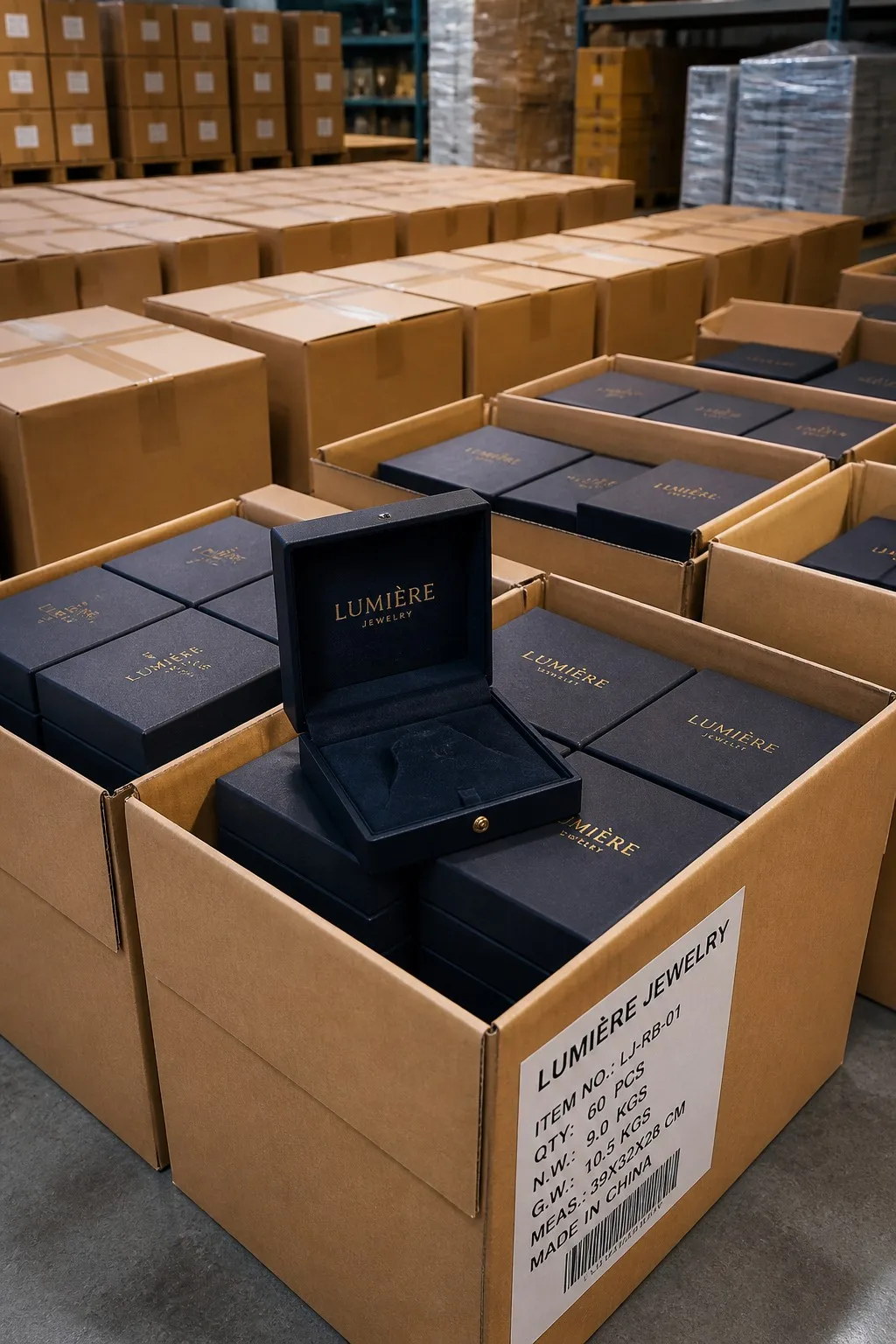
Volume is the pricing lever — identical boxes in production-scale lots, where fixed costs amortize at each tier
A packaging factory's cost per piece is the sum of four components, and each one behaves differently as quantity grows:
Tooling and artwork setup: Dies, magnets, foiling plates, and screen mesh are one-time fixed costs. Their per-piece share falls linearly as quantity rises — this is the largest driver of tier steps.
Material: Fabric, board, film, and adhesives scale almost linearly with quantity, and only step down at very large volumes when the factory can buy raw material in bulk lots.
Labor and changeover: Production runs are set up per batch. A 3,000-piece run and a 4,000-piece run of the same box cost nearly the same setup; the per-piece labor share falls within a tier, which is why factories hold the price flat instead of quoting 3,001 versus 3,999.
QC and packaging: Inspection and export packing are per-lot costs that amortize the same way as tooling.
The result is a step function: flat within a tier, a drop at the breakpoint, flat again. Fixed costs dominate even bulk jewelry packaging orders, which is exactly why factories hold the price flat within a tier. Understanding this prevents two common mistakes — expecting a lower unit price for a marginal quantity increase inside the same tier, and ordering just above a breakpoint thinking the price already dropped (it drops at the next one, not between them).
As a reference, a representative 2026 quote for a rigid magnetic jewelry box with a velvet interior and foil logo might look like this (illustrative figures; actual quotes depend on size, structure, and decoration):
Quantity | Approx. Unit Price | Total Order Cost | Unit Price Change |
|---|---|---|---|
300 | $1.60 | $480 | — |
1,000 | $1.35 | $1,350 | -16% |
3,000 | $1.15 | $3,450 | -15% |
5,000 | $0.98 | $4,900 | -15% |
10,000 | $0.82 | $8,200 | -16% |
Two patterns stand out. First, the unit price drops in near-constant percentage steps at the breakpoints — factories build tiers on fixed-cost amortization, so the step size stays consistent. Second, total cost always rises with quantity: a lower unit price never means a lower total bill, which is why tier buying is about value, not spending less overall. The right question is not "what is the unit price?" but "what total do I pay at 3,000 versus 5,000, and do I have sell-through for the extra 2,000?" A jewelry packaging price list that displays tiers at a glance beats a single quote number, and it is especially useful for jewelry packaging for small business buyers comparing two suppliers side by side.
Buyers sometimes read flat pricing within a tier as supplier inflexibility. In jewelry packaging it is usually the opposite: the factory is being honest about where its costs sit. For custom jewelry packaging boxes, an order of 3,000 and one of 3,500 pieces consume almost the same setup, the same tooling, and the same per-piece labor curve; quoting different unit prices for them would be arbitrary, not generous. The meaningful discount arrives at the next breakpoint, where the fixed-cost amortization actually changes.
This is why experienced suppliers answer tier questions with a table rather than a single number, and why the most productive pricing conversation a buyer can have is: "show me 1,000 / 3,000 / 5,000 — and tell me where the next real breakpoint is." A supplier that explains the structure of its tiers is revealing the cost logic of the order; a supplier that cannot explain its tiers is usually quoting arbitrarily.
Two real order records illustrate the mechanism in practice. In the first, a Germany-based buyer returning for a holiday-season restock asked to step down from 8,000 pieces to 6,000, expecting a meaningful saving. The supplier quoted both tiers and explained that the unit price was essentially flat between them — the next real breakpoint sat above 10,000. Faced with the actual numbers, the buyer held the 8,000-piece order and paid immediately, locking the factory's pre-season production slot. The outcome: no discount given away, no over-ordering forced, and a restock decision made on real cost structure.
In the second, a U.K.-based first-time jewelry packaging wholesale buyer pushed back on the minimum order quantity. Instead of defending the MOQ or offering an arbitrary discount, the supplier presented a "pay a little more, get a lot more" tier comparison — the minimum-viable quantity at one price versus a higher quantity at a lower unit price, with both totals laid out side by side — and let the buyer choose. The buyer took the higher tier, and the order closed at $400.
Four habits keep tier buying on the right side of the value line:
Always request a three-level quote. Asking a jewelry packaging supplier for 1,000 / 3,000 / 5,000 costs minutes and gives you the shape of the price curve before you commit to a quantity.
Compare totals, not unit prices. The tier that minimizes unit cost may not be the tier you can sell through; the right tier is the one where total cost matches realistic demand plus a small buffer.
Consolidate SKUs into one tier. Three box sizes of 800 pieces each are usually quoted as three small orders; combining them into a mixed program of 2,400 pieces with shared structure and decoration can move the whole program to the next tier.
Plan restocks around breakpoints. If you know you will reorder within a season, check whether ordering 5,000 now instead of 3,000 lands a lower unit price that offsets the extra inventory — and whether the factory's production calendar supports the larger run.
A custom jewelry packaging price comparison across two suppliers should always include the tier tables, not single unit numbers — and the wider sourcing framework for minimums, structure selection, and supplier qualification is covered in the 2026 B2B sourcing guide for small and growing brands.
A Germany-based jewelry brand buyer, already a returning customer with a 2,000-piece history, needed holiday-season restock packaging and planned to double the line to 8,000 pieces — split evenly between two box styles. The supplier quoted the order in two quantity tiers, 6,000 and 8,000, and explained the pricing logic plainly: the unit price between the two tiers was nearly identical, because the fixed costs — tooling, setup, and decoration plates — were already amortized at the 6,000 level; the next real price break sat above 10,000 pieces.
Instead of arguing for a discount at 8,000, the buyer's reaction was the opposite of a typical price negotiation: they held the 8,000-piece quantity and paid immediately. Two supporting factors made the decision easy — the supplier tied the order to the September-October capacity window before the holiday production rush, and agreed to a 30/70 split payment (deposit of $496.20, balance of $1,157.80) that matched the buyer's cash cycle. The total order value was $1,654. The outcome: the supplier gave away no margin, the buyer locked seasonal capacity and a volume tier they would have needed anyway, and the restock — not the discount — became the basis of the ongoing relationship.
Q: Why does the unit price barely move between 3,000 and 4,000 pieces?
A: Because packaging cost is dominated by fixed costs — tooling, artwork setup, and production changeover — that are already amortized at the 3,000 level. The next real drop happens at the next breakpoint, usually where the factory's material or labor economics change. Ask for the tier table and the breakpoints instead of negotiating inside a tier.
Q: What is the best quantity to order as a small brand?
A: The quantity that matches realistic sell-through plus a small buffer, not the lowest unit price. Order at the tier just below the next breakpoint unless you can sell through the extra volume — a lower unit price on unsold stock is more expensive than a higher unit price on sold stock.
Q: Can I mix different box sizes to reach a higher tier?
A: Yes — mixed-SKU programs with shared structure and decoration are usually quoted as one program, which can move the combined volume to a higher tier. Confirm the consolidation logic with the supplier before ordering.
Q: Is flat pricing inside a tier a sign of an inflexible supplier?
A: No — it is normally a sign of transparent cost logic. Flat pricing within a tier means the factory's costs genuinely do not change in that range; arbitrary per-piece discounts at any quantity usually hide padding elsewhere.
Q: Should I ask for a discount on the MOQ?
A: Instead of a discount, ask for a tier comparison: the minimum quantity at one price versus a higher quantity at a lower unit price, with both totals shown. Buyers frequently find the second option is the better value and the supplier gives up no margin.
Jewelry packaging pricing tiers are step functions driven by fixed-cost amortization: unit prices stay flat within a tier and drop at breakpoints, so the right buying habit is to request a three-level quote, compare total order costs rather than unit prices, consolidate SKUs to reach a tier, and plan restocks around breakpoints. An 8,000-piece restock held its tier because the supplier explained the price structure instead of discounting, and a first-time U.K. order closed at a higher tier through a transparent "pay a little more, get a lot more" comparison. The same sourcing fundamentals — minimums, structures, and supplier qualification — apply across the broader custom packaging market.
For tailored specifications and production-ready quotes, visit Utouch Packaging — and for tiered pricing on jewelry boxes, pouches, and packaging programs, reach the factory directly at Xiamen Yu Touch Imp & Exp Co., Ltd.
