
Views: 0 Author: Site Editor Publish Time: 2026-08-29 Origin: Site


Article Intro: Buying satin dust bags wholesale is a different discipline from buying stock bags: the order size, the supplier relationship, the quote structure, and the shipping all change at volume. This guide walks through the wholesale buying process — qualifying suppliers, getting a quote that means something, planning MOQs, verifying samples, inspecting production, and choosing the shipping that controls landed cost.
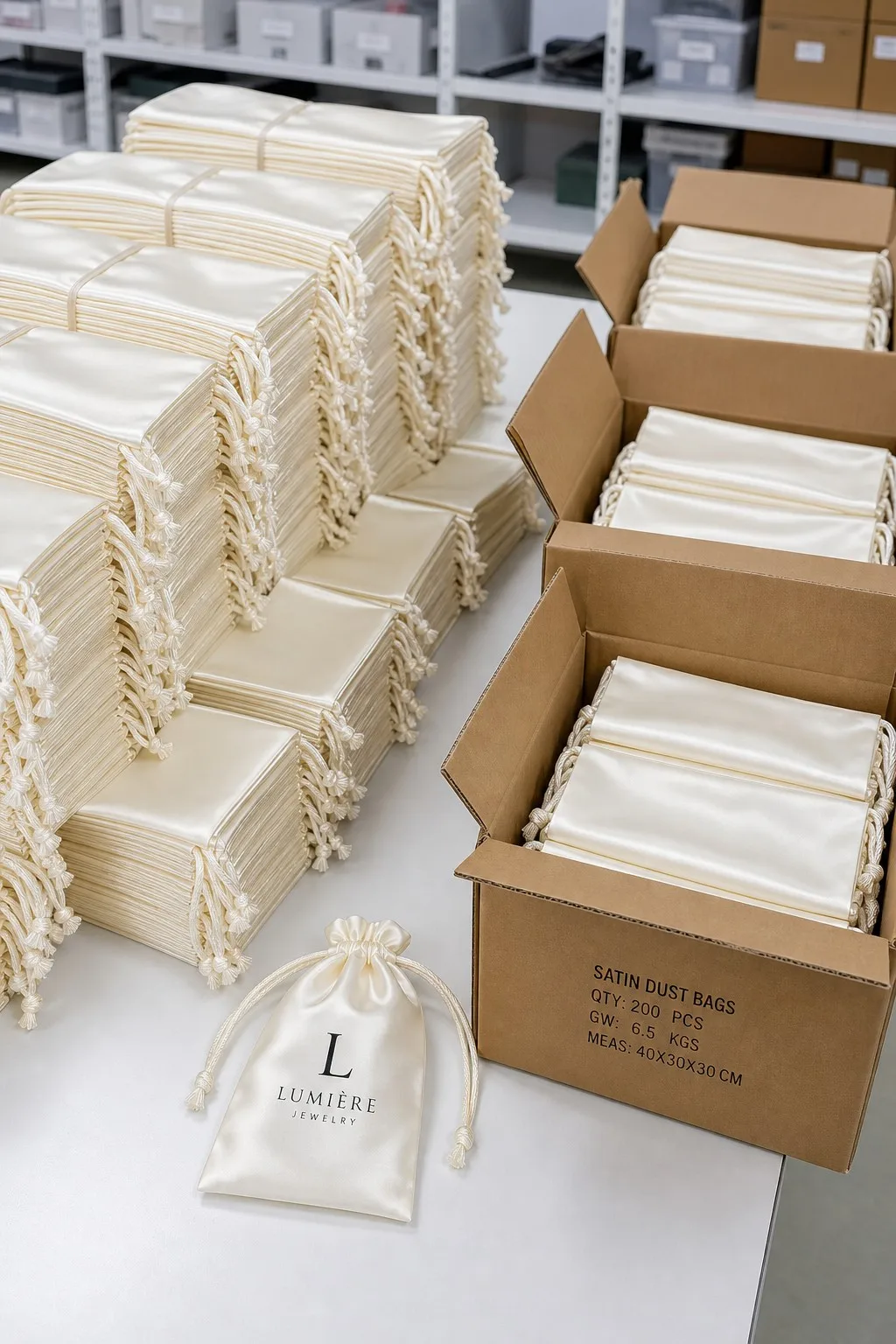
A wholesale satin dust bag order — bundled dozens, packed boxes, and the approved sample on top
Wholesale buying is defined by three shifts from retail buying. First, the order moves from single bags to order-of-magnitude quantities — hundreds to tens of thousands of pieces — and the unit price responds in tiers. Second, the specification moves from "whatever the listing shows" to a written spec: size, fabric, GSM, logo, color, closure, packaging. Third, the supplier moves from a storefront to a relationship: the quote, the sample, the production, and the shipment are all negotiated against that spec.
For satin dust bags specifically — and jewelry dust bags generally — wholesale almost always means custom or semi-custom: the brand's size mix, its logo, and its colors. That is why the wholesale buying process below is built around the spec — the quote, the sample, and the inspection all reference the same written document.
The supplier choice decides everything downstream, so the qualification step deserves the most time:
Factory vs. trading company: A factory controls fabric, print, and production, and answers spec questions directly; a trading company adds convenience and often handles small orders, but the factory behind it should be identified and verified.
Category evidence: Ask for satin dust bag production experience specifically — photos of similar pouch lines, fabric swatches, or references. Category experience shows up in the details: seam allowance, drawstring quality, print registration.
Responsiveness: Response time to a spec inquiry is a preview of order-time communication. A supplier that answers a detailed RFQ with a detailed quote is a supplier that runs orders on details.
Verification signals: Production videos, factory photos, and documents (business registration, export records) — the signals a serious factory can produce on request, and a thin operation cannot.
A practical filter: send the same detailed spec to three candidates and compare the quotes, the questions they ask back, and the response speed. The questions are as informative as the prices — a supplier that asks about the closure type and the print placement understands the product.
A wholesale quote is only as good as the spec behind it. A complete spec for satin dust bags wholesale orders includes:
Size (flat width × length, and the definition: flat or expanded, inner or outer)
Fabric and GSM (polyester satin, silk satin, cotton sateen)
Logo method and colors (screen, heat transfer, foil; number of colors)
Closure (drawstring, ribbon tie, fold-over)
Accessories (tags, tassels, care cards)
Packaging (bulk, poly-bagged, display-ready)
Quantity and delivery terms (FOB, EXW, or DDP; destination)
Ask for tier pricing — the same spec at 500, 1,000, 3,000, and 10,000 pieces — so the volume incentive is visible before you commit. And confirm the trade terms in the quote: FOB and DDP quote the same bag at different prices, and the difference is freight, insurance, and customs handling. A quote that states the terms and the spec is a quote you can compare; one that omits them is a starting point for a surprise. The sizes, colors, and logo combinations available on the Satin Bag product page are a practical reference when drafting the spec.
The first wholesale order should be sized to validate, not to gamble:
Start at the minimum that fills a channel: the quantity that stocks your main sales channel (e-shop, wholesale clients, or retail counters) without overcommitting capital.
Confirm the real MOQ: the supplier's stated MOQ usually reflects the spec — simple prints have lower minimums, foil and custom dye raise them. Ask how the MOQ breaks down (setup vs. per-piece) to understand where the floor comes from.
Plan the reorder ladder: the tier quote shows the next step — the quantity at which the unit price drops meaningfully. A common pattern is a modest first order, then a reorder at 2-3× that confirms demand and unlocks the better tier.
Consolidate the line: ordering satin dust bags together with other packaging — boxes, tissue, and a satin pouch for jewelry from the same line — in one shipment spreads the freight and simplifies the relationship.
Most brands err on the side of ordering too little variety and too much quantity per SKU — a tight size mix (small, medium, large) at a workable depth beats five sizes at thin quantities, because thin sizes drag the per-unit cost and complicate the inventory.
The sample is the bridge between the spec and the bulk order, and it earns its cost on every first order:
What to verify: fabric hand and GSM, color on fabric (satin reads differently from paper), print sharpness and placement, closure function, seam quality, and the fit of the actual piece inside the satin jewelry bag.
One sample per variant: each size and each color needs its own sample — one sample cannot verify a three-size order.
Digital proof first, physical sample second: the mockup settles layout questions (logo size, position, color) before fabric is cut; the physical sample then confirms the material and construction — and for a satin drawstring pouch bag for jewelry with a heat-transfer logo, the sample is the first true look at how the print sits on the fabric.
Keep the approved sample: the approved sample becomes the reference for production and inspection — it is the standard the bulk order is compared against, and the reorder reference later.
For first-time suppliers, the sample stage is also the fastest read on the relationship: a supplier that ships a sample quickly, labeled with the spec, and follows up on the feedback is a supplier that will run the bulk order the same way. For custom satin dust bags, that approved sample is also the reference the reorder is measured against — the same discipline that keeps the second order as clean as the first.
Wholesale production runs to the approved sample, and the buyer's control points are the schedule and the inspection:
Schedule: confirm the production window in writing — typically 3-4 weeks for satin dust bag runs after spec and sample approval, longer in peak seasons. A transparent supplier states the real window and updates progress rather than quoting an optimistic template.
In-process checkpoints: fabric confirmation before cutting, print/color confirmation before stitching, and a pre-shipment sample from the actual run — the checkpoint that matters most when the line includes a satin lined jewelry pouch or a satin round bottom jewelry pouch, since both add construction steps the flat bags skip. Ask for photos or videos at each checkpoint — a capable factory has no reason to refuse them.
Pre-shipment inspection: the finished bags are checked against the approved sample — dimensions, print, closure, stitching, packaging. Third-party inspection is available for larger orders; for most first orders, photo/video inspection with the approved sample in frame is practical and free.
Packing: agree the packing method (bulk, poly-bagged per dozen, display-ready) before production, since it affects both the unit cost and the arrival condition.
At wholesale volumes, freight is a real line on the total cost — and the shipping decision is a trade-off between time and money. A jewelry brand in the United States saw the full menu on a 30,000-piece organza bag order: the buyer questioned the freight, the supplier laid out sea, air, and rail options side by side — transit time, cost, and risk for each — and the buyer chose the option that balanced the season's deadline against the budget. The $2,565 order shipped on the chosen route, and the multi-option quote became the template for the brand's later purchases. The same logic applies to satin dust bags wholesale:
Sea freight: the lowest cost per piece, 3-6 weeks transit — right for standard lines ordered with lead time.
Air freight: 5-10 days transit at a higher cost — right for launches, reorders, and peak-season gaps.
Rail: a middle option on some routes — slower than air, cheaper than air, with its own seasonality and capacity caveats.
DDP vs. FOB: DDP puts the landed cost (freight, insurance, customs, duties) in one number the supplier owns; FOB leaves the freight and customs to the buyer. For first orders, DDP removes the surprise of customs handling; for repeat volume, FOB with your own forwarder can lower the freight line.
Ask for the shipping options as part of the quote, not after it: the price of each option changes the order decision, and comparing them at quote stage keeps the total cost — not just the unit price — as the number you decide on.
Q: What is the MOQ for wholesale satin dust bags?
A: It follows the spec — simple screen-printed wholesale satin bags commonly start in the low hundreds of pieces; foil, embroidery, or custom-dyed fabrics raise the minimum. Ask for the MOQ with the tier quote for your exact spec.
Q: What is the difference between FOB and DDP?
A: FOB prices the goods at the origin port and leaves freight, insurance, and customs to the buyer. DDP prices the goods delivered to the destination with duties included — one number, no surprises. First-time buyers often prefer DDP; volume buyers compare both.
Q: How long does a wholesale satin dust bag order take?
A: Typically 3-4 weeks of production after spec and sample approval, plus transit time (days by air, weeks by sea). Peak seasons stretch production, so order with the calendar in mind.
Q: Can I mix satin dust bags with other packaging in one shipment?
A: Yes — and it is usually smart. Combining bags with boxes, tissue, or pouches in one order spreads the freight and consolidates the relationship, at the cost of a slightly longer lead time for the full set.
Q: Should I use a third-party inspection?
A: For first orders and large volumes, yes — it is inexpensive insurance. For established suppliers, photo/video inspection against the approved sample covers most checks without the added cost.
Wholesale buying of satin dust bags runs on the spec: qualify suppliers by category evidence and response quality, quote with a complete spec and tier pricing on clear trade terms, size the first order to validate demand, verify every variant with a sample, control production with checkpoints and inspection, and decide shipping on total landed cost — sea for standard lines, air for deadlines, rail where it fits, and DDP for first orders. The discipline is unglamorous and it is exactly what separates a smooth wholesale relationship from a series of surprises. For wholesale satin dust bags and custom satin bags for your line, visit Utouch Packaging — and for direct factory quotes with tier pricing and shipping options, reach Xiamen Yu Touch Imp & Exp Co., Ltd.

