
Views: 0 Author: Site Editor Publish Time: 2026-09-07 Origin: Site


Article Intro: A jewelry roll bag is the travel organizer that rolls instead of stacks — a soft fabric case with interior compartments that rolls into a compact cylinder, protecting necklaces, rings, and earrings in separate slots. For jewelry brands, roll bags are the packaging that travels: the retail add-on that answers the customer's "how do I carry this safely?" question, the travel-line format, and the branded accessory that keeps the label visible in the luggage. This guide covers roll bag formats, materials, compartments, customization, and the wholesale notes for adding a roll line to jewelry packaging.
A jewelry roll bag is a soft organizer built on the roll principle: the case lays flat with jewelry in its compartments, then rolls into a cylinder and secures with a strap, tie, or zipper. The roll structure protects the pieces twice — the compartments keep them separated, and the rolled layers cushion them against the movement of a bag or suitcase.
Two roll families exist under the same name. The roll-up organizer carries the jewelry inside the rolled case — interior slots for chains, rings, and earrings, rolled and secured for travel. The roll-top bag carries the jewelry in the body of the bag and closes by rolling the top edge down — the classic canvas format that keeps contents secure by rolling and buckling the opening. A travel jewelry case roll typically means the first family; a cotton canvas roll top bag belongs to the second. Both share the same logic: rolling is the closure, the protection, and the space-saving trick in one motion. A jewelry roll organizer with a zipped or buckled cover adds the security layer on top of the roll structure, and the jewelry roll organizer format has become the standard answer to the travel question in jewelry retail.
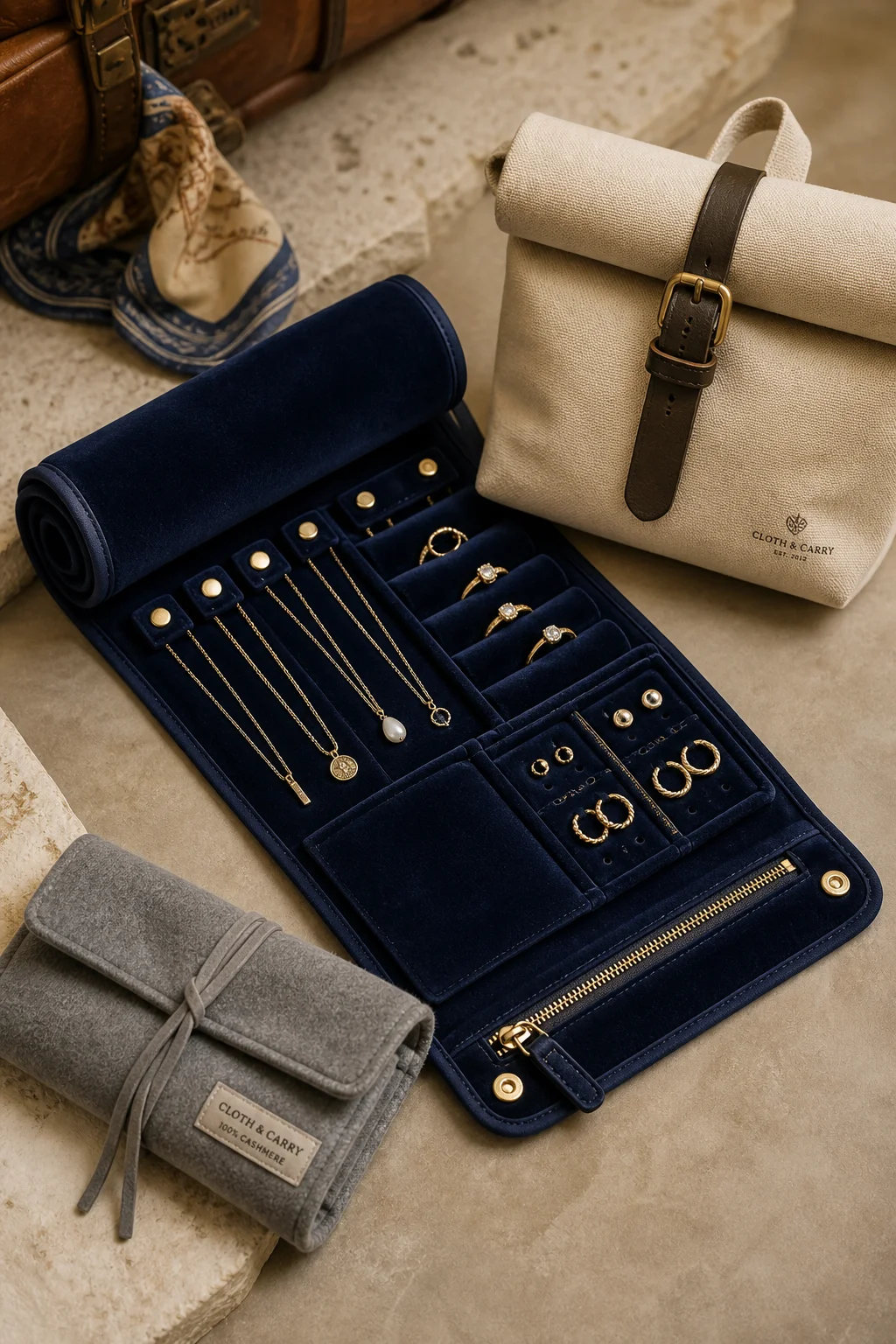
The roll family — a velvet organizer unrolled for travel, a canvas roll-top closed for carry
Rolls earn their place in the jewelry line through four advantages:
No tangles: Each necklace gets its own slot, each ring its own pocket — the separated compartments prevent the chain tangling that flat packing invites.
Compact in luggage: A rolled case is a cylinder — it tucks into a corner of a suitcase or a handbag where a box would waste space. The jewelry roll up bag compresses to a fraction of its flat size.
Cushioned protection: The rolled layers absorb the bumps of transit — the pieces sit between soft fabric layers instead of knocking against hard box walls.
Immediate wear access: Unrolled flat, the whole collection is visible at once — the traveler sees every piece and picks without unpacking everything.
The roll family covers several structures for different roles:
Format | Character | Best for |
|---|---|---|
Roll-up organizer | Multi-compartment flat case that rolls into a cylinder | Travel with several pieces |
Roll-top bag | Canvas bag that closes by rolling the top down | Bulk storage, everyday carry |
Roll-up pouch | Single-piece soft pouch with a roll closure | Single pieces, retail add-ons |
Double-roll set case | Two roll panels in one cover | Sets, matching collections |
Mini roll | Compact roll for rings and studs | Rings, small favors, gifting |
The fabric decides the roll's character and protection level:
Velvet and suede: The soft interiors — velvet or suede compartments cushion polished pieces and keep them scratch-free. A velvet customized jewelry roll bag pairs the plush interior with a decorative exterior.
Cotton and canvas: The durable workhorses — cotton canvas roll top bags and roll top cotton bags carry the everyday and bulk roles, with the natural canvas look suiting eco lines.
Cashmere and cashmere-blend: The luxury tier — a jewelry roll bag cashmere format lines the compartments in cashmere for the highest-end protection and the softest hand feel.
Leather and PU exteriors: Structured outer shells for the premium travel look — a leather jewelry roll reads as a luggage accessory rather than a pouch, with the leather exterior protecting the roll itself in transit.
Water-resistant linings: Interior linings that resist moisture protect pieces during travel — the practical layer for the travel role.
The material pairing usually splits: soft velvet or cashmere for the interior compartments that touch the jewelry, and canvas, leather, or decorative fabric for the exterior that travels. The fabric roll protects; the outer fabric carries the brand.
The compartment layout is the roll's real design work:
Necklace slots: Individual flat slots sized to chain length — each necklace lies straight in its own sleeve, the anti-tangle core of the roll.
Ring pockets: Small padded pockets or elastic loops that hold rings upright and separated.
Earring panels: Button-through or pocket panels where studs and drops stay paired.
Bracelet and watch zones: Wider padded areas or wrap straps for bangles and watches.
Zip and utility pockets: A flat outer or inner pocket for the pieces that do not fit the slots — the flexible catch-all of the roll.
The layout is specified with the piece plan, the same insert-first logic as box interiors: the necklace slots are sized to the longest chain in the line, the ring pockets to the band widths, and the panel count to the typical carry set. A roll designed around the pieces protects them; a roll designed only around its own looks leaves chains to tangle. This is why brands spec the roll with their actual pieces at the sample stage — the layout is proven with jewelry, not on paper.
Rolls work as both standalone products and packaging additions:
The travel add-on: Sold alongside the jewelry as the "travel safely" accessory — the retail add-on that lifts the basket size at the counter.
The purchase-with-purchase: A branded roll offered at checkout with a jewelry purchase — the practical companion that keeps the brand in the luggage.
The gift pairing: A roll-up organizer paired with a gift box — the box presents, the roll carries, and the gift arrives with its travel case ready.
The corporate and bridal line: Branded rolls for bridal parties, corporate gifts, and travel sets — the utility product that carries logos into long use.
For packaging brands, the roll extends the line beyond the box: it is the packaging the customer keeps using after the unboxing, which makes it one of the longest-lived brand carriers in the packaging family.
Customization turns the roll into a branded travel accessory:
Names and logos: A customize name jewelry roll bag program offers embroidery, foil, or printed marks — the name or logo on the exterior or the interior lining, personalization that makes the roll a keepsake.
Interior and exterior pairing: The brand selects the interior fabric (velvet, suede, cashmere) and the exterior fabric (canvas, leather-look, decorative print) as a pairing.
Layout and size: Compartment layouts and overall sizes specified to the line — from mini ring rolls to full travel organizers.
Color and trim: Brand-matched colors, piping, straps, and closures — the details that make a functional roll feel designed.
The customization workflow follows the standard stages — spec, mockup, sample, production, inspection — with the compartment fit and the closure strength verified at the sample stage. The fabric jewelry roll up pouch format takes the same customization path as the larger organizers, at a smaller scale.
Buying jewelry rolls wholesale:
MOQ by construction: Simple roll-top canvas bags start lower; multi-compartment organizers with fitted panels carry higher minimums. Ask for the MOQ per format with the tier quote.
Sample before production: The roll sample is checked for compartment fit, closure security, fabric quality, and roll integrity — the protection is verified with real pieces before the bulk order.
Spec the layout in writing: Compartment sizes, panel counts, closure type, and materials belong in the spec — the written discipline that prevents the "chains still tangle" surprise at arrival.
Combine with the line: Rolls ordered with boxes, pouches, and tissue ship together and spread the freight. The sourcing fundamentals — minimums, lead times, and supplier qualification — are covered in the 2026 B2B sourcing guide for small and growing brands.
Q: What is the difference between a roll-up organizer and a roll-top bag?
A: A roll-up organizer carries jewelry inside the rolled case — interior compartments roll into a cylinder. A roll-top bag carries jewelry in the bag body and closes by rolling the top edge down and buckling it.
Q: Are jewelry rolls good for travel?
A: Yes — the separated compartments prevent tangling, the rolled layers cushion transit, the cylinder packs compactly, and the full collection is visible at once when unrolled.
Q: What material is best for a jewelry roll?
A: Soft velvet, suede, or cashmere interiors protect the pieces; canvas, leather, and decorative exteriors carry the look and the brand. The interior protects, the exterior travels.
Q: Can rolls be customized with names or logos?
A: Yes — embroidery, foil, and printed marks on the exterior or interior, including name personalization for keepsake and gifting programs.
Q: What is the MOQ for custom jewelry rolls?
A: It follows the construction — simple roll-top bags start lower, multi-compartment organizers higher. Ask for the MOQ per format with the tier quote.
Q: How do I keep a jewelry roll clean?
A: Most fabric rolls are spot-clean only — wipe the interior with a soft dry cloth and air the roll after travel. Leather and canvas exteriors can be wiped gently; avoid machine washing velvet, cashmere, and suede compartments.
Jewelry roll bags protect and pack in one motion: roll-up organizers keep necklaces, rings, and earrings separated and cushioned for travel; roll-top canvas bags carry bulk storage; and mini rolls and pouches cover single pieces and gifting. The compartment layout is designed around the pieces — velvet, suede, or cashmere interiors protect, while canvas and leather exteriors carry the brand. For jewelry rolls, custom organizers, and complete packaging lines, visit Utouch Packaging — and for direct factory quotes on rolls, pouches, and cases, reach Xiamen Yu Touch Imp & Exp Co., Ltd.
