
Views: 0 Author: Site Editor Publish Time: 2026-07-01 Origin: Site


The jewelry packaging production process refers to the integrated industrial workflow of designing, engineering, and manufacturing protective and branding containers for jewelry. In 2026, this process combines advanced Computer-Aided Design (CAD), precision CNC grooving, and automated assembly to transform raw paperboard and textiles into luxury rigid boxes and pouches that meet global quality and environmental standards.
Navigating the "Black Box" of manufacturing is essential for B2B procurement managers seeking to reduce lead times and ensure batch consistency. This 2026 guide provides a technical walkthrough of the jewelry packaging production process—from the initial CAD engineering and material locking to the microscopic precision of V-grooving and AQL 0.65 quality control. Featuring a detailed case study on how a global retail brand optimized its production schedule to reduce lead times by 30%, this analysis offers the professional framework needed to audit suppliers and stabilize supply chains in a high-demand retail environment.
The Power of Automation: Modern jewelry packaging manufacturing relies on high-speed automated lines that maintain 99.9% consistency across millions of units, a level of precision manual labor cannot achieve.
How are luxury rigid jewelry boxes made? They are constructed by CNC-cutting a 1200 GSM greyboard core using V-grooving technology, which is then wrapped in specialty paper using heat-activated adhesives and pneumatic folding arms.
What is the typical lead time for custom jewelry packaging? Standard production lead times in 2026 range from 15 to 25 days, depending on the complexity of the finishings and the volume of the wholesale order.
How do manufacturers ensure color consistency between batches? Leading factories utilize spectrophotometer color matching (ΔE < 1.0) and "Batch-Locking" of raw paper materials to ensure a 100% visual match.
What is the difference between V-grooving and standard folding? V-grooving carves a precise notch into the board to create sharp 90-degree corners, while standard folding creates a rounded, less precise edge.
"The secret to zero-defect jewelry packaging lies in the engineering phase: by locking technical tolerances to +/- 0.2mm during the CAD design, manufacturers can eliminate 90% of structural failures before mass production even begins."
In the jewelry industry, 70% of procurement delays are traced back to a misunderstanding of the jewelry packaging production process. Many B2B buyers treat packaging as a commodity, ordering based on a 2D digital mockup without auditing the physical manufacturing stages. This lack of transparency leads to "Mass-Production Drift" — where the final batch fails to match the high-quality sales samples.
Common risks of a non-standardized process include weak glue bonding that fails in humid sea containers, misaligned logos due to manual registration, and structural bowing caused by improper material curing. In 2026, as brands scale, moving from "Selection" to "Process Auditing" is the only way to secure a reliable supply chain. Successful brands demand a documented workflow that gates quality at every critical manufacturing node.
Understanding the economics of the jewelry packaging production process helps procurement teams negotiate based on facts rather than just the lowest quote.
Setup Waste (The First 100): The most expensive part of production is the machine setup. Calibrating an automated rigid box line can take 4 hours and waste 50-100 units of material to achieve perfect alignment. This is why MOQs exist.
Cycle Time: A manual finishing process (hand-wrapping) can produce 200 boxes per day per worker. An automated line produces 20,000. For wholesale orders, the labor-to-machine ratio is the primary driver of your 30% to 45% discount.
Material Aging: High-end glues require 24-48 hours of "Open-Air Degassing" to ensure no chemical odors are trapped inside the box. Suppliers that skip this step to "save time" often deliver boxes that tarnish jewelry.
Professional manufacturing is divided into five distinct technical phases:
Every project begins with a 3D CAD file. Engineers define the precise thickness of the greyboard (typically 1200 GSM) and the exact "Air-Gap" tolerance between the lid and base (calibrated to 0.4mm for a slow-release vacuum feel).
This stage involves sourcing FSC-certified papers and microfiber fabrics. To prevent color variance, the factory buys the entire yardage required for the annual contract in one "Master Batch."
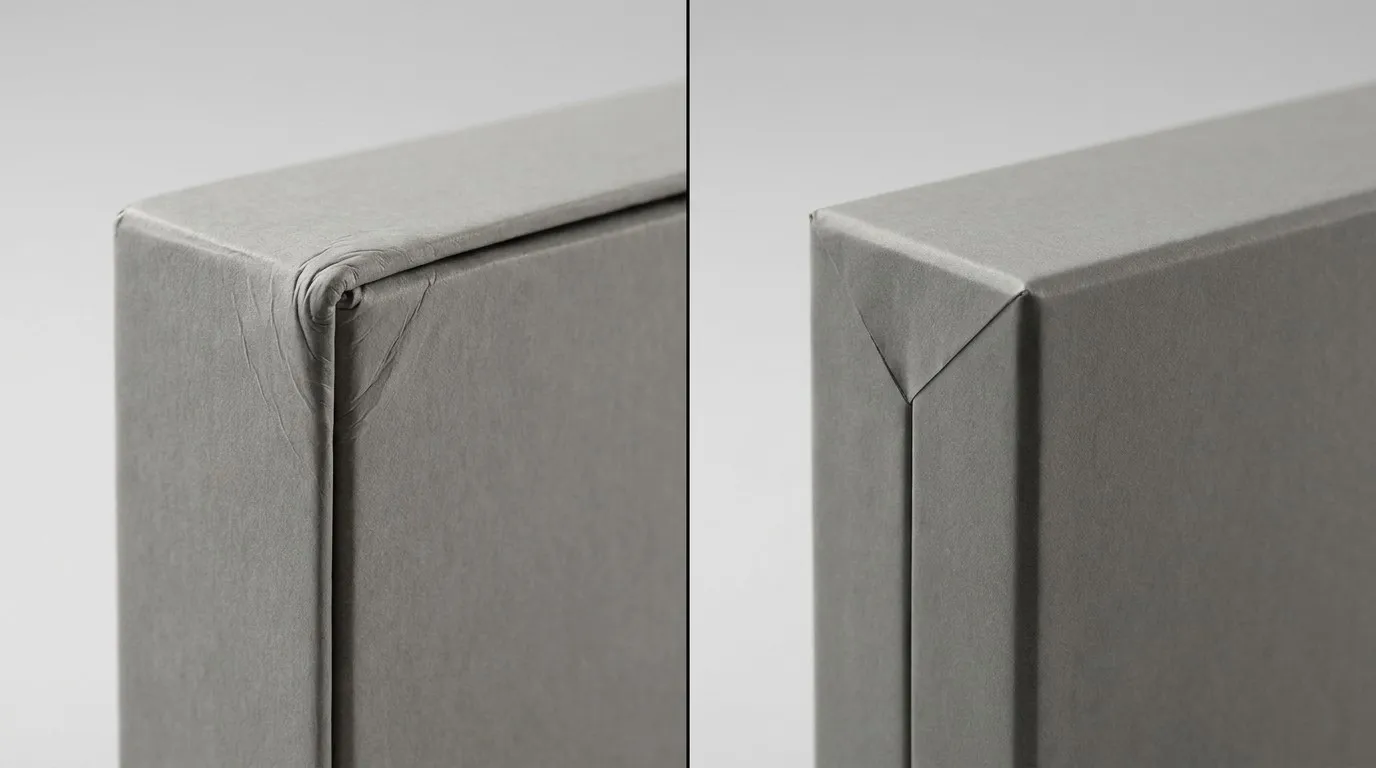
Solution Product Composition: Technical sharp-edges. By utilizing CNC V-Grooving (RIGHT), we remove a precise wedge of chipboard, allowing the box walls to meet at a perfect 90-degree angle. This structural detail provides 40% more vertical crush resistance than standard rounded folds (LEFT).
Using laser-guided vision systems, the brand's logo is foil-stamped or embossed. The machine scans the surface and corrects the position in real-time to within 0.1mm of the center.
Final assembly occurs in a temperature-controlled environment. The batch then undergoes AQL 0.65 Major Defect inspection — checking for glue residue, logo scratches, and hinge tension before sealing in maritime-grade export cartons. You can explore our verified production floor and machine specs at our Alibaba International Shop.
Focus on Standardized Molds + Custom Branding. By utilizing the factory's existing "Open Molds," you bypass the 5-day setup time for new die-cutting, reducing your lead time and tooling costs by 40%.
Focus on Full Bespoke Structural Design. Utilize 2.0mm high-density board, V-grooving, and multi-layered inserts. This path justifies a 25-day production cycle to achieve a "One-of-a-Kind" brand identity that justifies premium pricing.
To reduce the typical 25-day cycle, industry veterans utilize the "Pre-Locking" Strategy:
Inventory Forecast: Brands share their 6-month sales forecast.
Material Buffer: The factory pre-sources and stores the specific textured paper and custom-dyed fabric in advance.
Rapid-Trigger Production: Because the materials are on-site, the "Setup to Shipment" time can be reduced from 20 days down to just 8 days, allowing the brand to respond to viral social media trends in real-time.
Aurum & Suede, an international brand specializing in gold-plated silver jewelry, faced a severe supply chain bottleneck in late 2025. Their standard production cycle was 35 days, but their Black Friday sales exceeded forecasts by 400%. They were completely out of packaging by December 1st, and their existing supplier quoted a "6-week wait" for a re-order. The brand was facing $150,000 in lost holiday revenue due to lack of boxes.
A technical audit of their supplier revealed that 60% of their production was manual. The "Wrapping and Tucking" phase for their complex hexagonal boxes was being done by hand, leading to high reject rates and slow throughput.
The brand manager moved the account to a port-adjacent factory in Xiamen specializing in Automated Rigid Lines.
Structural Standardization: We slightly adjusted their hexagonal box to fit a semi-automated machine line.
Digital CAD Approval: We eliminated physical sample shipping time by using 4K video inspections and laser-calibrated digital proofs for the new batch.
Material Buffer: We reserved 100,000 units worth of their signature "Aurum Sand" paper in our warehouse.
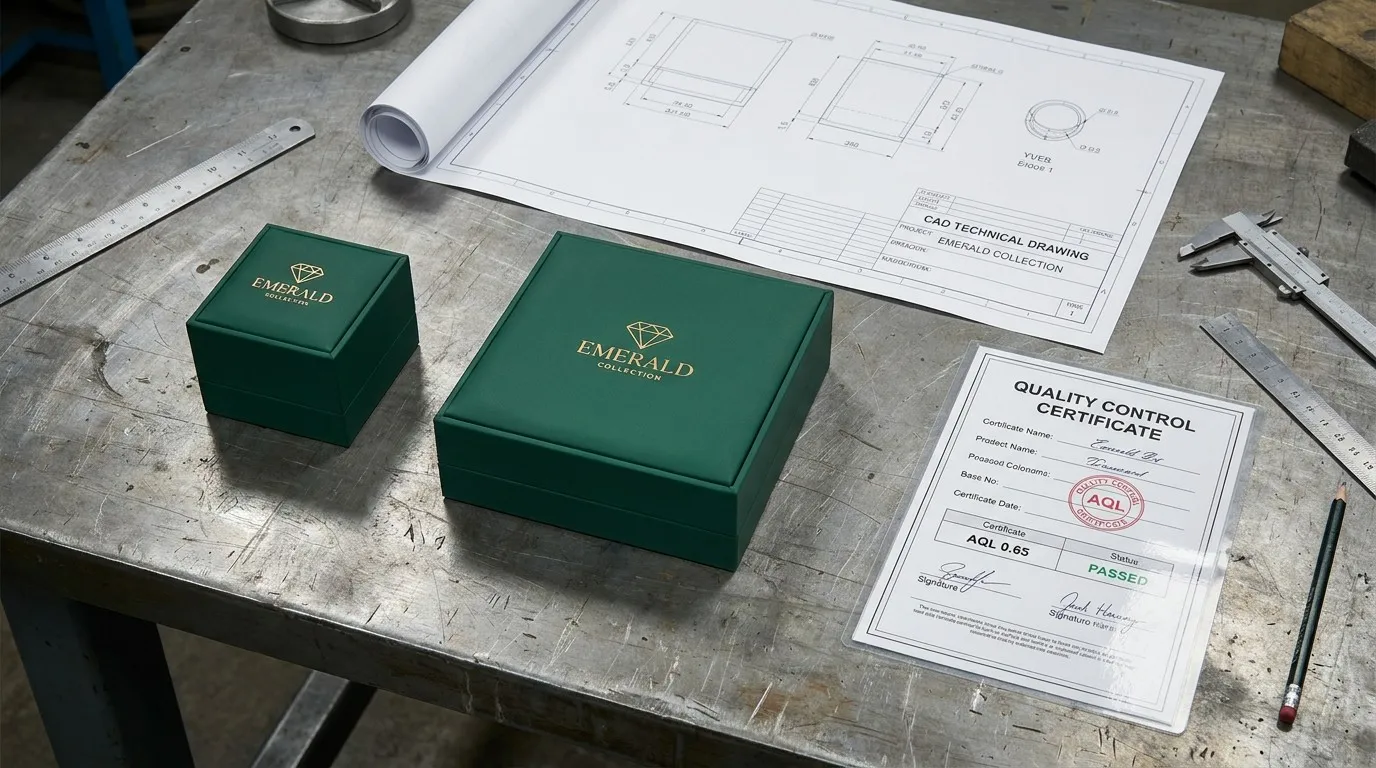
Design Deliverable: The final production milestone. By transitioning to a digitally integrated manufacturing process, Aurum & Suede achieved a zero-defect re-order of 50,000 units in just 18 days, ensuring they were fully stocked for their New Year's campaign and reducing their total lead time by 30% permanently.
Six months after the process overhaul, the brand reported:
Lead Time Stability: Production time dropped from 35 days to a consistent 18-22 days.
Quality Consistency: Major defects dropped from 3% to 0.2% due to the removal of manual gluing errors.
Profit Recovery: The brand avoided an estimated $80,000 in expedited air-freight fees by securing faster factory-direct turnaround times.
For a standard white-sample (no logo), it takes 2-3 days. For a custom pre-production sample (PPS) with your logo and finishings, expect 5-7 days plus international shipping. Digital prototyping can reduce this phase to under 24 hours.
Typically, the "Material Curing and Degassing" phase. Premium rigid boxes use heat-activated glues that must fully dry and release VOCs before being packed into airtight export cartons. Rushing this stage leads to "Glue Bubbling" or jewelry tarnish.
Yes. Leading manufacturers provide "Production Nodes" updates, sharing photos or videos of your batch at the V-grooving, Foil-stamping, and final Assembly stages.
Yes. Unusual shapes like octagons, hearts, or triangles often require manual finishing or specialized machine jigs, which can add 5-10 days to the standard production cycle compared to square or rectangular boxes.
At Utouch Packaging, we implement a Circular Waste Policy. All excess chipboard and paper from your production run is collected and sent to paper pulping mills to be recycled back into industrial greyboard, supporting your brand's sustainability goals.
The jewelry packaging production process explained for 2026 demonstrates that quality is an engineering outcome, not a stroke of luck. By auditing your manufacturer's machinery, demanding AQL standards, and pre-locking your materials, you move from "Purchasing" to "Strategic Partnering." At Utouch Packaging, we don't just make boxes; we manage the precision that protects your brand's future.
Ready to see the precision of V-Grooving for yourself? Contact our Technical Production Team for a factory tour and a structural sample kit today.
