
Views: 0 Author: Site Editor Publish Time: 2026-08-30 Origin: Site


Article Intro: A jewelry organizer box keeps a jewelry line organized, protected, and presentable — at home, at the counter, or in the stockroom. For jewelry brands, the organizer decision is about compartments, materials, and protection: how the pieces are stored, what the lining does to silver and gold, and how custom organizers extend the brand beyond the sale. This guide covers organizer types, materials, sizing, customization, and wholesale buying.
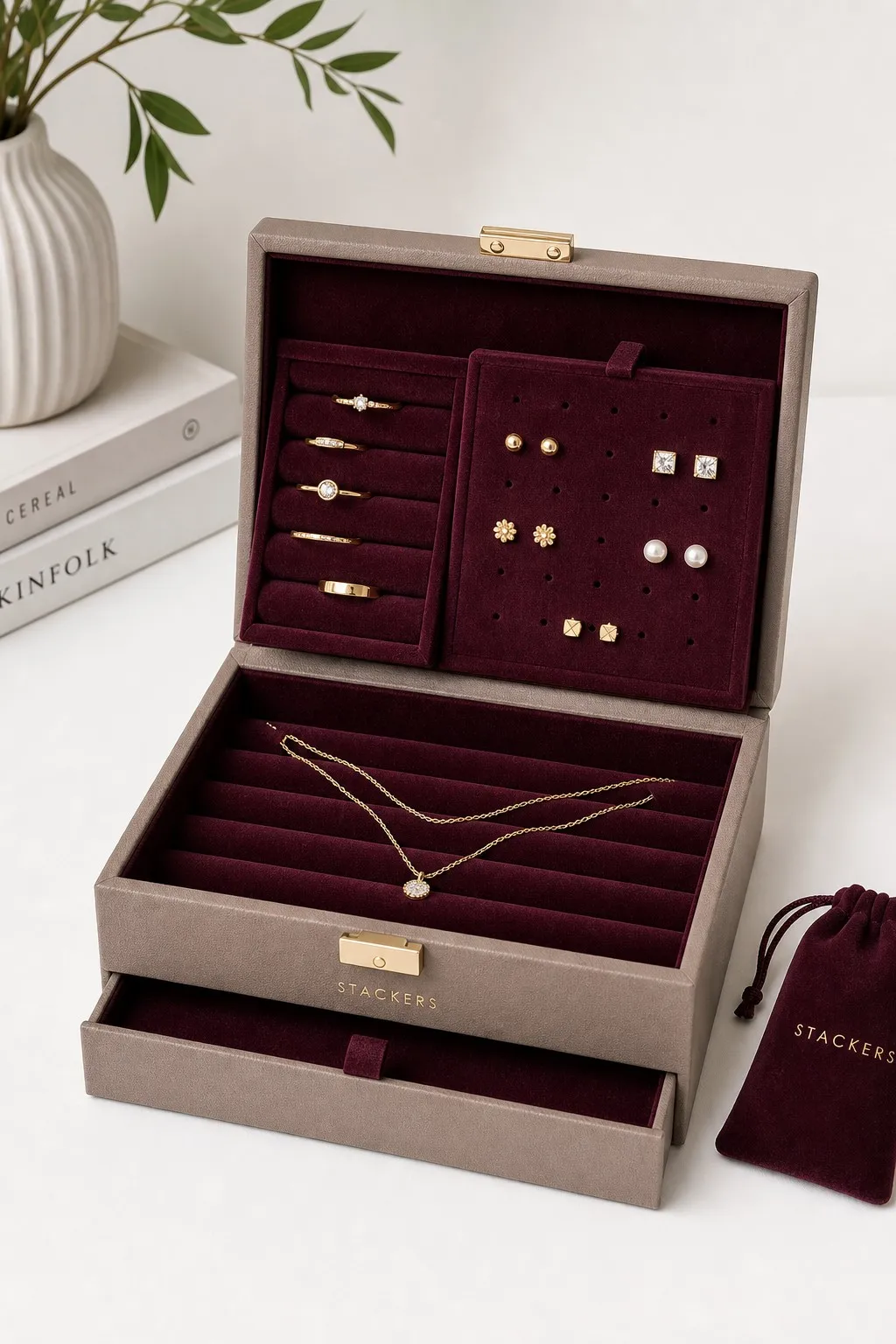
A two-layer organizer — ring slots and earring panels above, padded necklace compartments below
A jewelry organizer box is a storage container designed around jewelry's two enemies: tangling and tarnish. Where a gift box presents one piece for a moment, an organizer stores many pieces over time — rings in ring slots, earrings in perforated strips, necklaces in padded compartments, and bracelets in open trays. The organizing principle is separation: every piece has its own slot, so chains do not knot, stones do not scratch, and silver does not sit against other metals.
For brands, the organizer serves three roles at once. It is a retail product (a durable, reusable item customers buy and keep), a stockroom tool (keeping inventory organized and damage-free between production runs), and a branded touch (a custom jewelry case with a logo lives on the customer's dresser for years). The same organizer can be sold as an add-on, used to store samples at trade shows, and double as premium packaging for sets.
The organizer family spans several formats, each with a different job:
Type | Format | Best for |
|---|---|---|
Box organizer | Lidded box with compartments and a mirror lid | Home storage, gifting, sets |
Drawer organizer | Open trays and inserts that fit a dresser drawer | Daily-use pieces, easy access |
Tray | Flat padded tray, often stackable | Counters, displays, trade shows |
Storage bag | Soft pouch or zip bag with pockets | Travel, gifts, compact storage |
Roll / wrap | Rolled fabric with slots and ties | Travel, bracelets and chains |
Mini organizer | Small compartmented case for a few pieces | Earring pairs, rings, travel carry |
Most brands stock a mix rather than one format: a mini jewelry organizer boxes line for earrings and rings, a box organizer for sets and gifts, and storage bags for the pieces that move. The mix mirrors how customers actually use jewelry — some pieces live in the drawer, some travel, some are gifts. The jewelry organizer case format — a lidded box with interior fixtures — is the retail bestseller of the family, and a jewelry organizer pouch with zip pockets is the practical add-on for the pieces that travel.
The material of an organizer decides how well it protects — and how it feels in the hand:
Velvet-lined interiors: The standard for jewelry protection. Velvet cushions pieces, holds them in place, and does not scratch. A velvet jewelry storage box with a padded lid is the classic premium organizer.
Satin linings: Smooth and soft — a jewelry storage box with satin lining suits gold pieces and delicate chains that slip easily; satin shows less wear over time than velvet on heavy use.
EVA: Rigid, lightweight, and protective — jewelry storage bag eva anti tarnish formats and zip cases use EVA shells for crush resistance, ideal for travel and shipping.
Leather and PU: The exterior upgrade — leather jewelry storage boxes read as luxury at retail, a leather jewelry storage case carries the same feel in a portable format, and PU leather offers the look at a lower price point.
Plastic: Transparent or tinted organizers for visibility — practical for stockrooms and open storage, less premium at retail.
Two protection details matter beyond the lining: anti-tarnish properties (EVA and treated linings slow silver tarnishing by reducing air and moisture contact) and separation (individual slots prevent metal-on-metal contact). A jewelry storage box for a silver line should specify both; they are the difference between an organizer that stores and one that preserves.
An organizer is only as good as its compartment plan. The standard layout follows the jewelry:
Ring slots: Foam or velvet strips with individual ring slots — the highest-density format, usually 4-12 rings per strip.
Earring panels: Perforated or slotted panels for pairs — keeps pairs together and visible.
Necklace compartments: Padded areas wide enough for chains without tangling, or hooks in some organizers.
Bracelet and bangle trays: Open trays sized to the diameter of the bangles.
Watch and large-piece sections: Cushioned slots for timepieces and statement pieces.
Sizing the organizer to the line means counting the actual mix: a ring-heavy brand needs ring density, a chain-heavy brand needs necklace area, and a set-driven brand needs mixed compartments. The interior layout is customizable — a custom jewelry storage box can reallocate any section to match the brand's product mix, which is why the compartment plan is agreed at the specification stage, not improvised at production.
For jewelry brands, organizers are more than internal storage — they are a retail product with real margins. An organizer raises the average order value without raising the jewelry SKU count: a customer who buys a ring and an organizer spends on both, and the organizer keeps working as a branded presence long after the sale. Three commercial patterns repeat across the brands that sell organizers well:
The set companion: A jewelry set ships in a box organizer instead of a throwaway box — the packaging becomes the keep-item, and the perceived value of the set rises with it.
The add-on at checkout: Mini organizers and storage pouches offered alongside single pieces convert the "where do I keep this?" question into an add-on sale.
The gift upgrade: A velvet jewelry storage box as the gift upgrade tier — the customer pays the difference, and the giver receives a storage product instead of packaging waste.
The margin logic favors the brand: organizers are durable goods with few returns, they reorder on predictable cycles, and a custom jewelry case with a logo carries the brand into the customer's home for years. For a B2B buyer, that makes organizers a line to evaluate on repeat-purchase potential, not just on first-order margin.
Customization turns a storage item into a branded product:
Logo: Embossed, foil-stamped, or printed on the lid, interior, or a tag — a jewelry case organizer with a visible brand mark reads as a product, not a box.
Lining color and material: Brand-matched velvet or satin interiors; the lining color is often the brand color.
Exterior: Leather, PU, paper-wrapped, or rigid structures in brand colors.
Compartment layout: Reallocated slots to match the product mix — the customization that makes the organizer genuinely useful.
Packaging and add-ons: A branded sleeve or a satin pouch inside the organizer completes the set and lifts the perceived value.
The customization workflow follows the standard five stages — spec, mockup, sample, production, inspection — and the sample is where the interior layout gets verified with the actual pieces. A jewelry brand in the United States saw the value of the small-order start: it ordered 500 storage pouches as its first organizer-adjacent line, the sample process ran smoothly, the factory responded quickly through each confirmation, and the order moved from sample to payment to shipment without friction — $519.50 for the first run, and a reference process for the larger organizer orders that followed. The lesson for brands: verify the format with a small run before committing to the full organizer line.
Buying organizers wholesale follows the same discipline as the rest of packaging, with two organizer-specific notes:
MOQ by format: Boxes with interior fixtures (slots, panels, mirror lids) carry higher minimums than flat pouches, because the interior construction is the expensive part. Ask for the MOQ per format — a box line and a pouch line rarely share the same floor.
Sample every format: Each format — box, tray, pouch — needs its own sample with the actual pieces inside. One sample cannot verify a ring slot and a necklace compartment.
Combine with the packaging order: Organizers ordered with boxes, pouches, and tissue in one shipment spread the freight; the lead time extends to the slowest item.
Protection specs in writing: Anti-tarnish claims, lining material, and compartment dimensions belong in the spec — the same written discipline that protects every packaging order. The sourcing fundamentals — minimums, lead times, and supplier qualification — are covered in the 2026 B2B sourcing guide for small and growing brands.
Q: What is the difference between a jewelry organizer and a jewelry box?
A: A jewelry box is built around presentation — one or a few pieces, often for gifting. An organizer is built around storage — many pieces, separated and protected over time. Many products sit between the two: a box organizer with a mirror lid is both.
Q: What material protects jewelry best in an organizer?
A: Velvet-lined compartments are the classic choice — soft, non-scratching, and holding pieces in place. EVA shells add crush protection for travel, and treated linings add anti-tarnish properties for silver. Match the material to the line's metals.
Q: Can I customize the compartment layout?
A: Yes — the interior layout is fully customizable to the product mix: ring density, earring panels, necklace area, and bangle trays can be reallocated. The layout is agreed at spec stage and verified with a sample.
Q: What is the MOQ for custom jewelry organizers?
A: It depends on the format and the interior construction — flat storage pouches start lower, boxed organizers with fixtures carry higher minimums. Ask for the MOQ per format with your spec.
Q: Are organizers good for travel?
A: Yes — EVA-shell cases and roll formats are designed for it. For the travel-specific range (cases, rolls, and mini cases), a travel-focused guide covers the portable formats; the organizers in this guide are the home, counter, and stockroom formats.
A jewelry organizer box turns storage into protection and organization into brand presence: compartments separate the pieces, velvet and satin linings protect them, EVA shells guard them on the move, and custom branding makes the organizer a product the customer keeps. Match the format mix to the line — boxes for sets and gifts, trays for counters, pouches for the pieces that move — spec the compartments to the actual product mix, verify every format with a sample, and order organizers together with the rest of the packaging line. For custom jewelry organizers, storage boxes, and complete packaging lines, visit Utouch Packaging — and for direct factory quotes on organizer boxes and pouches, reach Xiamen Yu Touch Imp & Exp Co., Ltd.

