
Views: 0 Author: Site Editor Publish Time: 2026-08-22 Origin: Site


Article Intro: A B2B guide for growing jewelry brands on when and how to upgrade their packaging — the five signals that say it is time, the surface-to-structure-to-experience upgrade ladder, what an upgrade actually moves for the business, and how to switch without disrupting stock.
Definition: A jewelry packaging upgrade is a deliberate, budgeted change to a brand's packaging — a new surface treatment, a stronger structure, a fuller set of components, or a completely new design system — made to match a business stage: higher price points, new retail channels, rebranding, or competitive pressure. The upgrade is different from a redesign in one important way: an upgrade is staged and measurable, while a redesign is usually a one-time creative reset. A custom jewelry packaging upgrade can cost as little as a new foil treatment on the same structure, or as much as a full rigid-box system with custom inserts and components (illustrative figures range from roughly $0.05 to $1.50 per unit added, depending on the tier).
Quick Answer: Upgrade your jewelry packaging when at least one of five signals appears: your sales volume justifies a higher packaging tier, your prices are rising, you are entering retail or wholesale channels that demand display-ready packaging, you are rebranding, or your packaging looks dated next to competitors. Upgrade in three steps: surface first (foil, color, interior), then structure (rigid, magnetic, drawer), then experience (inserts, cards, ribbon) — each step has its own cost and risk, and most brands should stop at the step that matches their current stage. For jewelry packaging for small business and growing brands, the surface step alone delivers most of the perceived-value gain at the lowest cost.
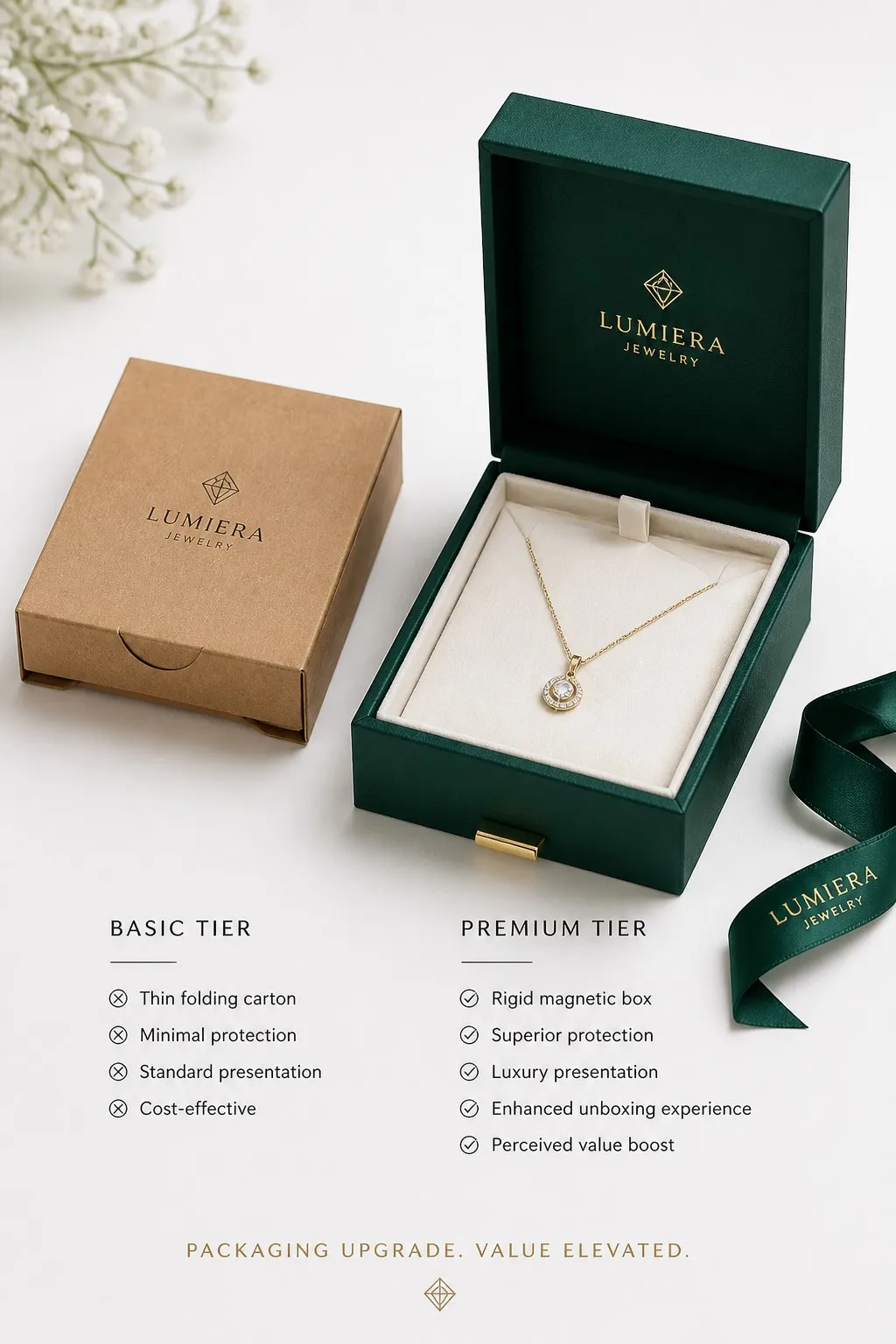
The upgrade ladder in one frame — surface, structure, and experience levels at a glance
The first upgrade decision is timing. Brands upgrade jewelry packaging for five main reasons, and the moment matters more than the design. Packaging that was right at launch is often wrong by year two, and the gap is easy to miss because sales are still growing. These five signals mark the moment:
Volume crossed a threshold. When a brand sells consistently at a level where unit-cost savings from a higher tier start to matter — typically a few thousand units per design — the cost argument for upgrading structures flips. Higher-volume brands can afford rigid and magnetic structures that were uneconomic at launch volumes, and the per-unit cost difference shrinks as quantity grows.
Price points moved up. A brand that raised prices 20-40% but kept launch packaging creates a visible mismatch: the product says premium, the box says starter. The packaging tier should track the price tier; the gap between them is a conversion risk, not a style preference.
New channels demand more. Retail counters, wholesale buyers, and trade shows expect display-ready, durable packaging. A brand moving from online-only to wholesale or retail will find that standard kraft mailers and plain pouches fail the channel test. This is the most common upgrade trigger for B2B jewelry packaging — the channel forces the change.
Rebranding or repositioning. A logo refresh, a new product line, or a shift to a higher price segment makes old packaging feel stale. The upgrade here is usually a full system change — new surface, new structure, new components — done once, deliberately.
Competitive comparison. When buyers photograph your product next to a competitor's and your box looks thinner, plainer, or cheaper, that comparison is happening in the market too. The fix is rarely a cheaper price — it is a packaging tier that matches the comparison set.
Upgrades fail when brands try to jump all three levels at once. The staged approach controls cost and risk:
Level 1 — Surface: The cheapest jewelry packaging design upgrade — and usually the highest-ROI — is the surface treatment: foil stamping, debossing, new exterior colors, a printed interior, a custom ribbon, or a logo refinement on the existing structure. A stock box with a custom surface — the same box competitors use — photographs and feels substantially more branded with gold foil and a colored interior. Custom jewelry packaging boxes with surface-only upgrades typically add $0.05-$0.30 per unit (illustrative), and the lead time is the same as a standard custom print run.
Level 2 — Structure: Moving from folding cartons or thin cardboard to rigid boxes, magnetic boxes, drawer boxes, or windowed structures. Structure upgrades add perceived weight and quality that surface treatments cannot fake — a rigid lid closes with a solid feel that signals investment. The cost step is larger ($0.30-$1.50 per unit added, illustrative), and the tooling and lead time are longer, but the structure upgrade is what carries a brand into the premium tier.
Level 3 — Experience: The full branded unboxing: custom inserts and cavities, thank-you cards, care cards, ribbon closure, tissue in brand colors, and multi-component sets. The luxury jewelry packaging tier — velvet interiors, satin ribbon, gold monogram — lives here. Experience upgrades are the most visible on social media and in gift contexts, and they matter most for brands whose customers photograph the unboxing. A luxury jewelry packaging box with a velvet insert and foil monogram is the end point of this ladder; a luxury jewelry packaging set extends it to a coordinated system of boxes, pouches, and cards.
The practical rule: upgrade one level at a time, measure the response (photos, shares, repeat rate), and move up only when the current level no longer delivers. Most brands that skip Level 1 and jump to Level 3 find the structure cost dominates while the perceived gain is smaller than expected — the surface was the gap all along. The same sourcing fundamentals — minimums, structures, and supplier qualification — are covered in the 2026 B2B sourcing guide for small and growing brands.
An upgrade is an investment, and it should be evaluated on what it moves, not on taste. Four measurable effects are worth tracking:
Price support: The packaging tier is part of the reason buyers accept a higher price. The upgrade supports a price increase that the old packaging would have made hard to justify.
Repeat and referral behavior: Gift buyers and social posters remember the unboxing. A visible upgrade increases organic sharing and repeat gifting — the channel where packaging cost returns best.
Channel qualification: For wholesale and retail entry, the packaging is a gate. Display-ready, durable, on-brand packaging is a condition of entry, not a differentiator — without the upgrade, the channel is closed.
Buyer confidence: For B2B buyers, packaging signals manufacturing quality. A brand whose own packaging looks premium is more credible when sourcing premium packaging from its suppliers — the upgrade compounds across the supply chain conversation.
None of these effects should be quoted as a guaranteed percentage. In practice, brands that track the change see movement in photos and shares first, repeat rate second, and price acceptance third — and the movements vary widely by market. For jewelry packaging wholesale buyers planning a brand's upgrade, the honest question is not "what percentage will it lift?" but "which of the four effects does this brand need, and does the upgrade deliver it?"
The operational risk of an upgrade is stranded stock and a messy transition. Three practices keep the switch clean:
Digest old stock first: Price remaining old-packaging inventory as a clearance or bundle before the new packaging lands, so no box of mixed generations sits in the warehouse.
Switch by SKU, not all at once: Upgrade the hero SKU first, run it for a season, and roll the new system to the rest of the line after the first sell-through confirms the direction. This limits exposure if the new design misses.
Plan the transition period: For retail, order a bridge quantity — enough old packaging to cover orders already placed, and enough new to start display — so no order ships in mismatched generations. For custom orders, the 300-unit minimum works in favor of staging: a brand can order the new surface at minimum volume, test it, and scale up only on the next reorder.
A jewelry seller in the United States had been buying one packaging category at a time — first pouches, then boxes — paying separate freight and handling on each order, and re-explaining the same specifications every time. The upgrade came not as a redesign but as a consolidation: the supplier proposed combining two categories into a single order — 800 storage boxes and 2,400 paper bags shipped together — so the seller got a coordinated packaging system in one freight move. The logistics change was guided clearly (carrier options and timing), and the sea-freight schedule was updated regularly so the seller always knew where the shipment stood. The combined order value was $388, and the seller has continued reordering through the same consolidated structure since (an illustrative account of a verified order).
The case illustrates the least-discussed upgrade path: upgrading the packaging system — the breadth and coordination of components — rather than the packaging tier alone. For many growing brands, the highest-value upgrade is not a more expensive box; it is a complete, coordinated set that ships together, reorders cleanly, and eliminates the friction of managing five separate orders.
Q: How often should a jewelry brand upgrade its packaging?
A: There is no calendar rule. Upgrade when a signal appears — volume threshold, price increase, channel change, rebrand, or competitive gap — and stage the upgrade one level at a time. Many brands upgrade surface treatment every 2-3 years and structure only when the price or channel moves.
Q: What is the cheapest upgrade that still looks premium?
A: The surface step: foil stamping, debossing, a colored interior, or a custom ribbon on the existing structure. It typically adds $0.05-$0.30 per unit (illustrative) and delivers most of the perceived-value gain.
Q: Should I upgrade all SKUs at once?
A: No. Upgrade the hero SKU first, run it for a season, then roll to the rest of the line. Order a bridge quantity of old packaging for orders already placed, and use the minimum order volume to test the new design before scaling.
Q: Can I upgrade packaging without changing the box structure?
A: Yes — surface upgrades (foil, color, interior, ribbon) change the perceived tier without touching the structure, keeping tooling and lead time unchanged. Structure upgrades come later, when volume or price justifies them.
Q: Does upgraded packaging support a price increase?
A: It supports one — the packaging tier is part of the reason a higher price feels justified — but it does not create one. The product, positioning, and market must support the price; the packaging removes the objection rather than adding the value.
Jewelry packaging upgrades work best as staged, signal-driven investments: upgrade surface first, structure second, experience third, and move up only when the current tier stops delivering. The five triggers — volume, price, channels, rebranding, and competition — tell you when; the ladder tells you how; and the four effects (price support, repeat behavior, channel qualification, buyer confidence) tell you what to measure. For growing brands, the surface step is usually the highest-ROI first move, and the packaging system itself — coordinated components ordered together — can be the highest-value upgrade of all. The same sourcing fundamentals — minimums, structures, and supplier qualification — apply across the broader custom packaging market.
For tailored packaging upgrade specifications and production-ready quotes, visit Utouch Packaging — and for custom jewelry boxes, pouches, and coordinated packaging systems, reach the factory directly at Xiamen Yu Touch Imp & Exp Co., Ltd.
