
Views: 0 Author: Site Editor Publish Time: 2026-08-28 Origin: Site


Article Intro: A custom satin dust bag turns a functional pouch into a branded asset — the logo, the color, the ribbon, and the tag are all customizable, and each choice affects the look, the cost, and the minimum order. This guide covers every customization option on a satin dust bag, compares the printing methods, and walks through the workflow and pricing of a custom order.
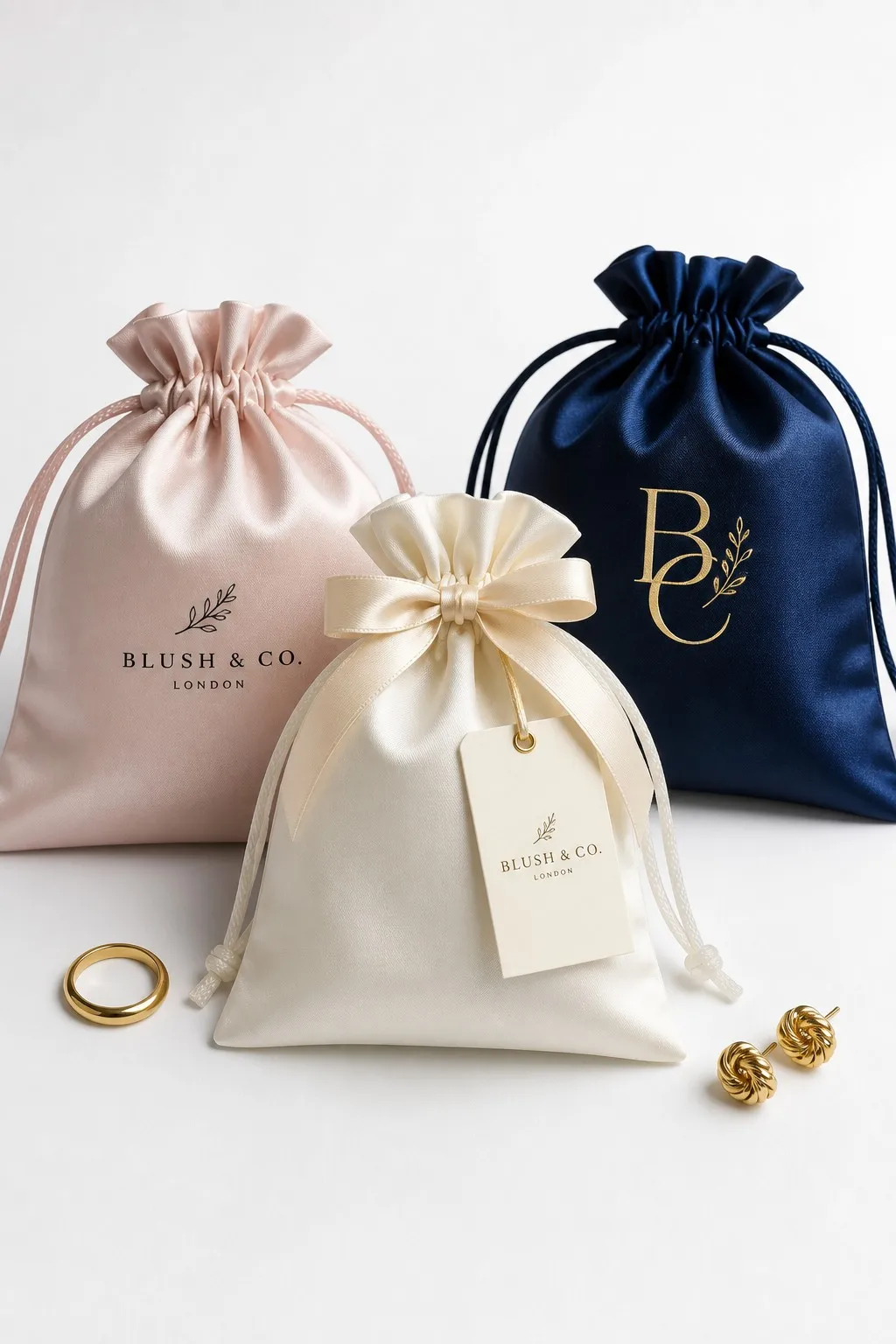
Three customizations in one frame — heat-transfer logo, ribbon and hang tag, and foil monogram
Nearly everything on a satin dust bag can be specified:
Logo and print: Brand mark, size, position, and print method
Color: Pantone-matched colors, custom-dyed fabrics, or stock colors
Fabric: Polyester satin, silk satin, cotton sateen, at a chosen GSM
Size and shape: Any dimension, plus flat, round-bottom, or gusseted shapes
Closure: Drawstring, fold-over with button, ribbon tie, or zipper
Accessories: Ribbon, tassel, hang tag, care card, or branded sticker
Lining: Unlined or satin lined jewelry pouch interiors, with or without pockets
Packaging: Individual OPP bags, poly bags, or display-ready packing
The customization menu is broad, but the decisions that matter most to the brand are the logo, the color, and the finishing accessories — because those are what the customer sees and remembers.
The logo is the customization that makes the bag a branded asset, and the print method decides how the logo looks:
Method | Look | Best for |
|---|---|---|
Screen printing | Flat, opaque, colorfast | Simple logos, solid colors, large quantities |
Heat transfer | Sharp detail, full color | Complex logos, gradients, small to medium runs |
Foil stamping | Metallic shine, premium | Luxury lines, monograms, gift collections |
Embroidery | Textured, dimensional | Larger marks on medium and large bags |
Woven label | Clean, durable, woven-in | Small marks, brand labels, high-end finish |
Satin's smooth face takes all five methods well, with screen printing and heat transfer as the volume defaults, foil as the premium step, and embroidery or woven labels for texture. Custom logo satin bags with a screen-printed mark are the standard ask for most lines — crisp, colorfast, and cost-efficient at volume, and the same holds for a jewelry bag with logo satin print. The mockup stage settles the method: the supplier renders the logo on the bag, the buyer approves the look, and the sample confirms it physically before production.
Color on a satin dust bag works in three ways:
Stock colors: The factory's standard palette (black, white, ivory, blush, burgundy, navy, and similar) — fastest and most economical, ideal for standard lines and quick reorders.
Pantone-matched: A specific PMS color matched to the fabric — the standard for brand consistency, with a small set-up cost and slightly longer lead time.
Custom-dyed fabric: Fabric dyed to a unique color — for signature brand colors that define the unboxing, usually worth it when the color is part of the brand identity.
Two color realities to plan for: satin shows color with a glossy depth that differs from matte materials, so the approved Pantone on paper reads slightly differently on the fabric — the sample is the truth. And dyed-to-match colors across different bag sizes or fabric weights can shift slightly between runs, so keep the reference sample from the approved run for reorders.
Finishing accessories turn a printed pouch into a finished piece:
Ribbon: A satin or grosgrain ribbon tie replaces or accents the drawstring — a common premium step, available in brand colors with printed or stitched logos.
Tassel: A small tassel on the drawstring end adds a hand-finished feel, popular for gift lines and wedding collections.
Hang tag: A branded card on the drawstring carries the logo, material, and care info — also the place for the price or the story.
Care card: A small insert with care instructions protects the fabric and answers the customer's questions before they ask.
Sticker and seal: A logo sticker or wax seal closes the bag for gifting and deters in-store handling.
Each accessory adds a small cost and a small lead-time step, so the rule is: choose the accessories that carry the brand story, and skip the rest. Ribbon and hang tag deliver most of the perceived value; tassels and seals serve specific lines (gift, wedding, luxury) rather than the whole range.
Beyond decoration, a custom satin dust bag can be built structurally different:
Closure: Drawstring is the default; fold-over with a button, ribbon tie, and zipper are the alternatives, each with its own feel and cost.
Shape: Flat envelope, round-bottom (a satin round bottom jewelry pouch stands on its own), or gusseted for volume.
Lining: A satin lined jewelry pouch with a soft interior protects delicate pieces; a double-layer or pocketed interior organizes sets.
Reinforcement: Interlining or a bonded base keeps the bag standing and protects heavier pieces — the structural upgrade that matters for cuffs and sets.
Structural options change the engineering of the bag, so they are confirmed with a sample rather than a drawing. A satin drawstring pouch bag for jewelry with a gusseted base, for example, needs the base construction verified physically before the first bulk order — and a satin pouch for jewelry with custom dimensions behaves differently at scale, so the sample closes the gap between the drawing and the bag.
A custom satin dust bag order runs through five stages:
Specification: Size, fabric, GSM, color, logo, print method, closure, accessories — written down before any pricing.
Mockup: The supplier renders the logo, color, and layout digitally. This is the stage for the buyer's adjustments — logo size, position, color — and a supplier that iterates the mockup quickly makes the whole order feel fast.
Sample: Physical samples confirm the fabric hand, the print result, the color on fabric, and the closure. One sample per size and per color variant.
Production: Runs to the approved sample and specification; the supplier confirms the schedule and the print details before cutting.
Inspection and shipping: The finished bags are checked against the approved sample, packed, and shipped by the agreed method.
Pricing sits at stage one, and it is where custom orders differ most from stock. A jewelry brand in the United States saw this directly: the website listed a standard price, the custom quote — with a printed logo, chosen size, and packaging — came in higher, and the supplier explained the difference line by line: the print setup, the fabric grade, the quantity break, and the packaging. Nothing was left as "that is the price"; each line of the quote was tied to a specification. The order closed on $383.50 with the buyer understanding exactly what the customization bought — and that transparency is the difference between a quote and a negotiation. For custom satin dust bags, expect the same breakdown: the spec lines determine the price lines, and a supplier that explains the quote is a supplier that can be trusted with the production. For a custom satin jewelry bag order, the same five stages apply, and the size, color, and logo combinations shown on the Satin Bag product page are a practical starting point for the specification.
Customization changes the economics of a satin dust bag order in predictable ways:
MOQ: Custom satin dust bags typically carry a higher minimum than stock bags, because the setup — print screens, color matching, cutting patterns — is spread across the order. The minimum usually sits in the low hundreds for simple prints and rises with complexity (foil, embroidery, custom dye).
Setup costs: Screen fees, color-matching, and pattern costs are one-time per order; they matter most on the first order and nearly disappear on reorders.
Unit price: Falls with quantity in clear tiers — the same spec at 500, 1,000, and 3,000 pieces is three different unit prices. Asking for the tier quote up front avoids the "why is the reorder cheaper?" surprise later.
Cost drivers: Print method, color count, fabric GSM, accessories, and packaging — each adds a line to the spec and a line to the price. The quote shows the breakdown when the spec is detailed.
The practical approach: request a quote with your full spec (size, fabric, GSM, logo method, colors, accessories, quantity, packaging), and let the supplier price the tiers. A personalized satin jewelry pouch with a heat-transfer logo at 1,000 pieces is a different product from the same pouch at 200 — the tier quote makes the volume incentive visible, and that visibility is what lets a buyer choose the quantity deliberately rather than guess.
Q: What is the MOQ for custom satin dust bags?
A: It depends on the complexity — simple printed bags usually start in the low hundreds of pieces, while foil, embroidery, or custom-dyed fabrics raise the minimum. Ask for the MOQ together with the spec, since the print method drives it.
Q: Which logo printing method is best for satin bags?
A: Screen printing and heat transfer are the volume defaults — crisp, colorfast, and economical. Foil stamping adds a premium metallic finish, and embroidery or woven labels give texture for larger marks.
Q: Can I match my brand color exactly?
A: Yes — Pantone matching is standard, and custom dyeing is available for signature colors. Plan for the fabric to read slightly differently from paper: the approved sample is the color truth.
Q: How long does a custom order take?
A: Typically 3-4 weeks from spec approval for simple orders, plus sample time and shipping. Mockup iterations and sample rounds add days, so settle the spec before production starts.
Q: Why is the custom quote higher than the website price?
A: The website price usually reflects a standard stock spec. Custom adds print setup, color matching, chosen size, fabric grade, and packaging — each appears as a line in the quote. A transparent supplier explains each line; that breakdown is the reason custom costs more and delivers more.
Every element of a satin dust bag is customizable — logo, print method, color, fabric, size, closure, ribbon, tassel, tag, lining, and packaging. The decisions that carry the brand are the logo (screen or heat transfer as defaults, foil for premium), the color (stock, Pantone, or custom-dyed), and the finishing (ribbon and hang tag deliver most of the perceived value). Custom orders run spec → mockup → sample → production → inspection, and the price follows the spec line by line — so a detailed spec earns a transparent quote, and a transparent quote earns a repeat customer. For custom satin bags with logo, color, and finishing options, visit Utouch Packaging — and for direct factory quotes on custom satin dust bags, reach Xiamen Yu Touch Imp & Exp Co., Ltd.

