
Views: 0 Author: Site Editor Publish Time: 2026-06-29 Origin: Site


Navigating the complexities of international trade is the ultimate test for a jewelry brand's supply chain resilience. This 2026 guide provides a technical roadmap for how to import jewelry packaging from China—from conducting virtual factory audits and choosing the correct HS Code to mastering DDP logistics from major hubs like Xiamen Port. Featuring a detailed case study on how "Cedar & Silver" optimized their procurement cycle to reduce landed costs by 22%, this analysis offers the professional framework needed to secure a stable, compliant, and high-margin supply chain in a volatile global economy.
Global Connectivity: In 2026, importing is no longer a 'Black Box.' Successful brands utilize digital logistics integration and port-adjacent manufacturing to ensure 100% supply chain transparency.
For many international brand owners, the idea of importing custom packaging is intimidating. The process often feels like a series of "Supply Chain Frictions": unpredictable shipping delays, hidden customs duties, inconsistent quality between samples and mass production, and the linguistic gap in technical specs. According to industry data, 85% of procurement failures in the jewelry sector are caused by a lack of Standardized Import Protocols.
In 2026, as geopolitical trade shifts and environmental regulations like the EU PPWR add new layers of complexity, "buying from a website" is not enough. To protect your brand's reputation and its profit margins, you must master the mechanics of how to import jewelry packaging from China. This involves moving beyond simple vendor selection and into the world of industrial-grade logistics and compliance auditing.
What is the best Incoterm for a jewelry startup? DDP (Delivered Duty Paid) is the "hassle-free" standard where the manufacturer handles everything from the factory floor in China to your warehouse in London or New York.
How do I pay a Chinese supplier safely? Leading B2B buyers utilize Alibaba Trade Assurance or Telegraphic Transfer (T/T) with a 30/70 split, ensuring payment is only finalized after a 3rd-party quality inspection report is approved.
Can I import small quantities from a factory? Many high-end manufacturers now offer "Growth MOQs" of 500 units for branded stock colors, allowing you to test the market before committing to a 40ft container.
What documents are required for customs? At a minimum, you need a Commercial Invoice, a detailed Packing List, a Bill of Lading (B/L), and an FSC Material Certificate for environmental compliance.
To calculate your Total Landed Cost, you must look beyond the unit price. A typical 2026 import model for jewelry boxes looks like this:
Unit Cost (EXW): $0.60 - $1.80 (Rigid boxes) or $0.15 - $0.50 (Cardboard).
Ocean Freight (LCL): Approx. $150 - $250 per cubic meter (CBM) from Xiamen to US/Europe.
Import Duties: Range from 5% to 25% depending on Section 301 (US) or GSP (EU) status.
Customs Clearance & Handling: $150 - $300 per shipment flat fee.
B2B Technical Note: Many brands lose 10-15% of their margin to "Volume Overspill." Because jewelry boxes are "Air-Heavy," a factory that uses 3D-Volumetric Loading CAD software to eliminate empty space in master cartons is a critical financial partner.
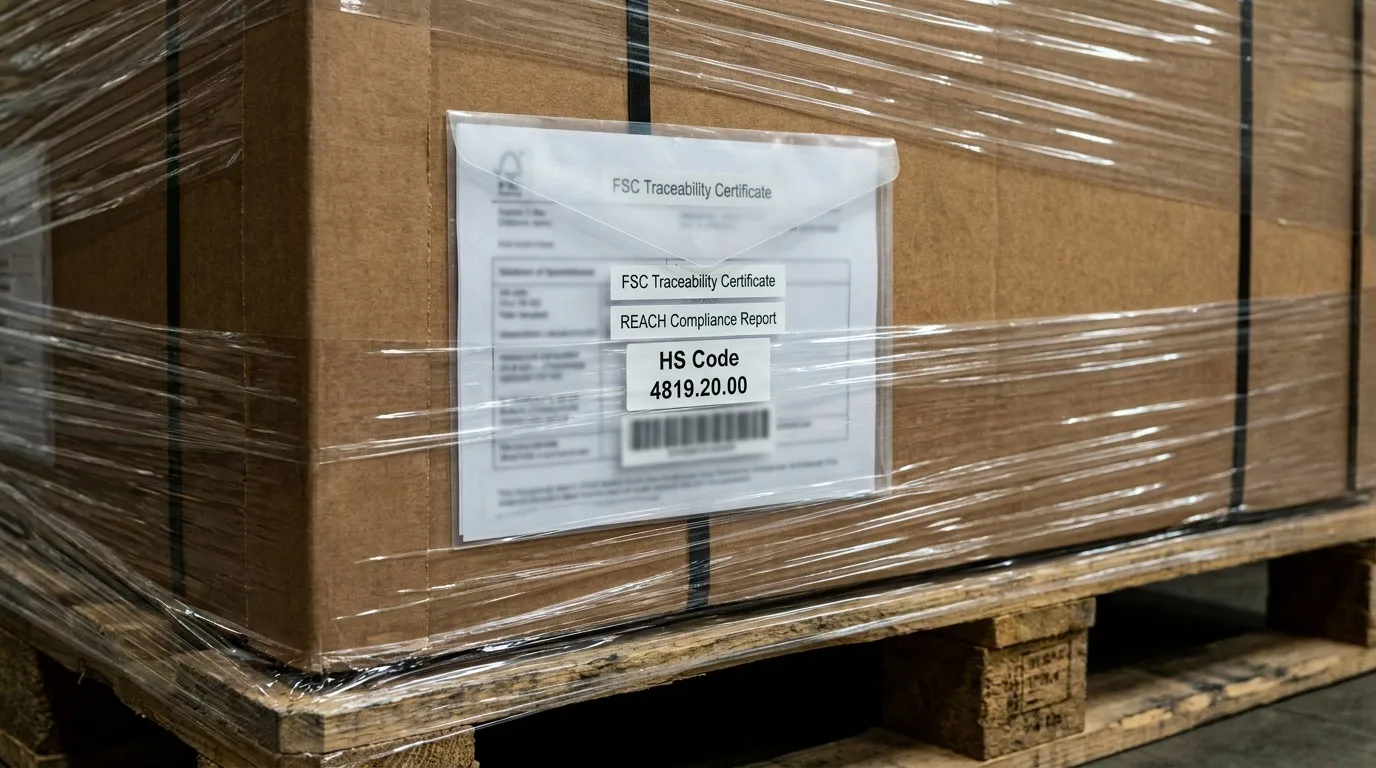
Solution Product Composition: International compliance is a technical deliverable. World-class manufacturers provide a 'Transparency Bundle' with every shipment, including verifiable FSC traceability and HS Code 4819.20.00 classification to ensure zero customs delays.
Professional procurement managers follow a five-stage Standard Operating Procedure to eliminate risk:
Factory Audit (Virtual or 3rd Party): Verify the ISO 9001 status and production capacity. Do not rely on showroom photos alone.
Prototyping & PPS: Order a Pre-Production Sample (PPS) with your logo. This is your "Legal Quality Benchmark."
Production Gating (AQL 0.65): Implement a "No-Release without Inspection" clause.
Incoterm Selection: Choose DDP if you lack a local customs broker; choose FOB if you want maximum control over your ocean carrier.
Documentation Audit: Ensure all HS Codes are correctly mapped (e.g., 4819.20 for boxes, 4202.92 for pouches) to avoid misclassification fines. You can explore our verified export credentials at our Alibaba International Shop.
Success in sourcing jewelry packaging from China is often a matter of geography. Factories located in the Xiamen Special Economic Zone benefit from one of the world's top 10 deep-water ports. For an international buyer, Xiamen offers:
Direct Routes: Direct vessel paths to LA, Rotterdam, and Hamburg, reducing transit times by up to 10 days compared to inland factories.
Consolidated Logistics: Xiamen is the global hub for high-end packaging; you can easily consolidate orders for boxes, pouches, and bags into a single container.
Cedar & Silver, an emerging silver jewelry brand based in Chicago, was sourcing their packaging from an inland workshop in Central China. They were buying on "EXW" terms, meaning they had to find their own truck, their own export broker, and their own sea carrier. Their supply chain was fragmented, with five different vendors involved in moving one shipment. In late 2025, a customs misclassification (using the wrong HS Code) led to a 20-day port hold and $4,500 in storage fees. Their total landed cost was $2.45 per unit, 45% higher than their budget.
The brand manager conducted a Logistics Audit and moved the account to a port-adjacent manufacturer in Xiamen. The goal was to simplify the chain into a single "Factory-to-Warehouse" flow. They shifted from EXW to a Full DDP (Delivered Duty Paid) Program, where the manufacturer assumed all liability for shipping and customs.
The new supplier engineered a logistics-first packaging suite:
Volumetric Redesign: By reducing the necklace box height by 4mm, they fit 20% more units per pallet.
DDP Consolidation: The brand received one invoice in USD that covered everything from paper to the final delivery truck in Chicago.
Batch Locking: The factory reserved a 6-month supply of their signature grey specialty paper to prevent color drift during the transit delays of the holiday season.
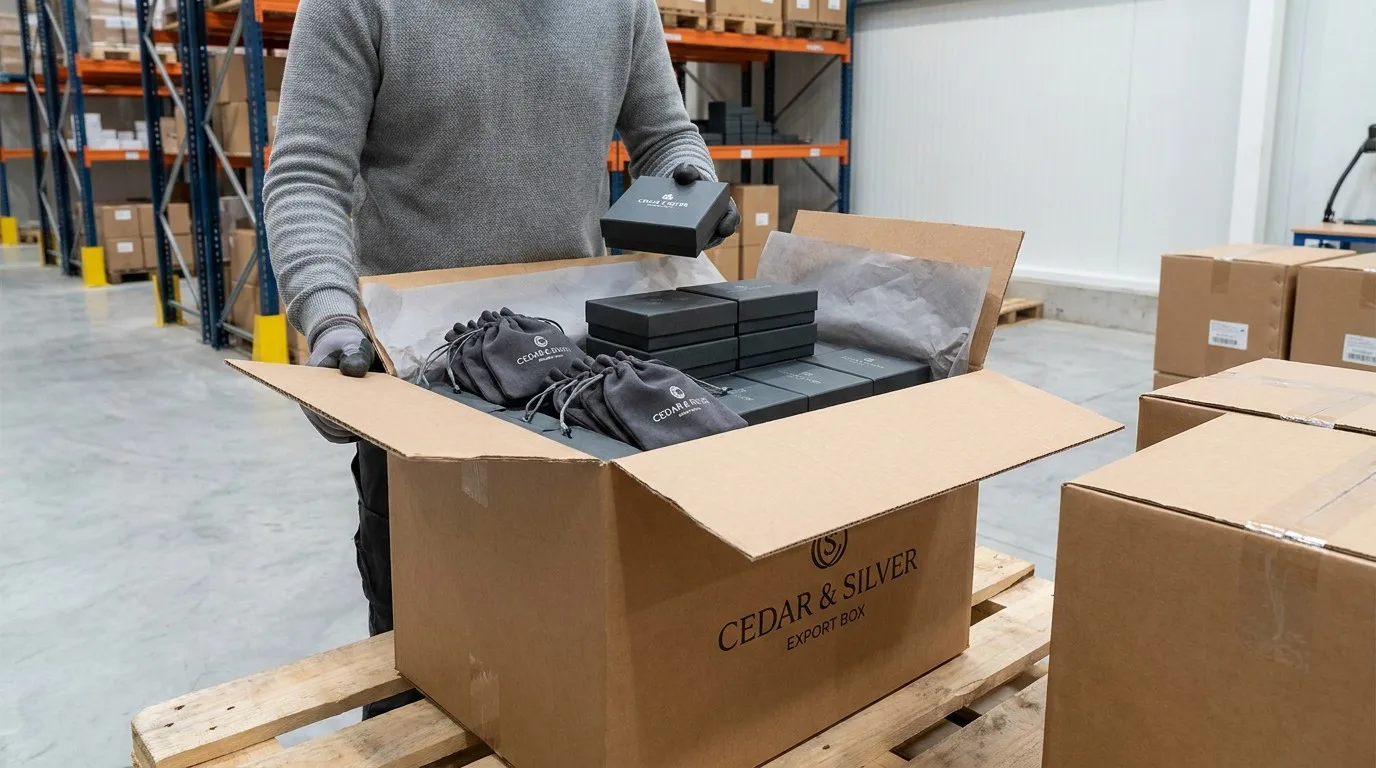
Design Deliverable: The final Cedar & Silver unboxing in their Chicago warehouse. By choosing a port-adjacent partner with DDP expertise, the brand received their stock with zero administrative friction and 100% price certainty.
Six months after the pivot to a professional China import partner:
Landed Cost Reduction: Total cost per box fell from $2.45 to $1.91 (a 22% saving).
Fulfillment Speed: The total time from "Order" to "Warehouse Arrival" fell from 75 days to 48 days.
Inventory Health: Zero "Moisture Damage" reports, thanks to the factory's maritime-grade shrink-wrap standard.
Shipping Method | Transit Time | Cost Tier | Best Use Case | Reliability |
|---|---|---|---|---|
Ocean Freight (FCL) | 30 - 45 Days | Lowest ($) | Annual bulk orders (5,000+ units) | High (Locked container) |
Ocean Freight (LCL) | 35 - 50 Days | Economy ($$) | Seasonal launches (1,000+ units) | Moderate (Shared space) |
Air Freight (Cargo) | 7 - 12 Days | Premium ($$$$) | Urgent restocks / Flash sales | Highest |
Rail Freight (China-EU) | 18 - 25 Days | Mid-Tier ($$$) | European brands seeking land-routes | Moderate |
Professional B2B buyers should know that reputable Chinese manufacturers are eligible for an Export Tax Rebate (Vat Refund) of up to 13%. When you buy from a small workshop that lacks export licenses, they cannot claim this refund, which means they must charge you more to cover their own costs.
Leading manufacturers like Utouch Packaging factor this rebate into their export pricing, allowing them to offer a "Direct Manufacturer Discount" that trading companies simply cannot match. Always ask your supplier if they are an "Authorized Exporter" — this one question can save you 10% on your total production cost before a single box is made.
Request their FSC License Code and check it against the official FSC Public Search database. Additionally, request their GRS (Global Recycled Standard) certificate if you are sourcing recycled microfiber or rPET materials.
Most manufacturers accept USD, EUR, and GBP via T/T. If you utilize Alibaba Trade Assurance, you can often pay in your local currency via credit card or local bank transfer, adding an extra layer of payment protection to your import project.
If you source on CIF or DDP terms, the manufacturer or their forwarder provides Marine Insurance. In the event of damage, the insurance covers the replacement cost. Always take photos of the pallets before unloading to support any potential claims.
For your first three orders with a new supplier, Yes. Firms like SGS or V-Trust charge approx. $300 per man-day to inspect your batch. This is a small price to pay to ensure 100% of your 10,000 boxes match the golden sample.
Consult with a customs broker to see if your specific material composition qualifies for any "Exclusions." Alternatively, request a DDP quote from your manufacturer, which includes the tariff in the final delivered price, providing you with total cost certainty.
Knowing how to import jewelry packaging from China is a competitive advantage in the 2026 market. It allows you to access industrial-grade technology, precision V-grooving, and sustainable materials at a price point that local wholesalers cannot compete with. By choosing a port-adjacent partner that offers DDP transparency and AQL quality standards, you transform your packaging from a logistics headache into a high-performance brand asset.
At Utouch Packaging, we bridge the gap between Xiamen and your warehouse. Ready to see our 'Global-Direct' DDP pricing? Contact our International Logistics Team for a landing-cost audit and custom quote today.
