
Views: 0 Author: Site Editor Publish Time: 2026-06-02 Origin: Site


Last updated: June 2026 · A B2B buyer's guide from Utouch Packaging
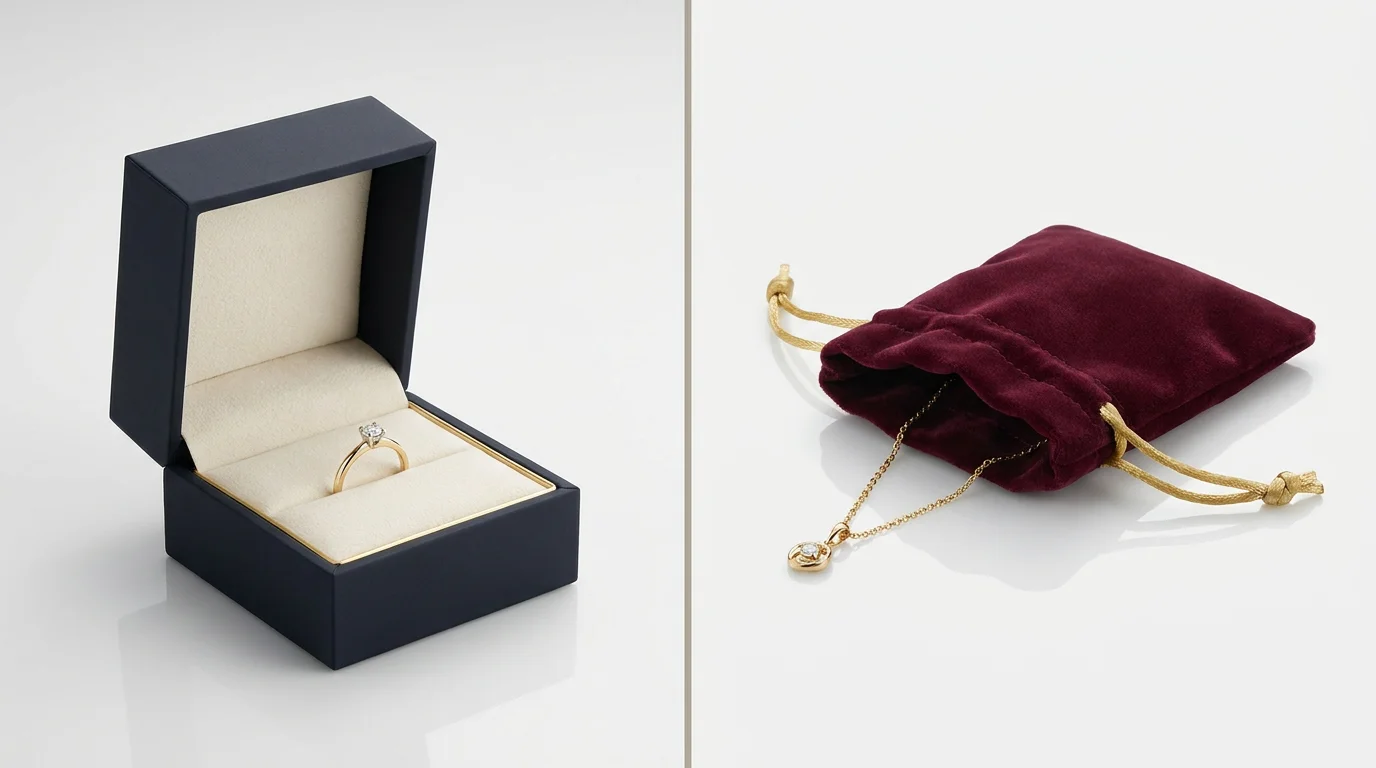
A rigid box and a velvet pouch solve the same problem in very different ways — and at very different unit costs.
If you sell jewelry online or run a retail brand, the packaging question comes up fast: should you ship in a structured box or a soft pouch? Both protect the product and both can carry your logo, but they create different unboxing moments, cost very different amounts per unit, and suit different buyers. This guide breaks down the real trade-offs — cost, perceived value, protection, shipping, and conversion — so you can choose the right format for each SKU instead of defaulting to one.
There is no universal winner. As a rule of thumb: rigid boxes sell better for high-ticket, gift-driven, and in-store items where the open-the-lid moment justifies the cost; pouches sell better for high-volume, lower-price, and travel-friendly items where unit economics and weight matter more. Most brands that scale eventually run both — a box for the hero pieces and a pouch for everyday SKUs and as a protective insert.
A jewelry box is a rigid or semi-rigid container — typically paper-wrapped cardboard, rigid setup board, or PU leather over a frame — with a fixed shape and an insert (foam, velvet, or EVA) that holds the piece in place. The defining feature is the lid moment: the small ritual of lifting a lid, which research has long linked to higher perceived value.
According to a widely cited Pregis study, packaging can influence perceived product value by roughly 45%, and surveys consistently show that close to 40% of shoppers say a memorable unboxing makes them more likely to buy from a brand again. For a $150 ring, a $1.50 box that lifts perceived value and repeat purchase is an easy investment.
Engagement & bridal: a ring box is part of the moment, not just packaging.
Gifting season: Q4 buyers want a piece that looks finished without extra wrapping.
In-store & counter sales: a box reads as “premium” on a shelf.
Fragile or multi-piece sets: a fitted insert prevents tangling and scratches.
Paper-wrapped jewelry boxes generally run about $1.00–$3.00 per unit at wholesale volume, rising when you add custom logos, foil stamping, magnetic closures, or velvet inserts. Rigid “setup” boxes and PU leather boxes sit higher, but deliver the heaviest, most premium feel. Boxes also take more warehouse space and add shipping weight — a real factor if you ship internationally.
A pouch is a soft fabric bag — velvet, microfiber suede, organza, or cotton/linen — usually closed with a drawstring. It molds to almost any item, protects against scratches and dust, and adds very little weight. For brands selling a wide range of shapes, one pouch size can cover many SKUs.
Pouches also double as storage the customer keeps. A velvet drawstring bag travels in a handbag or suitcase, so your logo stays in use long after the sale — a quiet but real branding advantage that a box left in a drawer does not always match.
Everyday and fashion jewelry: the price point can't absorb a $2 box.
High SKU counts: one pouch size fits rings, earrings, and pendants.
E-commerce & cross-border: light weight lowers shipping cost.
Protective inserts: a pouch inside a box prevents movement and scratches.
Material grade drives the price. Organza bags are the most cost-effective option, microfiber and suede pouches sit in the middle, and high-pile velvet pouches with custom-printed logos cost more but feel noticeably more premium. Across the board, pouches typically cost less per unit than a comparable rigid box and are far easier to store flat and ship in bulk.
Factor | Jewelry Box | Jewelry Pouch |
|---|---|---|
Typical unit cost | Higher ($1–$3+ for paper; more for rigid/PU) | Lower (organza cheapest, velvet mid-high) |
Perceived value | Highest — the “lid moment” | Premium but softer impression |
Protection | Strong — rigid walls + fitted insert | Good vs. scratches/dust; weak vs. crushing |
Shipping weight & space | Heavier, bulkier | Light, packs flat |
Best price point | Mid-to-high ticket, gifting, bridal | Low-to-mid ticket, fashion, travel |
Branding longevity | Display-ready, but often stored away | Reused for travel — logo stays in use |
SKU flexibility | Often size-specific | One size fits many items |
Customization | Foil, emboss, magnetic close, insert color | Printed/woven logo, color, drawstring, size |
“Box” and “pouch” are categories, not single products — the material you pick inside each one changes cost, feel, and sustainability just as much as the format itself.
Paper-wrapped cardboard: the volume workhorse — affordable, printable, and light enough for e-commerce.
Rigid setup board: thicker walls and a heavier feel for a clear step up in perceived value.
PU leather over a frame: the most premium, soft-touch option, popular for bridal and high-ticket pieces.
Organza: sheer and the most budget-friendly, good for favors and lightweight items.
Microfiber suede: smooth, scratch-safe, and clean to print — a reliable mid-tier choice.
High-pile velvet: the most luxurious hand-feel, closest to a box in perceived value.
Cotton or linen: a natural, recyclable look that suits eco-positioned brands.
A sustainability note that affects both formats. Buyers selling into the EU should plan around the Packaging and Packaging Waste Regulation (PPWR), which pushes toward recyclable, reducible packaging. Mixed-material boxes (board + plastic lamination + magnets + foam) are harder to recycle, while a clean paper box or a single-fiber cotton pouch is simpler to comply with. If sustainability is part of your brand story, factor recyclability into the box-versus-pouch decision — not just cost and looks.
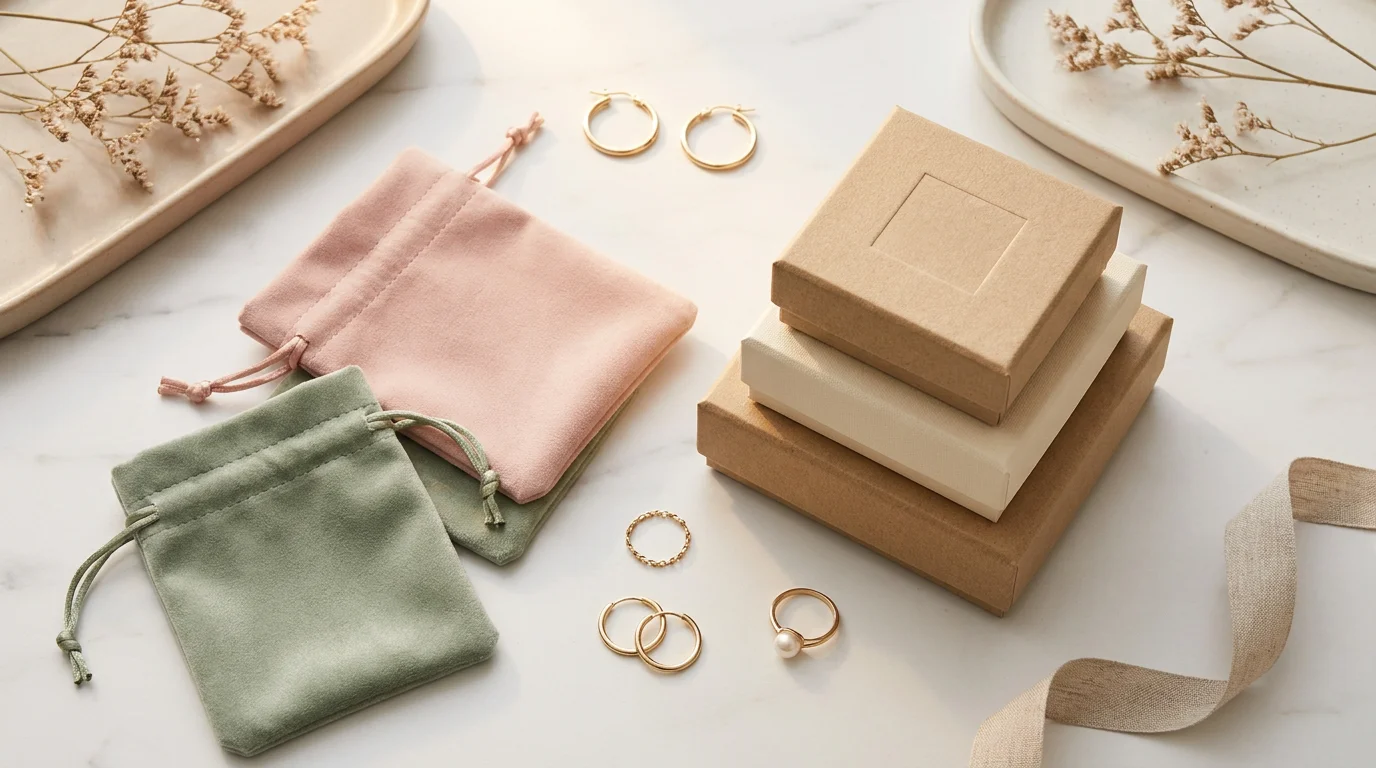
Many growing brands run a dual system: rigid boxes for hero pieces, velvet pouches for everyday SKUs.
Scenario 1 — A demi-fine brand launching online. Average order value sits around $90–$160, mostly rings and pendants given as gifts. Here the box earns its keep: a custom magnetic-close box with a fitted insert supports the gift narrative and the unboxing photos customers share. The brand adds a slim velvet pouch inside the box so the piece can be stored or travelled with later — box for the moment, pouch for the long tail.
Scenario 2 — A fashion-jewelry seller with 300+ SKUs. Items retail at $12–$35 and ship worldwide. A $2 box would erase margin and inflate shipping. The seller standardizes on one or two velvet pouch sizes with a printed logo, cutting packaging SKUs from dozens to a handful while keeping a branded feel. Pouches pack flat, so freight and warehousing both drop.
Scenario 3 — A retailer selling both online and in boutiques. In-store, a box on the counter signals quality and closes the sale. Online, the same retailer offers a pouch option at checkout for shoppers who want lighter, lower-cost packaging on travel pieces. The lesson: the “better” format follows the channel and the SKU, not the brand as a whole.
Forcing one format on every SKU. A $15 pair of earrings does not need the same box as a $200 necklace.
Ignoring shipping math. Box weight and volume can quietly raise cross-border costs more than the box itself.
Skipping the insert. A pouch inside a box (or a fitted foam) prevents the scratches that drive returns.
Over-ordering before testing. Start with a sample run, confirm fit and logo quality, then scale the MOQ.
Pouches are lighter and pack flat, so they usually lower shipping cost — ideal for cross-border e-commerce. Boxes protect better against crushing but add weight and volume. Many brands ship the piece in a pouch tucked inside a mailer box for the best of both.
Rigid boxes generally read as more premium because of the lid moment and structured feel. High-pile velvet pouches close much of the gap and feel luxurious in hand — the right choice depends on price point and the unboxing story you want.
Yes. Boxes can be foil-stamped, embossed, or printed; pouches can be screen-printed, hot-stamped, or woven. Logo clarity depends on material and method, so always approve a physical sample before a full production run.
MOQ depends on material, customization, and finish. Simple stock pouches start low, while fully custom rigid boxes carry higher MOQs because of tooling and setup. Tell us your design and we will quote the realistic MOQ and lead time for your case.
Often, yes. A pouch inside a box prevents movement, adds a second branded touchpoint, and gives the customer a reusable travel bag. It is a common upgrade for mid-to-high ticket pieces.
Map each SKU by price point and channel. Use boxes for high-ticket, gift, and in-store items; use pouches for everyday, high-SKU, and travel pieces; combine both for hero products. Then order samples to confirm fit, color, and logo quality before scaling.
“Boxes vs pouches” is the wrong question to answer once for your whole catalog. The brands that convert best match the format to each product's price, channel, and gifting context — and many run both. As a manufacturer with in-house OEM/ODM capability, we make custom rigid boxes, PU leather boxes, and velvet, microfiber, organza, and cotton pouches under one roof, so you can mix formats without juggling multiple suppliers.
Not sure which format fits your line? Send us your products and target price points, and we'll recommend a packaging mix, share samples, and quote realistic MOQs and lead times. Contact our Procurement Team for a 'Logistics-First' quote and sample kit today.
