
Views: 0 Author: Site Editor Publish Time: 2026-08-23 Origin: Site


Article Intro: A B2B guide to jewelry display cards — the earring cards, header cards, and insert cards that hold, display, and brand a piece of jewelry. Covers what display cards do, how cards combine with bags and boxes, customization options, and what to specify when ordering custom cards.
Definition: Jewelry display cards are flat printed cards that carry, hold, and present a piece of jewelry — earring cards with punched slots, necklace cards with a center notch, header cards that top a PVC bag, and insert cards that sit inside a box. They are the bridge between the product and its packaging: the card gives the jewelry a fixed position, a clean presentation, and a surface for branding, pricing, and care information. A custom jewelry card can be as simple as a die-cut paperboard earring card or as finished as a foil-stamped, velvet-laminated card with a printed logo.
Quick Answer: Jewelry display cards serve three jobs: they hold the jewelry securely for display and shipping, they present it at a retail angle that sells without a salesperson, and they carry the brand — logo, materials, care instructions, and story. Order them as part of a coordinated system: header cards with PVC bags for value lines, insert cards inside boxes for gifting lines, and stand-alone earring cards for retail wall displays. Custom printing, die-cutting, and foil stamping are all available from the same factories that make the boxes and bags, which keeps the system visually consistent and the logistics simple.
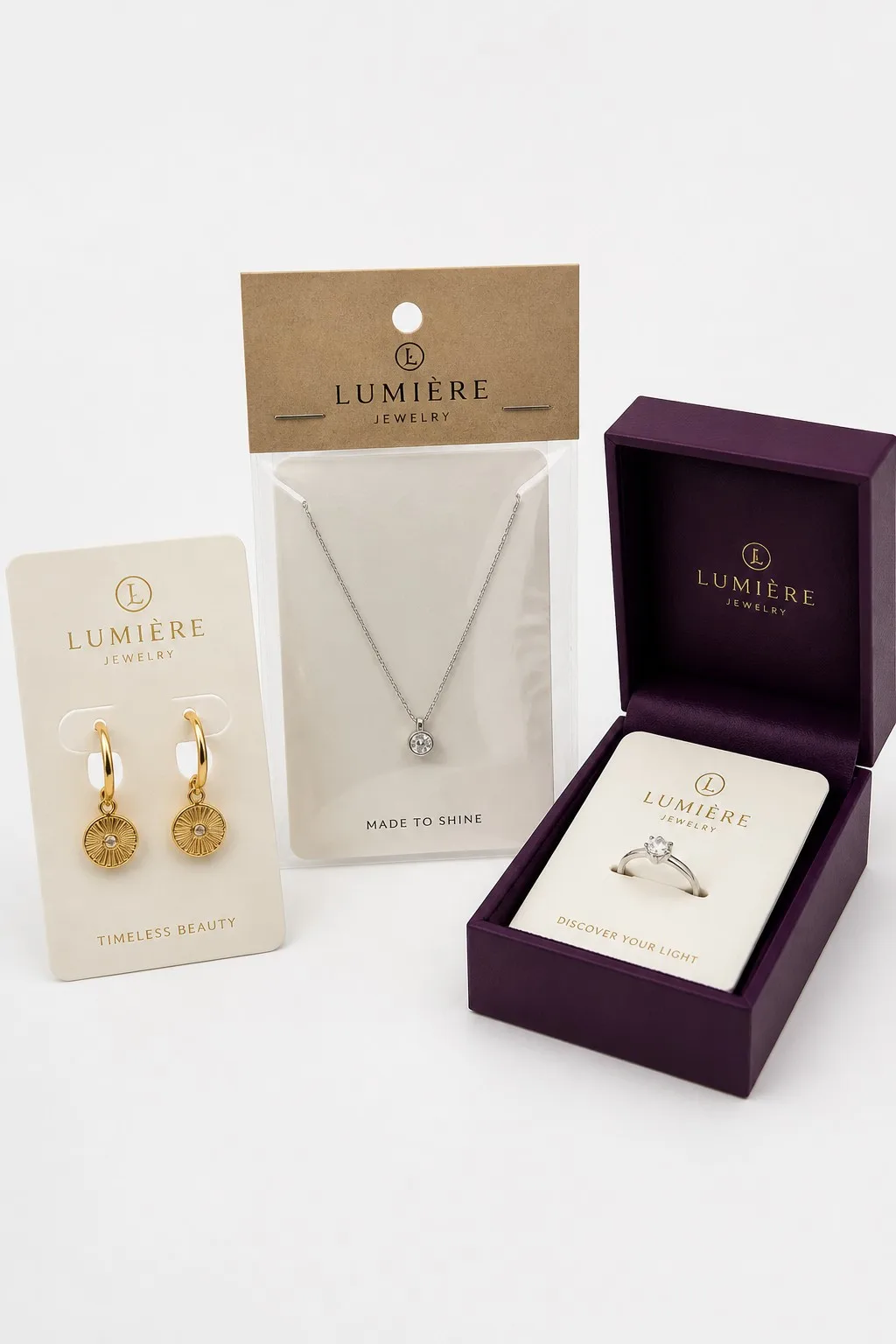
Three card formats in one system — stand-alone earring card, header card with PVC bag, and insert card in a box
A display card is a small piece of packaging with a large workload. Three functions matter most:
Holds and protects: Earring cards and necklace cards keep pairs together and keep posts, hooks, and clasps from tangling. The punched slot or notch holds the piece in place inside a box, a bag, or on a wall hook — which is also the shipping position, so the card protects the jewelry in transit without extra padding.
Sells at the point of display: On a retail wall or a market stall, a card is the presentation surface. A card that stands straight, shows the piece at eye level, and carries the brand logo does the selling that a staffed counter would otherwise do. For jewelry packaging display at trade shows and counters, the card is often the only branded surface the buyer sees before the box opens.
Carries information: The card is the natural home for the metal type, gemstone, size, price, and care instructions — printed once, at scale, instead of handwritten on every order. For compliance-sensitive markets, the card can carry material declarations and barcodes without touching the jewelry itself.
The card also affects perceived value more than its cost suggests: a punched, printed, branded card lifts a plain PVC bag from commodity to gift-ready, and the same card inside a box turns a simple unboxing into a presentation moment.
Display cards rarely work alone — they are the connective tissue of a packaging system:
Header card + PVC bag: The most common retail combination. A header card tops a transparent PVC bag, so the jewelry is visible and the brand rides on the card. For jewelry header card PVC bag combos, the card and bag are specified together — card size, bag size, and punch position must match exactly, which is why ordering them from one factory avoids fit problems.
Insert card + box: A card inside a jewelry box — an earring card, a necklace card, or a lay-flat card under the jewelry — holds the piece in place and adds a second branded surface. For jewelry packaging with card insert, the card is die-cut to the box interior, so the jewelry stays centered and the box looks finished on opening.
Stand-alone cards: Earring cards and necklace cards that are the packaging — punched, printed, and sold on a wall hook or rack. For earring cards and jewelry packaging aimed at high-rotation retail, this is the leanest format: no bag, no box, just a card that carries the pair and the brand.
The system logic is tiered: value lines use header card + PVC bag; mid lines add a jewelry card box with a printed insert; premium lines use a deep box with an earring card, ribbon, and outer sleeve. For jewelry packaging boxes and cards, the box and the card are designed as one unit — the card's cut, color, and finish echo the box's interior — so the brand reads consistently across every format the customer touches.
Jewelry card packaging is one of the most customizable packaging formats, because cards are flat, printed, and die-cut — three variables that factories control well:
Material and weight: Paperboard from 300gsm to 500gsm for standard cards; kraft for a natural, eco look; coated stock for vivid color; velvet or linen lamination for a tactile premium finish. Heavier stock stands straighter on hooks and feels more expensive in hand.
Print and finish: Double-sided printing, foil stamping, debossing, spot UV, and matte or gloss lamination. A gold-foil logo on a deep purple jewelry box with earring card is a classic premium combination — the foil catches light on the counter while the card holds the piece.
Die-cutting and finishing: Punched slots and notches, rounded corners, hang holes, custom shapes, and perforated fold lines for stand-up cards. Die-cutting is the step that makes a card feel designed rather than printed.
Compatibility specs: Card dimensions must match the bag or box interior; punch positions must match the jewelry's post spacing; hang holes must match retail hooks. A card that fits its system perfectly is invisible — the jewelry and the brand do the talking.
The customization workflow is mockup-driven: the factory sends a digital proof of the card art, the punch layout, and the finish, the buyer approves or adjusts, and the sample confirms the physical result before production. For jewelry packaging card earrings and necklace lines, the proof stage is where most errors are caught — which is exactly why it exists.
When ordering custom jewelry cards, five specifications decide the outcome:
Dimensions and shape: Exact width, height, and corner or shape details — including the cut of any slots, notches, or hang holes.
Material and weight: Stock type and gsm, plus any lamination or coating, stated on the order so the factory builds to the same reference every time.
Print specs: Colors (Pantone or CMYK), print sides, finishes such as foil or deboss, and the approved art file version.
Quantity and MOQ: Custom cards typically follow the same minimum as other packaging — from a few hundred pieces for a test run — and unit price falls as quantity rises, so a brand can order a small proof batch and scale on the reorder.
Packaging and delivery: How the cards are packed (bundled, boxed, or with the bags and boxes they belong to) and the delivery method, since cards are light and ship economically.
For jewelry packaging display setups, the cards, bags, and boxes should be ordered as one system from one supplier: the factory matches the card cut to the box interior and the punch position to the bag, prints to one brand standard, and ships the whole set in one freight move. That is also where the sourcing fundamentals for small and growing brands apply — minimums, lead times, and supplier qualification are the same conversation whether the order is cards, boxes, or a full system, and they are covered in the 2026 B2B sourcing guide for small and growing brands.
A jewelry brand in Singapore had been buying custom packaging from the same factory for years, and the relationship ran on a simple system: every specification — card dimensions, print files, color codes, and punch layouts — was archived after each order. When the brand reordered, the factory pulled the stored specs, confirmed the details, and produced without a new proof round. That speed mattered more than price: when a small cost increase had to pass through, the factory explained the change transparently before the order, the buyer accepted it, and the reorder continued without friction. The recurring orders have stayed in a modest range, from $194 upward, and the brand has never switched suppliers.
The case is a quiet one — no dramatic save, just a system that made reordering frictionless. For display cards specifically, that is the highest-value outcome: once the card art and die-cut are archived, a reorder is a confirmation call, not a redesign. The brands that win with cards are the ones that treat the specification as an asset and keep it current.
Q: What is a jewelry display card?
A: A flat printed card that holds, displays, and brands a piece of jewelry — an earring card with punched slots, a necklace card with a notch, a header card topping a PVC bag, or an insert card inside a box.
Q: What is the difference between a header card and an insert card?
A: A header card tops a bag — usually a transparent PVC bag — with the jewelry visible below and the brand on the card. An insert card sits inside a box, holding the jewelry in place and adding a second branded surface on opening.
Q: Can I order cards, bags, and boxes from one factory?
A: Yes, and for card jewelry packaging it is the recommended route: one factory matches the card cut to the box interior and the punch position to the bag, prints to one brand standard, and ships the set in one freight move.
Q: What is the MOQ for custom jewelry cards?
A: Custom cards follow the same minimum logic as other packaging — from a few hundred pieces for a test run — and unit price falls as quantity rises, so a small proof batch can be scaled on the reorder.
Q: How do I avoid color mismatch between my cards and my boxes?
A: Specify Pantone or CMYK references on the order and print the whole system at one factory, from one approved art file. Archiving the color codes after each order also makes reorders match automatically.
Jewelry display cards are the connective tissue of a packaging system: they hold and protect the piece, present it at a selling angle, and carry the brand and care information. The three formats — header card with PVC bag, insert card with box, and stand-alone earring card — cover every tier from value lines to premium gifting, and the customization options (stock, weight, print, foil, die-cut) make the card a full brand surface. Order the system as one unit from one factory, archive the specifications, and the reorders become confirmation calls instead of redesigns.
For custom display cards, boxes, and coordinated packaging systems, visit Utouch Packaging — and for direct factory quotes on cards, bags, and boxes, reach Xiamen Yu Touch Imp & Exp Co., Ltd.
