
Views: 0 Author: Site Editor Publish Time: 2026-09-08 Origin: Site


Article Intro: Round jewelry packaging is the shape that stands apart — a circular box or pouch breaks the rectangle of the shelf, softens the unboxing, and carries a symbolic weight that square packaging cannot match. For jewelry brands, the round decision is about structure and moment: which round box opens smoothly, which round pouch protects best, and when the circle is worth the extra tooling. This guide covers round boxes, round pouches, materials, customization, and the wholesale notes for adding a circular line to jewelry packaging.
The circle earns its place in the jewelry line through five traits:
Shelf differentiation: Most jewelry packaging is rectangular. A round jewelry box stands out on the shelf and in the listing photo — the silhouette is the first difference the customer sees.
The soft look: The curve reads as softer and more delicate than hard corners — a visual match for jewelry's feminine and romantic positioning.
The symbolic circle: The round form carries meaning — completeness, unity, eternity — which suits engagement, wedding, and anniversary gifting where the symbolism doubles the message.
The tactile opening: Round boxes open differently — a twist-off lid, a lift-off cover, a hinge — the different motion makes the unboxing feel special rather than routine.
Display efficiency: Round formats stack and display neatly in the round — a counter of round boxes reads as a curated collection, and the shape photographs well from every angle.
A round box for a ring or a pendant adds a moment that a square box cannot: the customer turns the lid, and the reveal comes from a different gesture — the circle makes the opening part of the experience.
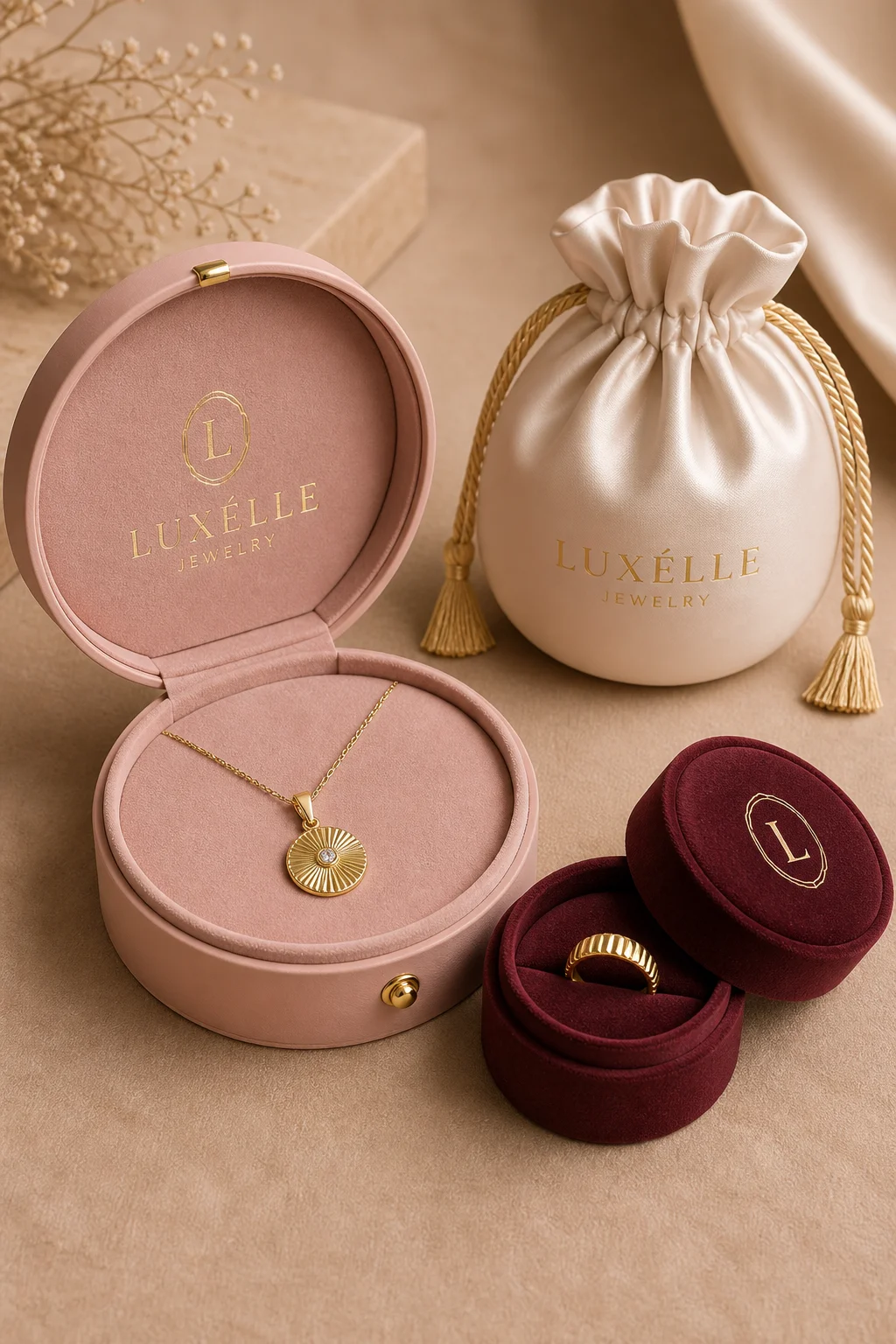
The round family — hinge box, lift-lid box, and standing round-bottom pouch
The round box family covers several structures and materials:
Rigid round boxes: Wrapped, rigid round boxes with lift-off or hinge lids — the premium format, available in velvet, leather-look, paper, and fabric finishes. A round velvet jewelry box with a lift lid is the classic luxury configuration.
Twist-open round boxes: The threaded lid that screws open — the mechanical reveal that adds the tactile surprise to the round format.
Magnetic-lid round boxes: The magnetic closure that seats the lid cleanly — the modern round format that opens and closes with a satisfying click.
Small round boxes: The compact sizes for rings, studs, and pendants — a small round jewelry box fits the single-piece gifting moment at a gift-friendly scale.
Round travel boxes: The portable round format with a secure closure for travel — a round travel jewelry box carries one or two pieces without the bulk of a full organizer.
Round jewelry box packaging follows the same structure logic as any box — the interior insert, the material, and the closure are specified together — with the round silhouette adding the tooling consideration: round structures need circular cutting and wrapping, which is why round boxes carry slightly different minimums than rectangles. For brands running a coordinated circular family, the jewelry box round range extends from small gifting sizes to large display formats — one round structure language across the catalog, from the ring box to the counter display.
The round format extends into soft packaging:
Round-bottom drawstring pouches: The drawstring pouch with a round base — the pouch stands upright when filled, a practical advantage over flat-bottomed versions. A satin round bottom jewelry pouch format carries the soft, standing silhouette.
Round pouches with base inserts: A jewelry pouch round base with a stiffened circular bottom holds the shape and protects the piece — the structure that keeps a round pouch round.
Round jewelry bags: Soft round bags for gifting and retail — the jewelry bag round format suits earrings, charms, and single pieces.
Microfiber round inserts: A microfiber round jewelry pouch insert provides the wiping and protection layer inside the pouch — the functional round for pieces that need cleaning on the move.
For a jewelry pouch round program, the base is the specification that matters: a stiffened base makes the pouch stand and present; a soft base lets it fold flat for shipping. The round pouch bridges the box and the bag — the silhouette of a box with the softness of a pouch.
The material menu for round packaging matches the rest of the line, with round-specific notes:
Velvet and fabric wraps: Wrapped rigid round boxes in velvet, linen, and fabric — the wrapping follows the curve, which demands careful cutting and sealing at the seam.
Paper and cardboard: Printed round boxes in paper and cardboard — the economical format with full print freedom on the round surface.
Transparent options: Clear round boxes and lids that show the piece — the display format that uses the round shape as a lens.
Metal and specialty: Round tins and metal-lid formats for the vintage and gift tiers — the round tin reads as heirloom packaging.
Printing on the round: Labels and prints are designed for the round surface — the artwork is laid out for the cylinder, with the seam and the wrap direction specified.
The round-specific discipline is the seam: every wrapped round box has a seam where the material meets, and the seam placement, cover, or ribbon detail is designed in rather than left to chance. Brands that spec the seam position get a clean circle; brands that do not get a visible join.
Customization follows the standard path with round considerations:
Logo placement on the curve: Foil, deboss, and print marks are placed with the round surface in mind — the logo works across the curve or centered on the lid where it reads flat.
Interior inserts: Round-cut inserts with grooves and compartments matched to the pieces — the insert is cut to the circle, not adapted from a rectangle.
Closure selection: Lift-off, twist, magnetic, and hinge closures chosen by the reveal the brand wants — each closure changes the unboxing motion.
Custom jewelry packaging round programs: The full round line — boxes, pouches, and travel formats sharing the round silhouette and the brand finish for a cohesive circular family.
The customization workflow is the standard stages — spec, mockup, sample, production, inspection — with the seam, the closure action, and the interior fit verified at the sample stage.
Where the round format earns its keep in practice:
The hero single-piece box: A round box for the signature ring or pendant — the differentiated hero piece that breaks the rectangle of the rest of the line.
Bridal and anniversary gifting: Round packaging for the symbolic moments — the circle's meaning reinforces the message for engagement, wedding, and milestone gifts.
Favor and sample formats: Small round boxes and pouches for favors, samples, and retail add-ons — the compact round that gifts well and costs little.
Display collections: A coordinated round display — boxes and pouches in one silhouette, arranged as a circular collection on the counter or in the listing.
The brands that run round well treat it as a deliberate silhouette choice rather than a novelty: one round hero line, coordinated round gifting formats, and the round symbol used where the message fits.
Buying round packaging wholesale:
MOQ by structure: Round pouches start low; wrapped rigid round boxes with circular tooling carry higher minimums than their square equivalents. Ask for the MOQ per format with the tier quote.
Sample before production: The round sample is checked for seam quality, closure action, interior fit, and artwork wrap — the round details are verified before the bulk order.
Spec the round details in writing: Diameter, height, seam placement, closure type, and interior cut belong in the spec — the written discipline that prevents the "seam on the front" surprise at arrival.
Combine with the line: Round orders combined with square boxes and pouches ship together and spread the freight. The sourcing fundamentals — minimums, lead times, and supplier qualification — are covered in the 2026 B2B sourcing guide for small and growing brands.
Q: Why choose round jewelry packaging?
A: The circle differentiates on the shelf, reads as softer and more delicate, carries symbolic meaning for gifting, changes the unboxing motion, and photographs well from every angle.
Q: How do round boxes open?
A: Round boxes open by lift-off lid, twist-off threads, magnetic closure, or hinge — each closure changes the reveal. The closure is chosen by the moment the brand wants to create.
Q: What is the difference between a round pouch and a round box?
A: A round box is rigid — structure, closure, and interior insert. A round pouch is soft — fabric with a drawstring or fold closure, often with a stiffened round base to stand upright.
Q: Do round boxes cost more than square boxes?
A: Usually slightly — round structures need circular cutting and wrapping tooling, which raises minimums and unit costs at small volumes. The differentiation often justifies the premium.
Q: What is the MOQ for custom round packaging?
A: Round pouches start low; wrapped rigid round boxes carry higher minimums than square equivalents. Ask for the MOQ per format with the tier quote.
Q: Which jewelry suits round packaging best?
A: Rings, pendants, studs, and charms suit small round boxes; necklaces and chains travel well in round pouches; and sets work in larger round display boxes. The piece fits the circle when the interior insert is cut to its exact size.
Round jewelry packaging stands apart on the shelf and in the moment: rigid round boxes with lift, twist, or magnetic closures; round pouches with stiffened bases that stand and present; small rounds for rings and favors; and travel rounds for the journey. The round-specific discipline is the seam, the closure, and the interior cut — specified at the sample stage with the piece inside. For round boxes, pouches, and complete packaging lines, visit Utouch Packaging — and for direct factory quotes on round and custom packaging, reach Xiamen Yu Touch Imp & Exp Co., Ltd.
