
Views: 0 Author: Site Editor Publish Time: 2026-09-14 Origin: Site


Article Intro: Zipper jewelry packaging is the closure family that keeps small pieces exactly where they were placed — the sewn zippered pouch, the zip-around case that opens flat, and the resealable zip-lock film bag. For jewelry brands the zipper is a specification rather than a style: the zipper type and gauge, the tape and thread colour, the puller, and the difference between internal and external dimensions all move the quotation. This guide covers the structures, the hardware, the specification list an RFQ should carry, and the wholesale notes for building a zippered line.
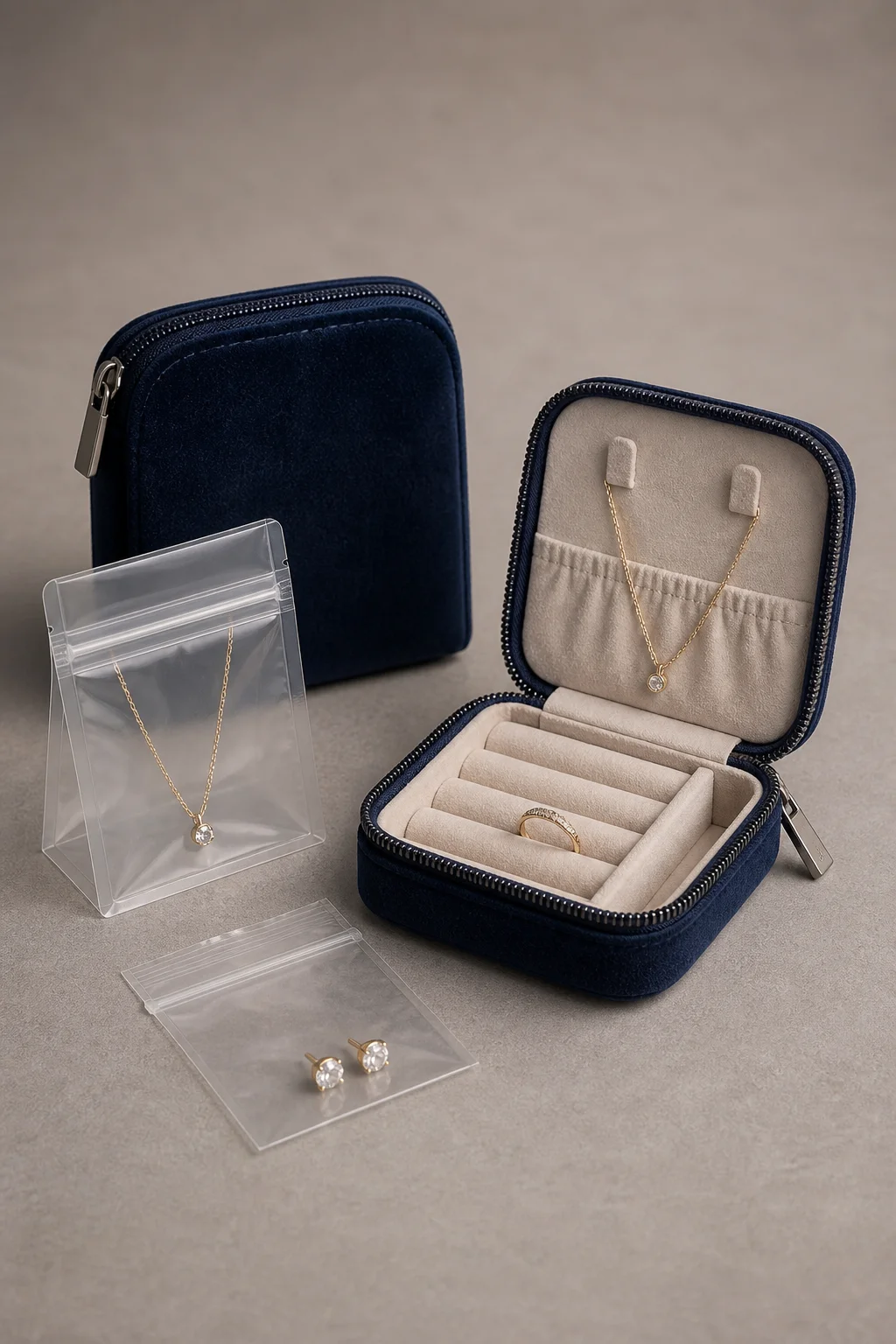
One closure family, four pieces and three structures — the zip-around case shown closed and open, the gusseted zip bag, and the flat zip-lock pouch
Zipper jewelry packaging describes any jewelry container closed with a zipper or a press-to-close zip seal. It reads like one category, but the products inside it belong to two manufacturing families that differ in almost everything except the closure itself: one family is sewn, the other is extruded and heat-sealed, and the two are tooled, decorated and priced separately.
The sewn structure is a textile pouch or case — velvet, satin, cotton, canvas, microfiber or leatherette — with the zipper tape stitched into the seam, so both the bought-in zipper and the sewing operation appear in the quote. The film structure is a PVC, EVA or PE bag closed by a press-to-close track or a slider, sealed rather than stitched, which is why it sits at a different price level and is grouped with soft packaging rather than with boxes.
A third format straddles the two: the zip-around case, where a zipper runs around three sides of a rigid or semi-rigid body so the case opens flat like a book. It is quoted like a rigid box, with the zipper as one line item among the body, the insert and the hand assembly.
Buyers search all three as “zipper jewelry bag”, “zipper jewelry pouch” or “zipper jewelry box”, yet they are tooled, decorated and priced differently. The first question in a zipper enquiry should therefore be which family is being bought, not which colour.
Four advantages explain why the closure keeps appearing across jewelry packaging formats:
Containment. A sealed opening holds pieces in position. A drawstring pouch loosened inside a handbag can spill its contents; a zipped pouch cannot, which is why small, high-value pieces are usually specified with a zip even when the pouch itself is fabric.
Slower tarnish. A closed compartment limits air exchange across the contents, and when the lining is a tarnish-inhibiting material the oxidation that dulls sterling silver is delayed considerably compared with an open tray or an unlined box.
Reusability. A properly specified sewn zipper survives repeated open-close cycles, so the pouch becomes storage the customer keeps rather than packaging that is thrown away on the first evening.
Handling and travel. A closed case can be stacked, packed and shipped without the contents shifting, which is the reason travel jewelry organizers default to zippers and why a zipped case is the standard format for pieces that travel with the customer.
There is also a branding advantage that costs nothing extra: the puller is a surface. A metal puller can be debossed or engraved, which gives a zippered line a second logo placement without adding a print area to the pouch face.
Six structures cover most of what buyers ask for. Cost rises with the amount of assembly, not with the size of the bag.
Structure | What it is | Where it fits | Cost tier |
|---|---|---|---|
Flat zip-lock film bag | PVC, EVA or PE film with a press-to-close track, heat-sealed, no sewing | Earrings, pendants and small pieces in retail and e-commerce | Lowest of the soft-package family |
Gusseted zip bag | Film bag with an expanded bottom and a zip or slider at the top | Necklaces, bracelets and bulkier pieces | Low |
Sewn zippered pouch | Fabric pouch with a coil zipper stitched into the top seam | A dust bag with a secure closure; gifting and storage | Low to mid |
Multi-pocket zip pouch | Compartmented pouch closed by a single zipper | Travel organizers, sets and mixed orders | Mid |
Zip-around case, semi-rigid | Zipper around three sides, opens flat, fitted interior | Retail presentation, travel, ring rolls | Mid to high |
Zip-around case, rigid | Board-bodied case with a zip and a hard shell | Luxury presentation and gifting | High, priced with the rigid box family |
The pattern behind the table is consistent. Film structures sit at the bottom of the soft-packaging band because they are extruded and sealed in a single pass. Sewn structures sit above a drawstring pouch of the same fabric, because the zipper adds both a component and an operation. Zip-around cases sit with the rigid box family, where the cost lives in the body, the insert and the hand assembly rather than in the zipper.
The closure is not free, and it is not always the right answer. Five limitations are worth weighing before the specification is fixed:
Cost and weight. The zipper is a component plus a stitching operation, and a zipped case is heavier and less compressible than a drawstring pouch of the same capacity — a difference that is paid for twice, at the unit price and again in freight.
Metal beside silver. Some metal zipper components and some leatherette tanning agents release sulfur compounds that accelerate tarnish on sterling silver. Specify nickel-free or plastic teeth, or a lining that isolates the hardware from the pieces.
Failure modes. Sliders that lose grip, teeth that jump, tape sewn with puckering and seams stressed by over-filling are the recurring faults. They are controlled by specification and inspection, not by supplier reputation.
Print area. The zipper interrupts the printable face, so artwork has to be laid out around the tape and the seam rather than across them.
Repair. A failed zipper cannot be re-sewn economically, so the whole pouch is lost. That risk is why the zipper grade and the pull test belong in the purchase order rather than in a conversation.
A jewelry brand in Seoul, in its launch year and selling its first collection online alongside one small wholesale account, was sourcing packaging from overseas for the first time. It needed a zippered line — single-piece pouches and a zip-around case for the gift tier — on a launch deadline, and the difficulty was not price. A wholesale account had asked where the packaging was made, and the brand could not answer, because from across a language barrier it had no way to tell a factory from a trading desk.
The first attempts did not survive scrutiny. One intermediary could not say which facility would run the job. Another returned a price and a catalogue page but no paperwork. A third supplied a sample without any indication of who had made it, which left the brand exactly where it started.
The supplier that won the order answered the question before the deposit. It issued a certificate of origin for the shipment, shot a production video on the floor showing the machine that would run the zipper work, and approved the sample — zipper tape colour, gauge, puller and lining — with a physical reference retained by both sides. The order was small by factory standards, a launch run rather than a seasonal one, and the documentation was still supplied in full.
The paperwork settled the account’s question and the launch proceeded on schedule. The brand’s own conclusion was that the documents, not the discount, had chosen the supplier — and that the questions worth asking on a first order are the ones a trading desk cannot answer.
Seven items keep a zipper enquiry from drifting:
Zipper type and gauge. Nylon coil is the default on soft pouches — light, flexible and colour-matchable. Resin and metal teeth are chosen for weight and feel. The gauge rises with the opening width, and it should be written into the quote rather than implied.
Tape and thread colour. Both are specified and both are matched to the pouch body and to the other packaging in the same order. A zipper tape in the wrong tonal black is the most visible defect on a zipped line.
Internal and external dimensions. A zipper is stitched into the seam, so the usable opening is shorter than the outer width and the usable depth is reduced by the tape. Writing internal and external dimensions into the purchase order prevents the most common dispute in soft packaging.
Puller. Metal, ribbon or a custom logo puller. A custom puller carries a die cost, so it belongs in the first quotation rather than in the reorder.
Lining and fabric weight. The lining determines protection and assembly time; a tarnish-inhibiting lining is specified when sterling silver is involved.
Decoration. Screen print, foil stamp, woven label or a rubber patch on film — each carries a different set-up and a different minimum.
Test protocol. An open-close cycle test, a pull-force check against the approved sample, a colour check under agreed light, and the packing method for transit.
A zip-around case is bought for two moments, and the specification follows the moment.
In retail, the case is the presentation itself. Because the zip opens flat, the interior is a layout rather than a cavity: ring rolls along one side, a necklace panel with hooks, an earring panel and a small compartment. The customer handles the case open at the counter, which is when the lining and the insert geometry are judged.
In travel, the same case is chosen because it compresses flat and holds its contents when the bag is searched or jostled. A ring roll with a zip closure, a flat zip pouch for chains and a gusseted bag for larger pieces will cover most trips, and the set can share one lining and one tape colour.
There is a compliance dimension worth stating in the RFQ as well. A leatherette zip case combines PU, board, foam and metal hardware, while a textile zippered pouch in a single fibre is far easier to defend under mono-material recyclability requirements and eco-modulated fees. For brands selling into the European market, the simpler construction is a sourcing advantage, not a downgrade.
Three practical points when buying zippered packaging:
Price the zipper into the quote, not onto the reorder. The quotation should name the zipper gauge, the tape colour, the thread colour and the puller. The zipper is the component most often silently substituted on a repeat order, and the substitution shows on the shelf before it shows on the invoice.
Build component lead time into the schedule. Zipper tape and custom pullers are bought in, so they sit ahead of the sewing line. On a seasonal order the puller can be the critical path item rather than the fabric.
Specify the line together. Tape, thread and puller are best chosen against the boxes and dust bags in the same order, so the closure reads as part of one brand rather than as a detail added later. The sourcing fundamentals — minimums, sampling, tiered pricing and supplier qualification — are covered in the 2026 B2B sourcing guide for small and growing brands.
Q: Are zippered pouches better than drawstring pouches?
A: Neither is universally better. A drawstring costs less and compresses flatter; a zipper holds small pieces more securely and survives more open-close cycles. Choose the zipper when the pieces are small, valuable or handled often, and the drawstring when the pouch mostly travels inside another box.
Q: Does a zipper make silver jewelry tarnish?
A: The zipper is not the cause, but some metal zipper components and some leatherette tanning agents release sulfur compounds that accelerate tarnish. Specify nickel-free or plastic teeth and a tarnish-inhibiting lining, and avoid direct contact between the hardware and sterling silver pieces.
Q: What zipper should I specify for a jewelry pouch?
A: A nylon coil zipper is the default for soft pouches — light, colour-matchable and flexible enough to follow a curved seam. Move to resin or metal teeth when the pouch should feel heavier, and name the gauge, tape colour and puller rather than leaving them to stock.
Q: Can zip-lock film bags carry a logo?
A: Yes, by screen print or an applied label. Artwork has to sit below the zip track and clear of the seal line, and the print should be proved on the actual film, because ink behaviour differs between PVC, EVA and PE.
Zipper jewelry packaging is a closure family rather than a single product. The sewn pouch, the resealable film bag and the zip-around case share one closure and very little else: different tooling, different decoration, different durability and different cost tiers. What they have in common is that the zipper is the specification worth writing first — gauge, tape colour, thread, puller, and the split between internal and external dimensions — because those are the details a reorder is most likely to change without saying so. A line ordered as one shipment also shares freight, one approval cycle and one colour standard, and the closure that holds a piece in place through a courier network or a handbag is the same closure the customer meets at the counter.
Utouch Packaging manufactures custom zippered jewelry packaging — sewn pouches and zip-around cases in velvet, satin, cotton and microfiber, plus zip-lock and gusseted film bags — with zipper gauge, tape colour and puller matched across the line, tarnish-inhibiting linings for silver, and samples approved before bulk. For wholesale and custom enquiries, visit the Utouch Packaging contact page or reach the export team through Xiamen Yu Touch Imp & Exp Co., Ltd.
