
Views: 0 Author: Site Editor Publish Time: 2026-09-28 Origin: Site


Article Intro: Two buyers can approve the same velvet swatch and still receive pouches that read one shade apart and behave differently in the hand, because the two properties that decide a pile fabric's appearance and its rigidity — which way the pile lies, and how far the fabric bends under its own weight — are rarely written on the order. Published fabric-mechanics work puts numbers on both, and part of it contradicts the instinct most buyers follow.
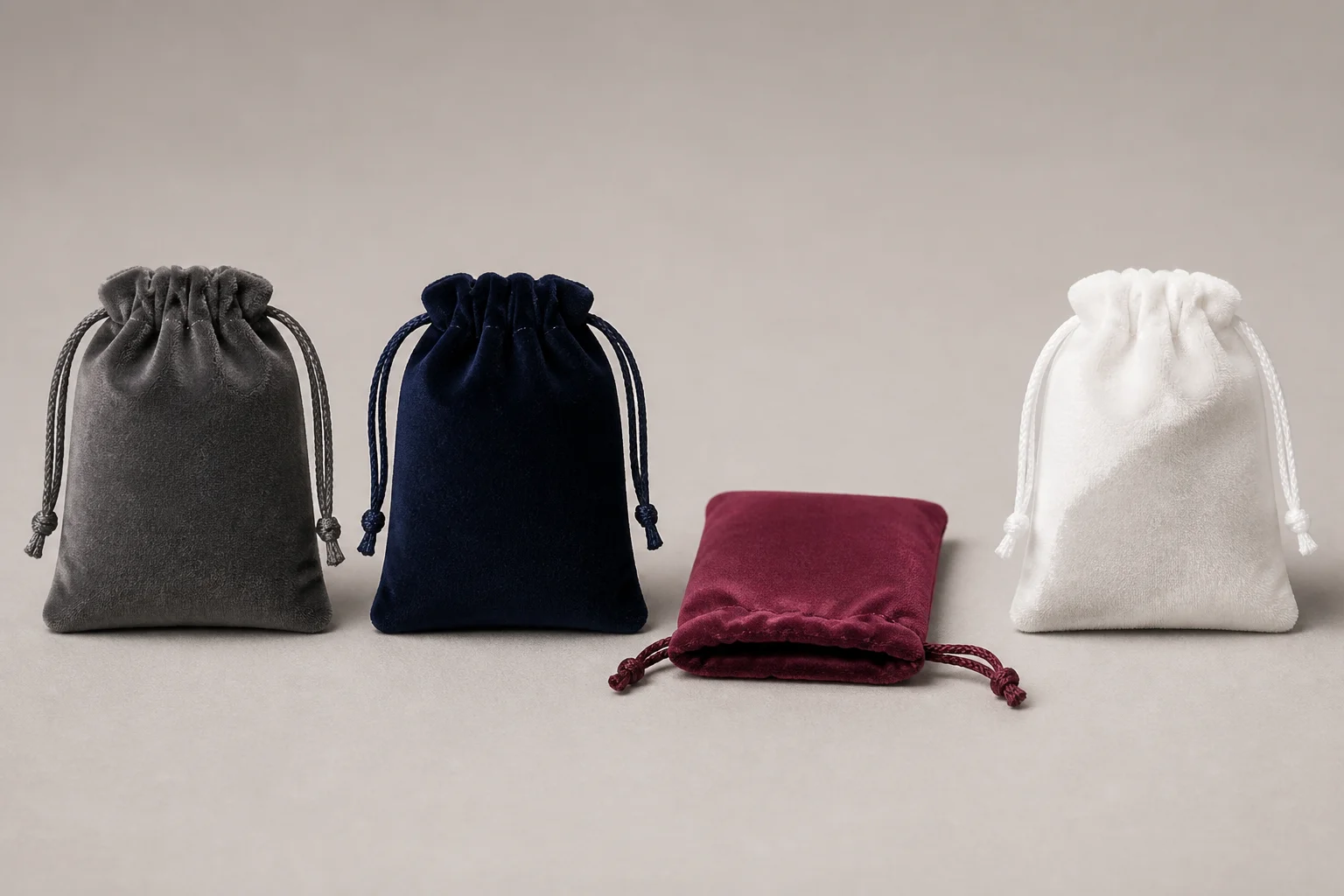
Pile direction reads as tone; the ground decides whether the pouch stands
Pile direction — the nap — is the lay of the cut fibres on a velvet face. Stroking one way lays the pile flat and the face reads lighter; stroking the other lifts the tips against the light and it reads darker. Two panels from one roll, dyed in one bath, can look like two fabrics. For a jewelry velvet pouch the consequence is shading — and a cutting instruction that belongs on the order.
Under the pile sits the ground, the cloth that carries the load. The nap gives depth and touch; the ground decides whether the pouch collapses. Most buyers specify the first and never name the second, which is why the same velvet pouch for jewelry can arrive soft from one supplier and self-supporting from another at an identical gram weight.
Quick Answer: Pile direction decides how the face reads under light; the ground decides whether the pouch holds its shape. Ask for the pile to run the same way on every panel, and for bending behaviour — not weight — to be confirmed on the sample.
Pile shading is strongest where the surface is light. A pink velvet jewelry pouch and a white velvet jewelry pouch show a shade shift between two panels where a black one hides it, so on pale orders the cutting direction matters more, not less. It is judged by eye under raking light, which is how a retail display lights a pouch.
Bending, by contrast, has been measured for close to a century. The cantilever method, standardised as ASTM D1388, lets a strip overhang and bend under its own weight, recording how far it projects before its edge drops to a set angle. Peirce's relation still holds: flexural rigidity is proportional to weight per unit area multiplied by the cube of half the bending length.
That cube is the part worth pausing on. Specimens are 25.4 mm wide, the measuring plane sits at 41.5°, and published work conditions strips at 21 ±1 °C and 65 ±2% relative humidity. The reading converts into a rigidity and a modulus, so suppliers can be compared on one scale.
Measured quantity | What it is | What it tells a buyer |
|---|---|---|
Bending length | How far a strip overhangs before bending to a set angle | The most sensitive number: rigidity rises with its cube |
Bending rigidity | Weight per unit area × the cube of half the bending length | Whether the cloth resists folding |
Bending modulus | Rigidity normalised for thickness and weight | Fair comparison between two gram weights |
Brand Background: The buyer is a United Arab Emirates–based jewelry brand selling through its own retail channel. It placed a 500-piece order for deep navy velvet drawstring pouches, 18 × 10 cm, with a gold foil mark and a ribbon closure.
The Packaging Challenge: The format was changed after the first quotation was accepted. A pouch is not a fixed object whose old price can be scaled: widening the face changes the panel area, the length of ribbon gathered around the opening, and the fabric consumed per unit, so the three move together.
The Procurement Decision: The supplier confirmed the new dimensions the same day and re-quoted the next, sending the revised size, the revised total and the available colour and ribbon options in one message rather than in a sequence of corrections.
The Solution: The order ran at 18 × 10 cm in deep navy velvet, 500 pieces, with the gold foil mark and the ribbon closure, at $0.444 per unit — goods of $222 — plus $100 freight, for a total of $322.
Measurable Results: The change was absorbed in one re-quote, with size, consumption and closure restated together, and the order proceeded at $322. The lesson is a specification lesson rather than a pricing one: on a velvet pouch, format, closure and consumption are one decision, so a size change has to come back as a complete specification, not a new unit price.
Published testing of woven and knitted fabrics contradicts the first fix most buyers reach for: fabric thickness did not show any significant effect on the draping ability of the samples tested. Buyers brief for a heavier velvet on the assumption that weight produces body, but weight enters the rigidity relation linearly while bending length enters as a cube.
A second study, on industrial fabrics, named the dominant variable: yarn or fibre diameter is the most important structural property affecting a fabric's stiffness, at a coefficient of determination of 0.899. More yarns per unit length reduced rigidity, because the finer yarns needed to hold the same cover carry less bending stiffness than the coarse ones they replaced. Fibre freedom of movement reduces stiffness too: high-twist yarns are stiffer than low-twist, sized than unsized.
Change to the specification | Effect on rigidity | Why |
|---|---|---|
Heavier velvet, same construction | Small rise | Weight enters linearly, not cubed |
Thicker fabric, same yarn and ground | Not significant | Thickness was not significant in published drape testing |
Coarser yarn or fibre | Largest rise measured | Diameter was dominant, R² = 0.899 |
More, finer yarns per unit length | Falls | Finer yarns carry less bending stiffness |
Higher twist or sized yarns | Rises | Fibres that cannot slide transmit shear |
Stiffer liner between layers | Rises significantly | A liner measurably raised bending rigidity |
For a velvet pouch that points somewhere specific: the nap is not the body, so a self-supporting pouch comes from a denser ground, a stiffer yarn or an interline, not a heavier pile. The velvet jewelry pouch large formats depend on this most, because the larger the face, the more the panel must resist its own weight.
Neither study above tested a pile fabric, so the pile's own contribution is not among their figures; what they establish is that rigidity comes from the ground beneath it. A velvet bag jewelry buyers treat as a gift item usually carries the deepest pile in a range, and the deepest pile hides the least structural support.
Velvet form | Face it gives | Effect on the body | Where it suits |
|---|---|---|---|
Short, dense pile | Even tone, crisp edges | Ground dominates the feel | Printed marks, tight formats |
Standard cut pile | Soft depth, visible nap shading | Little added rigidity | Retail and gifting |
Long pile | Deep, luxurious hand | Compressible; can mask a soft body | Presentation pieces |
Interlined ground | Face unchanged | Rigidity raised; the lever that works | Pouches that must stand |
That is why a luxury velvet jewelry gift pouch with the deepest pile in the range is the one that most needs the interline written into the order.
The industrial-fabric study recorded a finding with no equivalent in a swatch approval. Specimens were tested in the warp direction, and whether the long warp knuckle sat on the upper or lower face changed the flexural rigidity: with the long knuckle down the fabric bent more easily, and with it up the fabric was stiffer. In some samples the differences were drastic, up to 600 percent.
Two consequences follow. A pouch whose front and back panels face opposite ways carries one panel that bends more easily, which shows as an uneven mouth and a body that folds to one side; on a pile fabric the same logic applies to the nap, where a mixed run reads as a tone step down the seam.
Panel orientation | What the buyer sees | What the pouch does |
|---|---|---|
All panels cut the same way, pile together | One even tone under raking light | Both faces bend alike; the mouth stays level |
Panels mirrored without changing fabric face | Tone step along the seam | One side folds first; the pouch leans |
Front and back from opposite faces of one roll | Shading that looks like a dye-lot fault | Asymmetric stiffness across the body |
Nap up on one panel, down on the other | The most reported of the four | Soft side collapses while the other holds |
One line on the cutting ticket prevents all four: keep the pile direction and the fabric face identical on every panel.
What velvet pouches buy:
A jewelry velvet pouch reads as a premium gift object before it is opened, at a unit cost far below a rigid box (illustrative).
The pile absorbs handling and conceals scuffs better than a flat face.
One body serves retail and gifting, so a velvet jewelry pouch bulk order and a small gift run can share a specification.
What they cost:
Pile shading makes cutting direction a quality variable flat fabrics do not have.
The nap can hide a soft ground, so a sturdy-looking pouch may still collapse on a display.
Only a specified ground or an interline raises rigidity; adding gram weight does not reliably do it.
What a buyer means by a velvet pouch for jewelry high quality is, in practice, a pouch that keeps its face and holds its shape after handling. That is a set of lines rather than an adjective.
Line on the order | Why it is required |
|---|---|
Pile direction identical on all panels | Prevents a tone step along the seam |
Fabric face identified, marker matched to it | Mixed faces change rigidity and make the pouch lean |
Ground construction, not only gram weight | Weight enters rigidity linearly; bending length as a cube |
Whether an interline is present | A liner between layers is the reliable lever |
Format and closure quoted together | Size, closure length and consumption move as one |
Approval on a filled, standing sample | An empty pouch shows the face but not the body |
Whether the order is a plain bulk run or a velvet jewelry pouch with logo, those six lines stop a face-and-shape problem from arriving with the bulk. The wider framework is in the custom jewelry packaging wholesale guide.
Q: Is a heavier velvet stiffer?
A: Slightly, but not enough to rely on. Weight enters the rigidity relation linearly while bending length enters as a cube, and published drape testing found thickness was not significant.
Q: Why do two panels of my pouch look different in colour from the same dye lot?
A: Pile direction. Stroking one way lays the fibres flat and the face reads lighter; the other way lifts them against the light. The fix is a cutting instruction, not a re-dye.
Q: What makes a velvet pouch stand up on a counter?
A: A stiffer ground — woven rather than knitted, coarser yarns, or a liner between layers. All raised rigidity in published testing; a deeper pile does not.
Q: Should the sample be approved empty or filled?
A: Filled and standing. An empty pouch shows the face but not the body, which is what retail tests first.
Q: Are the studies cited here about velvet?
A: No. One tested industrial woven fabrics and found yarn diameter the dominant structural variable; the other tested woven and knitted apparel fabrics. Neither tested a pile fabric, which is why the pile's contribution is described here as shop practice.
Two properties decide how a velvet pouch looks and behaves, and both are structural rather than visual. Pile direction governs how the face reads under raking light, panel by panel, and it is controlled on the cutting ticket. Bending length governs whether the pouch collapses or holds, and the published relations make its weight plain: rigidity rises with the cube of bending length but only linearly with weight, and testing across woven and knitted fabrics found thickness was not a significant variable for draping at all. The dominant structural property in the industrial-fabric work was yarn or fibre diameter, at a coefficient of determination of 0.899, with fibre freedom of movement reducing stiffness and a stiffening liner between layers raising rigidity. The same study recorded that the fabric face — whether the long warp knuckle sat up or down — changed rigidity by up to 600 percent in some samples, which is the measured version of what a mixed pile direction does to a pouch by eye. For buyers the conclusion is compact: name the pile direction, name the fabric face, specify the ground rather than the weight, say whether an interline is present, quote format and closure together, and approve the sample filled.
Utouch Packaging produces velvet pouches and drawstring bags across short, standard and long pile fabrics, cut with the pile direction and fabric face controlled per panel and specified against the lines above. For wholesale and custom enquiries, visit the Utouch Packaging contact page or reach the export team through Xiamen Yu Touch Imp. & Exp. Co., Ltd.
