
Views: 0 Author: Site Editor Publish Time: 2026-09-24 Origin: Site


Article Intro: Men's jewelry packaging is not a women's line in a darker colour. The pieces are heavier, the formats are wider, and the buying route differs: a larger share of men who buy jewelry for themselves order it online, so the box carries a presentation job a counter used to do. This guide covers what changes on the bench — cavity depth, closure load, insert design, format choice and finish register — and how a brand entering the segment can specify one format set that carries chains, signets and watches.
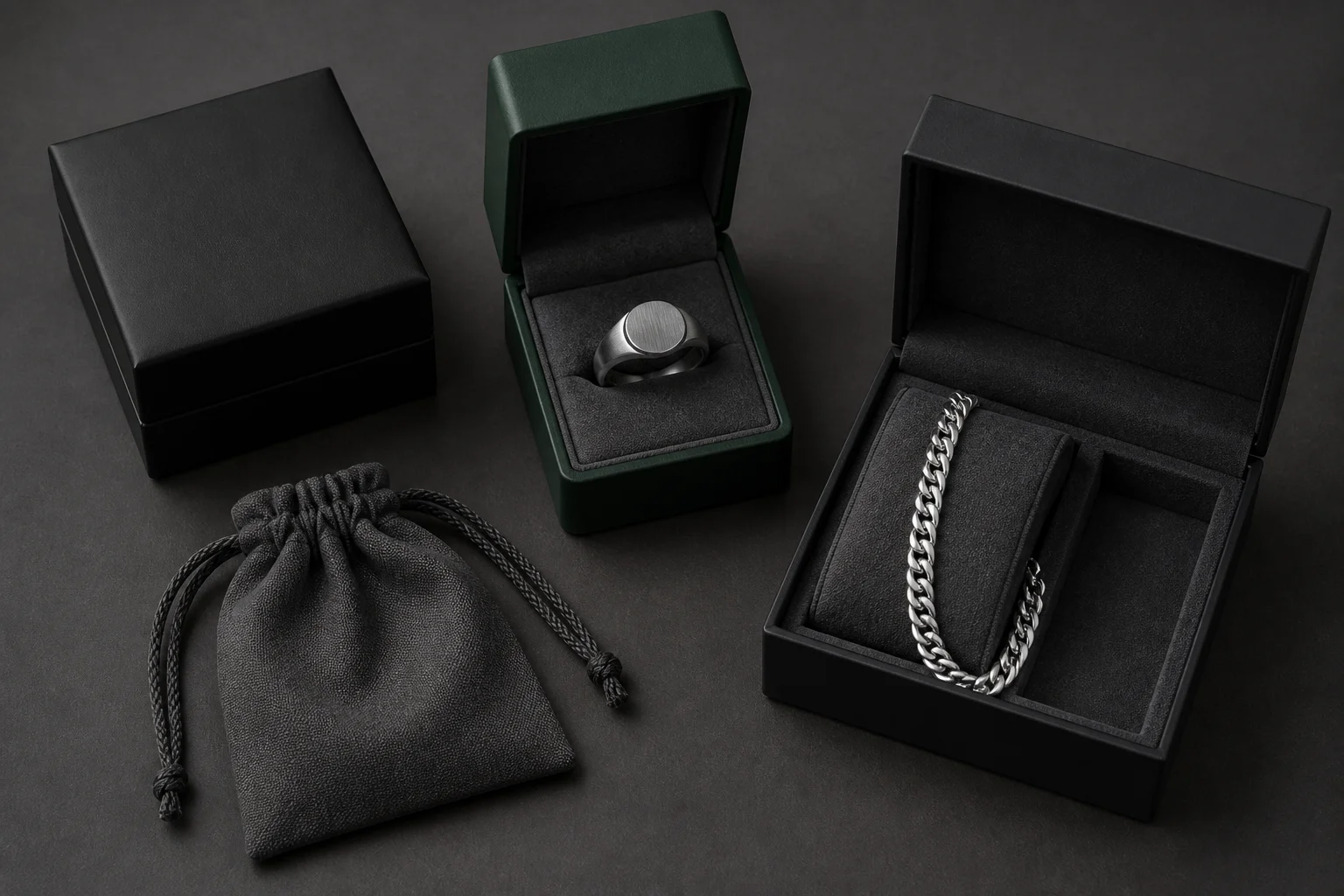
The working set for a men's line — rigid box, signet insert, watch-and-jewelry format, and a pouch for the lower tiers
Men's jewelry packaging is the set of box, insert, pouch and closure formats specified for jewelry made and merchandised for male wearers. It is not a separate material science; it is a different specification. The pieces are usually larger and heavier than the ring-and-pendant core of a women's line, and the presentation register leans matte rather than glossy.
What makes the category worth its own specification is the buying route. When a piece is chosen in a store, the counter does part of the selling. When it is chosen from a photograph, the men's jewelry box does all of it: opening sequence, interior contrast and the way the piece sits in the insert are the whole first impression.
Quick Answer: Specify men's packaging around load and format, not decoration. Choose a reinforced board grade for heavyweight chains, size the cavity to the piece laid flat rather than to a jewellery-type default, rate the closure for the weight it will carry, and keep the insert material matte so plated and oxidised finishes read correctly. One format set — a deep rigid box, a watch-and-jewelry configuration, a travel case and a pouch — usually covers a full men's capsule.
A women's-line brief and jewelry packaging for men differ in four places, and all four surface in the first sample round.
Weight, not delicacy. A heavyweight link chain or a solid cuff loads the lid, the hinge and the insert in a way a fine chain never does. A closure that holds a pendant can fail under a chain, so the specification has to name the load, not just the format.
Cavity depth. Chains take up area and a signet ring with a raised face needs depth; a shallow tray built for stacking fails twice, once on clearance and once on the lid closing over the piece.
Finish register. Matte board, soft-touch lamination, dark suede interiors and blind debossing do the work that gloss and bright foiling do elsewhere. A jewelry box for men rarely needs a bow, and adding one reads as a gift-shop default.
The watch pairing. A large share of men's buying is gifting, and the gift is often a watch, which makes a watch and jewelry box a mainstream format here rather than a specialist one.
One consequence of the channel shift is easy to miss: the jewelry box men buy for themselves is often chosen from a photograph and opened after delivery, so the specification has to work without anyone adjusting the insert at a counter.
Brand Background: The evidence is documented third-party research rather than a single order: a 2025 YouGov survey of British men who buy jewellery for themselves, a 2024 survey of 1,002 men in the United States, and market estimates published by Polaris Market Research, Prophecy Market Insights and Grand View Research.
The Packaging Challenge: Two documented findings collide with the template most brands inherit. The first is channel: 47% of British male self-purchasers said they bought mostly or entirely online, against 35% who usually bought in person, so the box carries the presentation role a salesperson used to carry. The second is the piece: the categories men buy most are chains, signets and watches, which are heavier and larger than the ring-and-pendant formats a women's line is built around.
The Procurement Decision: A brand entering the segment typically starts with a three-to-five design capsule, so the format decision is made once and must carry everything: a cavity deep enough for a heavyweight chain, a closure that keeps its hold under load, and an insert that holds a signet upright without gripping the shank.
The Solution: The documented pattern argues for a narrow format set. In Britain, chains or necklaces led male self-purchases at 33%, just ahead of watches at 32%, with bracelets at 24%, fashion rings at 22% and earrings at 21%. In the United States, regularly worn pieces rank watches and wedding rings first, then chains, then bracelets and non-wedding rings. Engagement concentrates among younger buyers: 24% of British Gen Z men had bought jewellery for themselves in the previous year, against 17% of Millennials and Gen X and 14% of Baby Boomers.
Measurable Results: Men's-only estimates for 2024 range from $35.87 billion to $48.56 billion, and a triangulated planning range for 2026 sits near $42–$59 billion. A broader men end-use slice ran $97.51 billion in 2025 and is forecast at $140.10 billion by 2033, with men named the fastest-growing end-use group.
The reading is not that the segment needs a different kind of box. It needs the same box specified for weight, and for a buyer who never touches it before it is opened.
Four formats cover most men's briefs, and each fails in a predictable place.
Format | What it carries | Specification that decides it | Where it fails |
|---|---|---|---|
Deep rigid box with fitted insert | Signets, cuffs, heavy bracelets, single chains | Cavity depth, insert hardness, hinge rating | Lid closing onto a raised signet face |
Watch and jewelry box | Watch on a cushion, plus chain or cufflinks | Cushion compression, well separation, lid clearance | Cushion too firm for a clasp; pieces touching the second well |
Jewelry travel case for men | Multi-piece travel sets | Closure rating, divider count, crush resistance | Dividers collapsing in transit |
Pouch, fabric or suede | Entry tiers, secondary wrapping | Fabric weight, closure type, lining | Thin fabric printing through |
The watch-and-jewelry format carries the segment's gifting volume. A jewelry and watch packaging box is specified around two clearances: the cushion has to compress enough to hold a watch case without leaving the bracelet loose, and the second well has to sit far enough away that the two pieces cannot touch when the lid closes. Getting one right and the other wrong is the most common first-sample reject in this format.
Two more configurations belong in the format set. A mens jewelry set box with two wells does the work of two formats when a chain and a ring ship together, and a man jewelry storage box with a lift-out tray holds a collection kept at home; neither needs new board, only a different divider pattern.
Three failure modes account for most rework in this segment, and all three are specification gaps rather than manufacturing faults.
Failure | What was actually missing | How to specify it |
|---|---|---|
The lid will not close over the piece | No clearance figure between the piece's highest point and the lid's inner face | State the piece height, then add lining and insert thickness to get the required internal depth |
The closure lets go in transit | No stated load; the format was chosen on appearance | Name the weight and the closure's holding force, then test with the heaviest piece in the range |
The insert marks the finish | Insert material and hardness never named | Specify insert material, hardness and whether the contact surface is smooth or brushed |
One size question belongs in the drawing: a jewelry box for watches is dimensioned from the case plus the cushion, not the case alone, a watch and jewelry travel case from the longest piece it must carry, and a jewelry travel case for men from the largest configuration it must hold rather than its most common one.
Advantages of specifying a dedicated men's format set:
One tooling investment covers a whole capsule: a deep rigid box with a fitted insert handles chains, cuffs and signets without a format per piece type.
Heavier pieces are protected on the transit leg, since the specification is written around load rather than appearance.
The format set does the presentation work a store counter would otherwise do, which matters most for the digital-first share of this segment.
Drawbacks to plan for:
Depth and load cost material: a taller board grade, a stronger closure and a thicker insert all move unit cost and carton volume.
Matte finishes show handling marks more readily than gloss, so the packing standard has to be tighter.
A narrow format set is efficient but inflexible; an unusually long chain still needs a one-off insert and its own tooling.
The decision usually comes down to volume against range breadth. The two formats that most often justify custom tooling are the deep rigid box and the watch-and-jewelry configuration.
Route | Best when | Trade-off |
|---|---|---|
Stock format, printed | Testing the segment; a short seasonal run | Sizes and insert shapes are fixed |
Custom insert in a stock box | A defined piece mix close to a standard footprint | Cost sits in tooling; a design change means a new insert |
Fully custom format | A committed capsule or a signature opening | Highest entry cost, longest lead time |
Minimums follow the usual pattern. Logo printing on pouches and trays typically starts at 200–500 pieces, while custom-dyed or Pantone-matched materials run 1,000–5,000 and need a dye sample before production, with bulk production three to four weeks after approval. That is why size and quantity belong in one decision rather than two, and the wider framework sits in the 2026 B2B sourcing guide for small and growing brands.
For a brand testing the segment, the middle route is a custom insert inside a stock box: correct piece fit without the full tooling budget, upgradeable once the capsule is proven.
Q: Does a men's jewelry box need different materials, or only different styling?
A: Mostly the second, with one exception. Board and lining materials are the same family used across jewelry packaging; only the board grade and the surface finish change. The genuine change is the insert, which has to support a heavy chain while leaving a plated or oxidised surface unmarked.
Q: Is a watch and jewelry box worth tooling for a small brand?
A: It depends on how much of the range is gifting. Where a watch is a common accompanying purchase, the format carries two pieces in one pack and beats shipping two boxes. Where the range is mostly chains and rings, a deep rigid box with an interchangeable insert covers more of the catalogue for the same spend.
Q: How should a brand size a jewelry travel case for men?
A: From the largest configuration it must hold, not the most common one. Measure the longest chain or widest cuff, allow for dividers, then confirm the external footprint still fits the carton and the pallet. Under-sizing by a few millimetres is the usual error, and it cannot be corrected once the divider pattern is tooled.
Q: Can one insert serve a man jewelry storage box and a travel case?
A: Rarely, because the two formats load the piece differently. A storage box holds pieces still and can use a shallow fitted well; a travel case must keep them still while the case moves, which needs compression or a deeper well with a lip. One insert serves both only where the piece mix overlaps almost exactly.
Men's jewelry packaging is specified around load, format and buyer route rather than around colour. The pieces that carry this segment — chains, signets, cuffs and watches — are heavier than the ring-and-pendant core most packaging is built for, which pushes the specification toward a deeper cavity, a stronger closure and an insert that supports without marking. The buying route pushes it a second way: with a large share of male self-purchasers ordering online, the box has to present the piece on its own, without a counter or a salesperson in the loop. Third-party research on the segment points the same way, showing a narrow set of high-volume categories, the strongest engagement among younger buyers, and a channel mix that keeps moving toward direct and online retail. Practically, that means one tooling decision covering a deep rigid box, a watch-and-jewelry configuration, a travel case and a pouch, with the load, insert material and clearance figures written into the specification before tooling starts.
Utouch Packaging produces custom jewelry packaging that can be specified around this framework — rigid boxes, fitted inserts, watch-and-jewelry formats, travel cases and fabric pouches — with the board grade, closure rating and insert hardness confirmed before production. For wholesale and custom enquiries, visit the Utouch Packaging contact page or reach the export team through Xiamen Yu Touch Imp. & Exp. Co., Ltd.
