
Views: 0 Author: Site Editor Publish Time: 2026-09-27 Origin: Site


Article Intro: A jewelry travel case is normally specified by size, colour and compartment count, while the forces it will meet are never written down. Two published distribution studies have measured those forces: how often a shipment is dropped, from what height, onto which face, and how much vibration reaches a package depending on its position in a load. This guide converts those measurements into the lines a travel case specification actually needs.
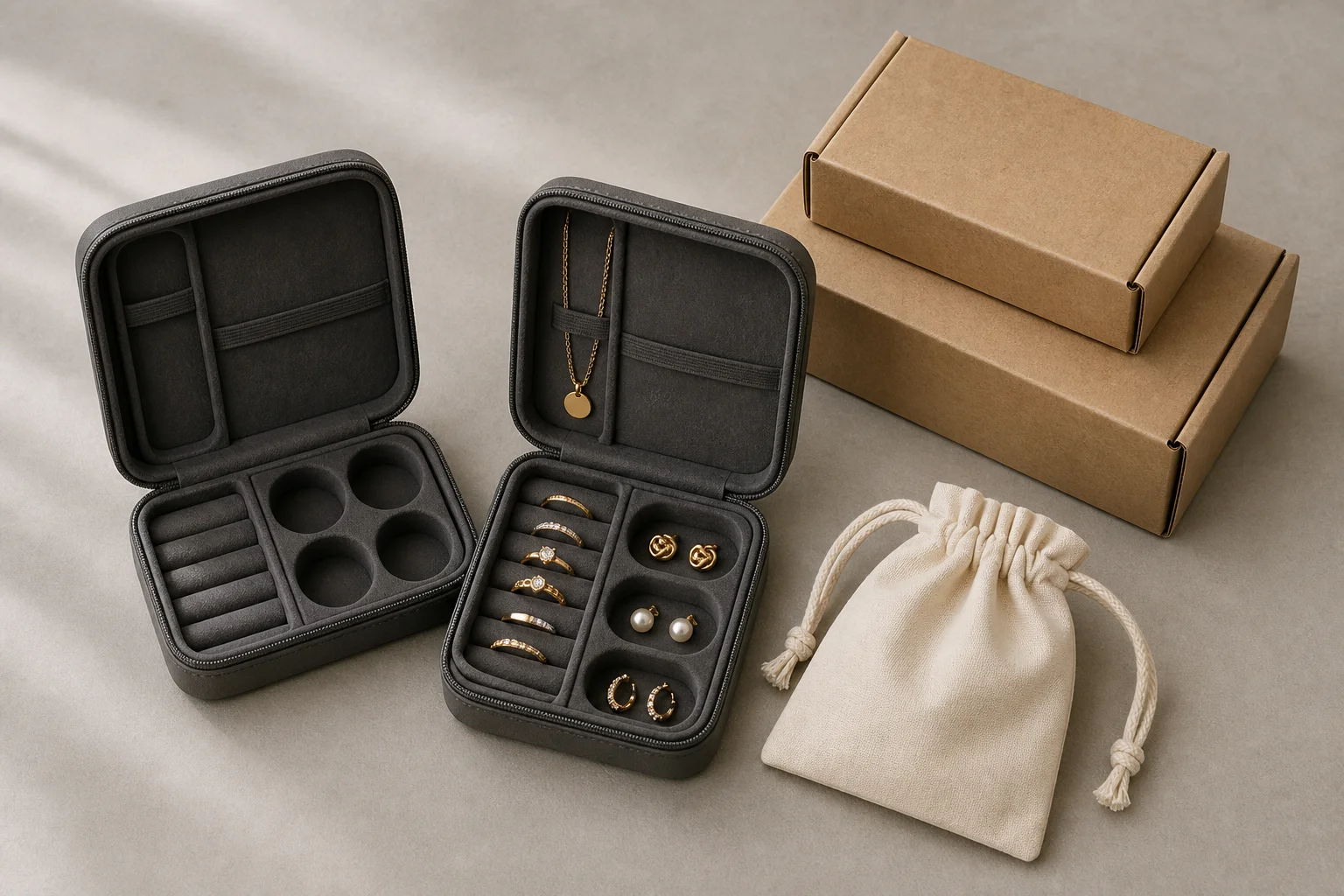
Retention, void and the carton the case travels in — the three variables a specification has to settle
A jewelry travel case is a rigid or semi-rigid container built to carry jewellery outside the home, proportioned to fit a handbag, a carry-on or a coat pocket. Its defining property is not its shape but its retention: every piece occupies a defined position and stays there while the case changes orientation.
A retail box is opened once. A case travels inside a bag that is inverted, compressed and dropped, and a jewelry travel box within it takes those loads with the bag: one is judged at the moment of opening, the other over the whole journey.
Protection therefore has to come from how the contents are held: a compact travel jewelry box for a weekend and a luxury jewelry travel box shipped as a corporate gift meet the same mechanics, and differ only in finish and compartment count.
Quick Answer: Specify retention, then clearance, then finish. Each piece seats in its own cavity under tension, the shell carries the load rather than the contents, and the closure is chosen for the faces that actually get hit. Test the case loaded, at the height the measurements indicate, before approving the first run.
The values below come from two published studies: a parcel-van vibration measurement and a ground-shipment study using drop-height recorders. Both were run so measured conditions could be reproduced in laboratory testing.
Measured drop behaviour | Plain shipper | With a precautionary label | Inside a corrugated box |
|---|---|---|---|
Recorded drops above 7.62 cm, one route | 95 | 104 | 165 |
Average drop height | 0.23 m | 0.24 m | 0.27 m |
Height covering 90% of events | 0.56 m | 0.42 m | 0.56 m |
Height covering 95% of events | 0.70 m | 0.64 m | 0.77 m |
Height covering 99% of events | 1.02 m | 1.67 m | 0.99 m |
Two findings are uncomfortable. Handling labels changed nothing measurable, and putting the item inside a second box did not reduce handling: the boxed shipments averaged 18 drops per one-way trip at 0.30 m against 10 drops at 0.23 m.
Impact direction matters as much as height. Unboxed items were dropped 60% on the sides and 40% on the bottom; boxed items were spread as 34% side faces, 28% edges, 22% bottom and 16% corners. Edges and corners, where a latch releases and a hinge takes its load, were 44% of boxed impacts.
Measured vibration | Van floor | Top layer of a three-layer load |
|---|---|---|
Vertical level relative to the floor | 1.00× | 1.21–1.51× |
Lateral level relative to the floor | 1.00× | 1.44–2.81× |
Vertical events below this level, 50% of the time | 0.37 g | 0.48 g |
Lateral events below this level, 50% of the time | 0.18 g | 0.45 g |
Highest recorded peak | 0.13–0.18 g typical | 4.16–5.94 g lateral, 3.99 g vertical |
Its most intense vertical vibration fell between 8 Hz and 50 Hz, amplified the higher a package sat in the stack and the more room it had to move, and transmissibility in the top layer peaked at 11.9 times the floor input. Recorded events were non-Gaussian, with kurtosis between 1.18 and 6.76, so occasional peaks rather than any average are what a specification must survive.
Brand Background: The evidence is documented third-party distribution research rather than a single order. One study measured vibration in stacked parcels carried in delivery vans, from Széchenyi István University's Department of Logistics and Forwarding, published in Applied Sciences in November 2020. The other measured shocks in single-parcel ground shipments, from the School of Packaging at Michigan State University with Cal Poly, published in Packaging Technology and Science in 2009.
The Packaging Challenge: A case can only be specified against the forces it will meet, and those forces are invisible on a purchase order. Protection is described in adjectives — sturdy, hard-shell, shock-proof — while the environment is a set of measurable heights, accelerations and directions, so the case ends up heavier than it needs to be or untested where it matters.
The Procurement Decision: Both studies instrumented real shipments with tri-axial recorders. The van study built three-layer stacks with free movement space set at 0%, 10% and 20% and measured every layer against the vehicle floor; the parcel study shipped instrumented pails with and without an outer corrugated box and with and without precautionary handling labels, then analysed drop heights, orientations and counts.
The Solution: Both environments proved position-dependent: vibration rose with stack height and free movement space, reaching 1.21–1.51 times floor level vertically and up to 2.81 times laterally, with 50% of vertical events above 0.37 g on the floor but above 0.48 g in the top layer. Drop events clustered well below the maximum, with a long tail of heavier impacts.
Measurable Results: Three results bear directly on a specification. Handling labels changed nothing. An outer box did not reduce handling: boxed shipments recorded 18 drops per one-way trip at 0.30 m against 10 drops at 0.23 m, an 80% increase in drop count at a 25% higher average height, with 44% of boxed impacts on edges and corners. And because the environment amplifies with position and free movement rather than averaging out, the useful figure is the occurrence band — 0.56 m for 90% of events and 1.02 m for 99%, not a single nominal height.
That is the argument for writing the environment into the brief: a case approved without a test height has been approved against an assumption.
The van study's controlling factor was free movement space — how much room a package had before it hit something. Inside a case the same variable exists as air. A jewelry bag organizer with correctly cut cavities gives a piece almost no travel; one large open compartment gives every piece the full width of the box.
Retention should therefore be designed per piece rather than per case. A necklace channel needs enough tension to stop a chain sliding, ring slots should hold a band without deforming it, and earring wells need depth so a post cannot reach the closing face. Cavities should also not be shared, because two pieces in one pocket arrive against each other on every impact.
Soft formats solve the same problem differently. A travel jewelry pouch or a portable jewelry box with sleeves holds contents against each other rather than in defined positions, which suits a chain or a pair of studs and nothing with a stone or a clasp. An organised soft case sits between the two: fabric body, defined sleeves inside. Someone ordering a carry jewelry bag is ordering sleeves rather than structure, and buyers often count sleeves assuming they retain the piece.
Once the environment is measured, the specification stops being a list of adjectives and becomes a set of testable lines.
What the measurement shows | What belongs in the brief |
|---|---|
Impacts concentrate on sides, edges and corners | Closure and hinge rated for the tested faces, not for the bottom alone |
Height covering 90% of events sits near 0.56 m | A stated loaded drop height, with orientation, rather than "drop tested" |
Outer boxes multiply handling events | Carton and inner packing designed together, since a shipper is not automatic protection |
Vibration amplifies with free movement and stack position | Per-piece cavities and insert tension, plus a carton spec for the position the case ships in |
Handling labels changed no outcome, and peaks far exceed typical values | Protection engineered into the case rather than requested on the outside, and acceptance stated as an occurrence level rather than an average |
The same lines apply whether the piece goes to a stockist or is carried by a customer. They are also what separates a custom jewelry travel case with logo from a generic one, because the branding is the easy half of the order and any configuration the buyer draws can be produced; the sequence from brief to approved sample is set out in the custom jewelry packaging wholesale sourcing guide.
Both studies were run so that measured conditions could be reproduced in a laboratory. The checks below follow from the numbers above and give a buyer something verifiable before a run is approved.
Check | How it is run | What failure looks like |
|---|---|---|
Loaded drop | Case filled with the real collection, dropped on face, edge and corner from the occurrence height in the brief | Closure releases, hinge deforms, contents leave their cavities |
Inversion hold | Closed case inverted and held, then shaken gently | Any audible movement means free travel inside the case |
Vibration exposure | The case run against the measured profile band with the load it will ship in | Fasteners loosen, chains migrate between compartments |
Cavity fit | Each piece seated and photographed before approval, as in any insert-led order | A piece that needs pushing in will press on its neighbour instead |
None requires a new supplier capability, but all require the buyer to name a collection and a height. That is why travel cases are under-specified: the environment is knowable, and nobody writes it down.
What measuring the environment buys:
Protection stops being a claim and becomes a test result at a stated height and orientation.
Weight and wall thickness can be argued from occurrence levels rather than appearance.
Insert design is settled once against a known collection, then reused across the range.
What it costs:
A measured brief needs a real collection to load the case with, which delays the first sample.
Per-piece cavities add insert tooling and make the case specific to one range.
Occurrence-based acceptance rules out the cheapest shells for anything with a stone.
Soft formats such as a jewelry travel pouch cannot meet the same criteria by design, so a range has to be specified in tiers.
Q: Does putting a jewelry case inside a box protect it?
A: It changes the risk rather than removing it. In the measured shipment, boxed items recorded 80% more drops at a 25% higher average height than unboxed ones, and 44% of those impacts landed on edges and corners. A carton is part of the protection system and has to be designed with the case.
Q: What drop height should a travel case be tested to?
A: Start from the recorded distribution, not a round number. In the study used here, 90% of events fell at or below 0.42–0.56 m and 99% at or below roughly 1.0 m. The 90% band is a reasonable first gate for a carry case; anything with a stone or a rigid frame needs the higher band.
Q: Is a hard case always better than a soft one?
A: No. A hard case earns its weight through clearance, because the shell takes the load so the contents never do, and it loses that advantage if the interior lets pieces move. The soft formats listed as jewelry bags for travel cannot offer clearance at all, but they are lighter and suit pieces that cannot be crushed.
Q: How many compartments should a travel case have?
A: Enough that no two pieces share a cavity, which is usually fewer than buyers expect, since more compartments add size and weight. The retention inside each cavity matters more than the total.
Jewelry travel cases are a retention problem with a transport problem attached. Published distribution studies show what the transport side contains: drops concentrated on sides, edges and corners, average heights near a quarter of a metre, occurrence bands reaching roughly half a metre for most events, and vibration that grows with stack position and free movement rather than averaging away. Handling labels changed nothing, and an outer box increased recorded drops rather than reducing them. The practical conclusion is narrow: name a test height, name the orientation, design the interior so no piece has room to travel, and treat the carton and the case as one system.
Utouch Packaging produces jewelry travel cases and the soft formats that sit beside them, specified around this framework — per-piece insert cavities, declared drop and vibration testing, closure and hinge selected for the faces that take the impact, and cartons designed with the case. For wholesale and custom enquiries, visit the Utouch Packaging contact page or reach the export team through Xiamen Yu Touch Imp. & Exp. Co., Ltd.
