
Views: 0 Author: Crow Wang Publish Time: 2026-01-22 Origin: Site


Article Intro: A brand that sells a piece usually ends up selling something to keep it in, and the three formats that carry that job - the lidded storage box, the roll and the tray - are constantly treated as one product with different shapes. They are not. Each solves a different failure: the box keeps dust and light off, the roll keeps chain from tangling in transit, and the tray keeps a collection visible and countable. This guide separates the three by what they are asked to prevent, sets out the dimensions that decide whether each works, and leaves the gift-box question to the articles that already cover presentation.
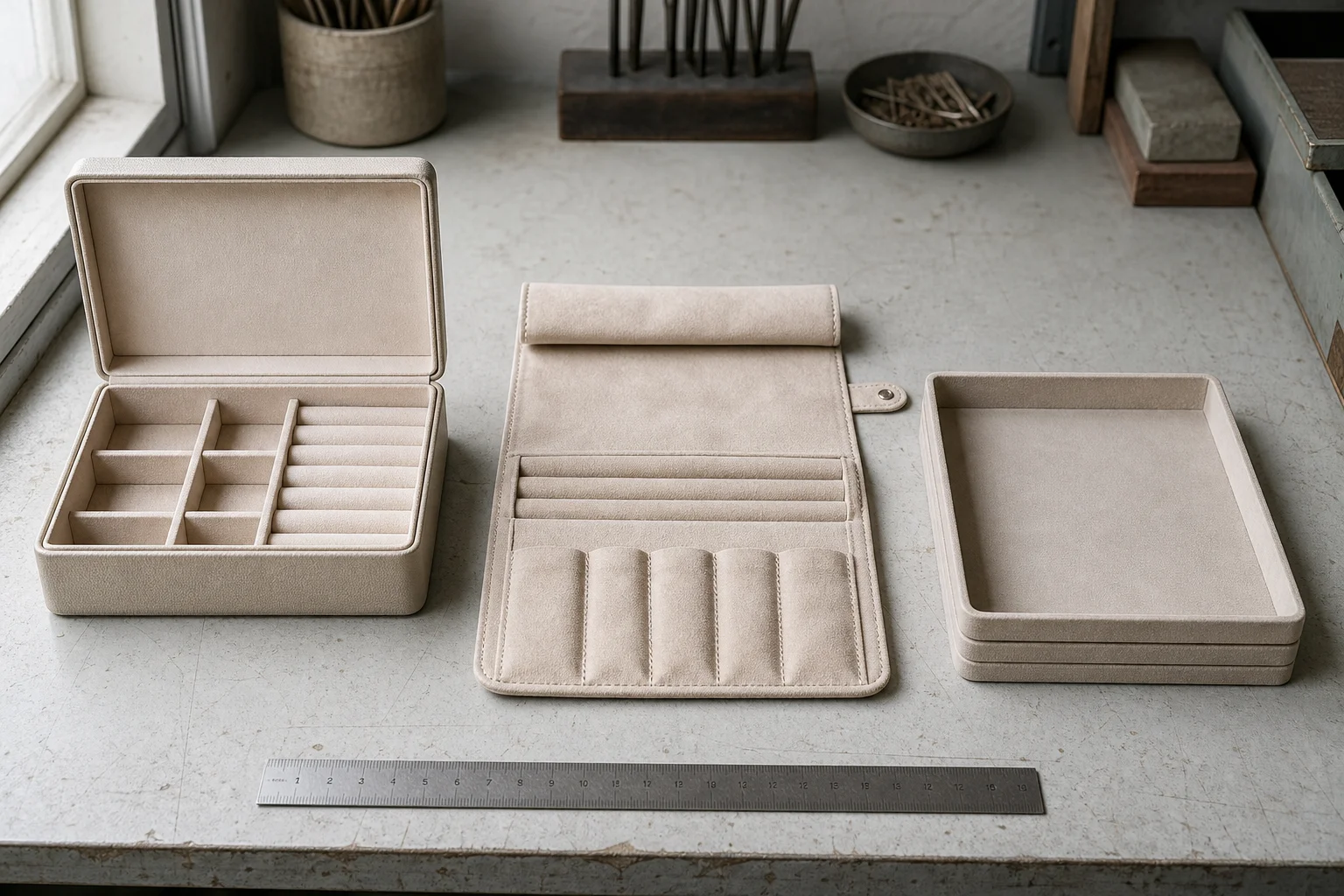 Three formats, three different jobs: a divided box, an open roll and a shallow tray.
Presentation packaging is opened once, in front of a customer, and then usually discarded. Storage packaging is opened repeatedly, kept for years and judged by whether it still does its job. That difference changes almost every specification decision.
Quick Answer: A presentation box is judged on the first ten seconds; a storage box is judged on the tenth year. That is why a storage format needs a closure that survives a thousand cycles, a lining that does not shed onto the contents, and dimensions that leave the piece room to be taken out rather than levered out.
Three clarifications belong here. Storage formats are sold to consumers, which means the brand is buying them as a resale item rather than as packaging cost, and they carry a different margin expectation. They are also shipped as products, so their own packaging has to survive transit, which is a requirement a gift box never faces. And a storage format that looks handsome but cannot be opened one-handed will not be used, whatever its specification says.
A lidded storage box does four things: it excludes dust, it excludes light, it buffers humidity change, and it prevents physical contact with other objects. Of those, light exclusion is the one buyers underestimate.
Silver darkens faster under ultraviolet and visible light, and a piece left on an open tray by a window will tarnish on a schedule set by the window rather than by the metal. A closed box removes that variable, which is why a plain box outperforms an elegant open tray for long-term storage even though the tray is better for daily use.
The failure that matters is the hinge or the lid interface. A storage box is opened far more often than a gift box, and a paper hinge that would last a season of retail will fail in a year of daily use. That is the argument for a rigid construction with a separate lid over a folding carton with an attached one.
A roll exists to stop chain tangling, and it does that by keeping each strand on its own radius. Everything else about a roll - the fabric, the closure, the number of pockets - is secondary to whether the spacing is right.
| Roll feature | What it controls | Where it fails |
|---|---|---|
| Pocket spacing | Whether strands can reach each other | Spacing set by fabric width rather than by chain gauge |
| Pocket depth | Whether a clasp stays covered | Deep enough for a chain, too shallow for a pendant |
| Roll diameter | The curvature a chain is held at | Too tight a radius sets a kink in stiff wire |
| Tie or snap closure | Whether it stays closed in a bag | Ties loosen; snaps fail at the fabric |
| Outer fabric | Abrasion against other luggage | Smooth fabric slides and the roll opens |
The third row is the one that generates complaints. A heavy curb chain rolled tightly takes a set and will not hang straight afterwards, and the customer blames the chain. A roll sized for the heaviest piece in the collection solves it at the cost of bulk.
A tray is the only one of the three that is a working tool rather than a container. It exists so that a collection can be seen, counted and reached, which is why trays dominate at retail counters and in a photographer's kit and are rare in a home.
That working role sets the specification. A tray has to be shallow enough to reach into, compartmented enough to keep pieces apart, and stable enough to be lifted full. Depth is the parameter that decides whether it works: too shallow and rings roll across compartments, too deep and fingers cannot get under a chain.
Stackability is the second requirement and the one that is usually designed in last. A tray that stacks badly wastes the vertical space that made it worth using, and a set of trays bought as a system will often be sold with a lid that turns the stack into a single box.
| Storage box | Roll | Tray | |
|---|---|---|---|
| Primary job | Exclude dust, light and contact | Prevent tangling | Make a collection visible |
| Best for | Silver, pearls, pieces worn occasionally | Chains, bracelets, travel | Retail counters, daily wear |
| Weak against | Daily access; hinges wear | Heavy chain taking a set | Dust and light |
| Key dimension | Internal depth against the tallest piece | Pocket spacing and roll diameter | Compartment depth and reach |
| Lifecycle | Years, opened often | Years, opened rarely | Constant handling |
Read across the "weak against" row and the commercial answer becomes obvious: the three are complements, not competitors. A brand that sells one usually sells the other two to the same customer within a year.
What this section is. The account below is a completed order recorded in our own sales records, not a published study. Figures are the values visible in that record.
A US customer ordered 800 storage boxes and 2,400 paper bags in the same cycle. The two lines had nothing in common except the customer, which is precisely why they were consolidated: the boxes were the product and the bags were the wrap, and shipping them together removed a second freight movement, a second set of documents and a second arrival to schedule.
The order closed at USD 388 for the recorded lines and turned into a repeat pattern. The customer's requirement was not a better box; it was a simpler supply chain, and the record notes that the combined shipment reduced handling and increased the likelihood of the next order.
What the record preserves is a point that applies to every storage program: a brand buying storage formats is buying a range, and a supplier who can ship the range together is solving a problem the buyer has and rarely names. It also records the practical detail that the freight saving from consolidation was larger than any achievable reduction in unit price on either line.
Storage formats are bought by external size and fail by internal size, and the gap between the two is where most return requests originate.
| Measurement | What it must be set against | Typical error |
|---|---|---|
| Internal depth | Tallest piece standing, plus lid clearance | Measured from a flat-lying piece |
| Compartment size | Longest item plus finger access | Sized to the item exactly |
| Roll pocket length | Chain length divided by usable turns | Set to the fabric width |
| Tray stack height | Total of loaded depths plus lid | Summed from empty trays |
| External size | The shelf or drawer it must fit | Assumed from the internal need |
The second row explains a common complaint that sounds like a quality problem and is not. A compartment sized exactly to a ring cannot be reached into, so the customer tips the tray rather than lifting the ring, and pieces migrate between compartments. Two or three millimetres of clearance is what makes a tray usable.
A storage format spends its life being handled, which puts different demands on a surface than a gift box does.
| Surface | Why it suits storage | Where it disappoints |
|---|---|---|
| Coated paper board | Wipes clean; holds a rigid edge | Corners bruise with handling |
| PU leather wrap | Resists scuffing; wipes clean | Can crack at a fold over years |
| Flocked interior | Soft contact; holds pieces in place | Sheds onto contents if unfinished |
| Uncoated kraft | Absorbs moisture; cheap | Marks with handling; not wipeable |
| Fabric exterior | Quiet, tactile, forgives scuffs | Absorbs spills; hard to clean |
The last two rows matter for the same reason: a surface that absorbs is comfortable in the hand and impossible to clean, and a storage object that cannot be wiped will look worn long before it fails.
The ordering question is not which format is best but which one a customer will buy alongside a piece they have just purchased.
A single storage box sized for the piece just sold is the easiest first item, because it is the one the customer already understands. A roll is the second, because chain buyers discover tangling immediately. A tray is the third and usually sells to people who already own a collection rather than to first-time buyers.
That sequence also sets the production order. A box in one or two sizes can be run as a stock item; rolls multiply by pocket count; trays multiply by compartment layout and are the most expensive to hold in depth. Starting with a box and adding formats as the range matures keeps tooling and inventory aligned with actual demand.
A storage format that is looked after will outlast the piece it was bought for, and three habits cover most of the difference. Keep it out of direct light, because the exterior fades before the structure fails. Do not store it in a bathroom, where humidity cycling attacks both the board and the plating on the contents. And open it rather than forcing it, since most lid and hinge failures begin with a customer pulling a stuck lid.
For the interior, brush rather than wash. A flocked or fabric lining that has collected fibre can be cleared with a soft brush, and water will generally make the problem worse by driving dust into the pile.
Is a storage box the same as a gift box? No, and the difference is in the closure and the lining rather than the look. A storage box is opened thousands of times over years and needs a lid interface that survives that; a gift box is opened once and is judged on appearance.
Why do chains kink in a roll? Because the roll diameter forces the chain to hold a curvature, and a stiff wire link takes a set at a tight radius. A larger roll, or a pocket that holds the chain straighter, removes the problem at the cost of bulk.
How much clearance should a compartment have? Enough to get two fingertips under the piece. Sizing a compartment exactly to the item makes it look precise and makes the tray unusable, because the customer tips the tray instead of lifting the piece.
Can one format cover everything? No. The three formats solve three different failures, and a brand that offers only one will find customers buying the missing two elsewhere. A box is the right first product; rolls and trays follow as the range matures.
Storage boxes, rolls and trays are three answers to three failures: dust and light, tangling, and invisibility. Judging them on appearance conflates them with gift packaging and leads to specifications that look right and fail in use. Set internal dimensions against the tallest and longest piece rather than against the item as it lies flat, leave fingertip clearance in any compartment that has to be reached into, and choose a closure that survives repeated opening rather than a first impression. Where a brand stocks a range, consolidating the formats into one shipment saves more than any unit-price negotiation on a single line, and building the range in the order customers discover the need - box, then roll, then tray - keeps tooling and inventory aligned with demand.
Jewelry storage boxes, rolls, trays and the gift packaging they sit beside are produced by Utouch Packaging. Compartment and insert construction is set out in the jewelry packaging sets sourcing guide, and a format-level view of how boxes and trays are specified together is in the custom jewelry packaging sourcing guide. A range can be quoted through the contact page. Storage and gift programs are also listed with Xiamen Yu Touch Imp. & Exp. Co., Ltd.
