
Views: 0 Author: Site Editor Publish Time: 2026-09-19 Origin: Site


Article Intro: Jewelry shipping packaging is the layer most brands specify last and regret first. The retail box is designed to be seen; the transit pack is designed to survive, and the two jobs pull in opposite directions. This guide covers the transit layer on its own terms: the formats that carry jewelry, what damages a shipment, and how chargeable weight, DDP terms and the retail box should be specified together.
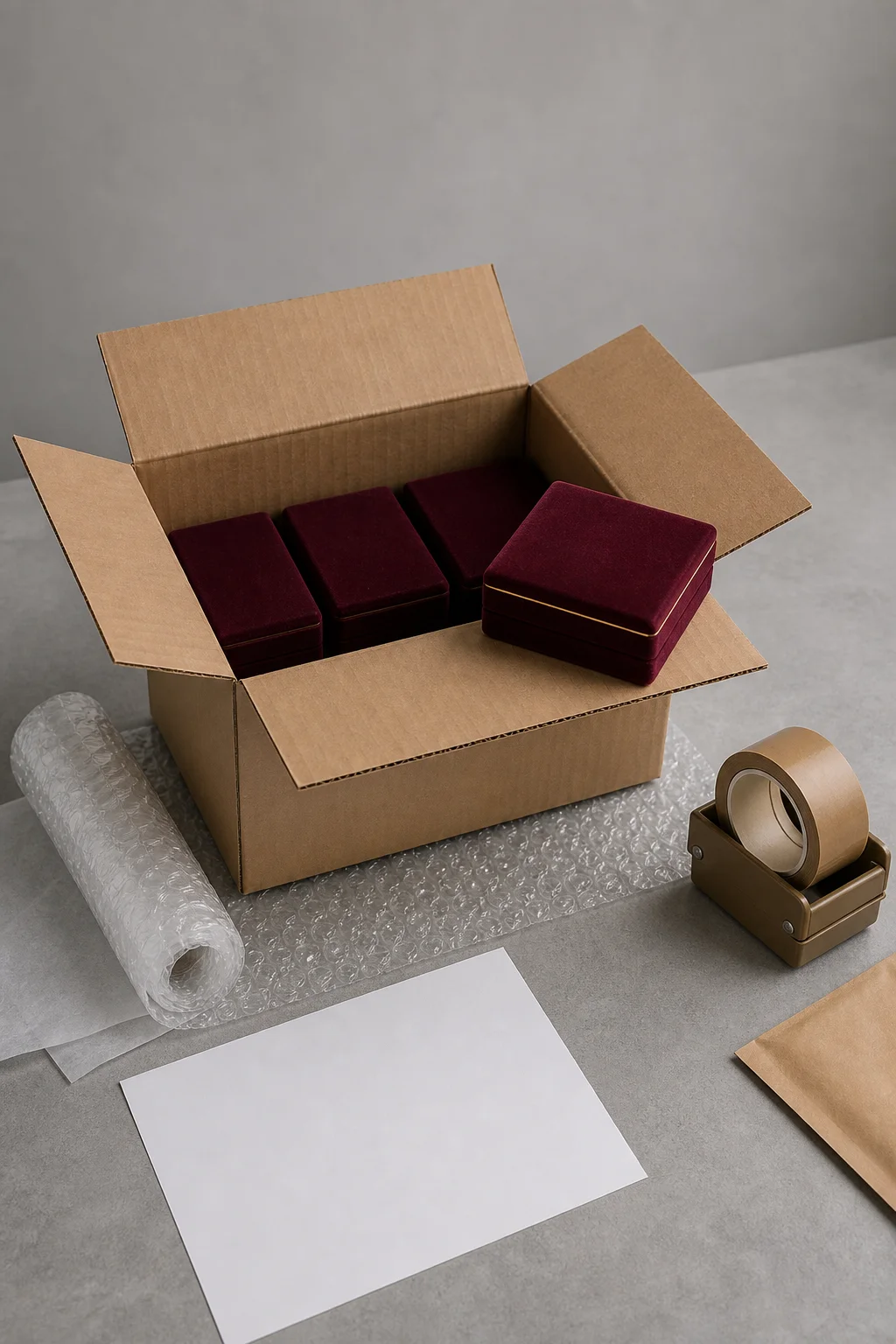
The transit layer at the packing table — retail boxes nested in a plain corrugated carton with bubble wrap, tape and a blank packing sheet
A shipping box for jewelry is the outer container that carries the retail presentation to the customer, and it is judged by different criteria: stacking strength, void fill, moisture protection and clearance risk. Jewelry delivery packaging therefore has two layers normally bought as one decision — the retail pack the customer keeps, and the transit pack the customer discards.
The transit layer covers corrugated cartons in single, double and triple wall, kraft and poly mailers, molded pulp trays, void fill, tamper-evident seals and inner bags for pieces that ship without a box. The retail layer stays as it was: rigid boxes, pouches, sleeves and inserts.
Quick Answer: Jewelry shipping packaging should be specified from the outside in. Decide the carton, the void fill and the closure first, because those three determine whether the parcel survives; then size the retail box to the carton so the two fit without gaps that let boxes shift; only then settle the presentation. A parcel that arrives intact converts better than a beautiful box that arrives dented.
Six formats cover almost every jewelry shipment, and each answers a different failure mode. The cost column is relative, not a quoted price.
Format | Best for | Weak point | Relative cost |
|---|---|---|---|
Kraft mailer, single wall | Flat pouches and sleeves, low-value orders | Little crush resistance; needs a rigid inner board | Lowest |
Corrugated carton, double wall | Boxed pieces and mixed orders | Only as good as its void fill | Low |
Carton with fitted insert | Sets and multi-piece orders | Needs a die cut per box size | Moderate |
Molded pulp tray | Heavier pieces, plastic-free programmes | Tooling per cavity; less precise than foam | Moderate |
Air pillows and paper fill | Filling the top void in any carton | Compresses under load; no lateral grip | Low |
Fitted foam or EVA insert | High-value pieces, fragile settings | Highest unit cost; slowest to pack | Highest |
One design point is a rule: void fill protects against movement, not weight from above, while compression strength protects against weight but not movement. A jewelry shipping containers unique box design that solves only one of the two problems still fails.
At typical 2026 factory quotes a plain three-layer corrugated box lands near $0.23-$0.25 per unit, a printed shipping box around $0.45-$0.88 at a 1,000-piece minimum, and a custom rigid retail box $1.60-$2.10 at the same quantity (typical 2026 figures). The transit layer is normally the cheaper half of the bill, which is why cutting it rarely delivers the saving it looks like.
Brand Background: The buyer is a U.S.-based online jewelry retailer selling direct to consumers through its own storefront and a marketplace channel. Restocking is small and frequent: single pieces ship daily in retail boxes, while replacement stock is consolidated into batched air shipments of modest value. The consignment carried an invoice value of $318.
The Packaging Challenge: Two things created friction before the goods moved. The air quote used chargeable weight, which takes volumetric rather than scale weight, so it did not match the buyer's estimate from the carton dimensions. And under the agreed DDP terms the buyer expected a waybill number on the day of dispatch, while the waybill is only generated after customs clearance — a gap the buyer read as a shipment gone missing.
The Procurement Decision: Rather than restate the price, the supplier separated the quote into actual and volumetric weight, showed which governs the charge and why, then wrote the DDP sequence as a timeline marking where the waybill number appears. The buyer kept the air shipment because the timeline had become predictable, not because the price had changed.
The Solution: The consignment was released on the agreed DDP terms with the milestone sequence fixed in writing before dispatch, so the buyer knew when to expect the waybill number and when delivery would arrive.
Measurable Results: The $318 order shipped under the original terms with no re-invoicing and no chargeable-weight dispute, and the buyer's expectations were corrected before the goods moved rather than after arrival. For a restocking account ordering in small batches, the practical value was that the air route stayed usable without a monthly argument about the invoice.
The pattern generalises beyond this order. When a shipment is questioned, the useful response is rarely a discount; it is a line-by-line explanation of how the number was built and a written sequence for everything the buyer cannot see.
Damage claims cluster around five causes, and only one is about impact.
Movement and abrasion. A box that slides inside its carton rubs against its neighbours for the whole journey; fitted inserts and a snug carton solve this, loose void fill does not.
Tarnish and moisture. Humidity plus airborne sulphur dulls silver, and a sealed plastic bag traps the moisture already inside it. Anti-tarnish tissue or a desiccant does more than another layer of bubble wrap.
Compression. Parcels are stacked, the bottom carton carries the load, and single-wall cartons with a full void arrive crushed.
Pilferage and tampering. Small, high-value parcels are the ones that disappear, so opaque outer packaging and tamper-evident tape matter.
Presentation damage. An intact parcel can still arrive with a scuffed lid, because the retail box was allowed to touch the carton wall directly.
The remedy is structural: a retail box that cannot move, a carton sized to that box rather than a round number, and a gap filled with something that does not collapse.
Most jewelry packaging moves by air, but the same carton is priced differently on each route.
Air freight advantages:
Speed against a launch date. Weeks rather than months, which makes it the default for restocking and gifting.
Lower damage exposure. Fewer handling cycles than an ocean container, and less time in damp conditions.
Simpler cash cycle. Stock arrives while the campaign that needs it is live.
Lighter packaging. A shorter journey tolerates a thinner carton.
Air freight drawbacks:
Chargeable weight rules. Light, bulky cartons are charged on volume, so a carton sized generously for presentation can cost more to move than its contents suggest.
Higher cost per unit at volume. The gap widens on bulk restocks, where a ready to ship jewelry box costs a fraction of the freight.
Capacity risk in peak season. Rates and space tighten exactly when gifting orders peak; global air cargo spot rates swung 41% year on year as recently as May 2026.
More customs touchpoints. Frequent small consignments mean more clearance events and more documentation.
Worked example. A 40 x 30 x 25 cm carton holds 30,000 cubic centimetres; divided by the 6,000 divisor used for air freight, its volumetric weight is 5 kg, and 5 kg is what is charged for even if the scale reads 2.5 kg. At the published 2026 Asia-North America range of $5.70-$7.50 per chargeable kilo, that carton moves for $28.50-$37.50, and twelve such consignments a year - 60 chargeable kilos - carry $342-$450 of freight (illustrative). The freight line can therefore be rebuilt from the carton dimensions before anything is packed.
The practical rule is to air-freight the presentation and sea-freight the volume: send retail boxes and pouches by air when they are needed against a date, and move plain components by sea in bulk — including the jewelry bag shipping element of a range, because a transit bag does not care how long the journey takes.
Shipment type | Retail layer | Transit layer |
|---|---|---|
Single-piece direct to consumer | Rigid box or pouch, tissue, card | Kraft mailer with rigid backing board, or a small double-wall carton |
Multi-piece gift order | Boxes with fitted inserts | Carton sized to the boxes, corner protection, minimal void |
Retail restock in batches | Boxes flat-packed or assembled | Double-wall carton, fitted tray, moisture barrier inside |
Marketplace intake | Retail box with barcode window | Carton meeting the channel's labelling and size rules |
Trade show or samples | Display-ready boxes | Hard case or double-wall carton with reusable inserts |
Two consequences follow. First, jewelry boxes ready to ship should be specced at the same time as the carton, because a retail box two millimetres too large forces either a custom carton or a loose parcel. Second, when a brand moves from single pieces to sets, the transit layer is usually what changes — not the retail box the customer already approved. This is also where a jewelry shipping boxes for small business programme gains most from standardising one or two carton sizes.
Duty terms change the landed cost of the same shipment and what the buyer can be told in advance. Two terms cover most jewelry packaging orders: DDP, where the seller clears and delivers duty paid, and DDU or DAP, where the buyer clears and pays at destination.
The documentation that matters is short: a commercial invoice with a consistent description and HS code, a packing list matching the carton count, and where the material requires it a certificate of origin. Customs bags jewelry shipments cleared on a consistent description move faster than shipments whose invoice wording changes from order to order.
A second example shows how compliance and cost interact. A separate U.S. order invoiced at $232 completed after the delivery address was moved to a tax-free state, removing $18 of tax from the buyer's landed cost. The change was made only where the documentation allowed it, and the point is the sequence: the tax position was confirmed before dispatch, so the invoice the buyer approved was the invoice the buyer paid.
MOQ is per component, not per order. Retail boxes, pouches and printed cartons each carry their own minimum, so a programme needing three components is really three minimums. Typical minimums run 200-500 units for logo work on pouches and trays, and 1,000-5,000 for custom-dyed or Pantone-matched materials. Consolidating components into one purchase cycle clears the same minimums at a lower total commitment.
Lead time is set by the slowest component. Plain cartons and stock pouches move quickly; printed cartons, die-cut inserts and foil-stamped boxes add weeks. When a packaging jewelry box for delivery has to reach a customer by a date, the transit layer is ordered first, because it decides whether the parcel can be packed.
Peak season is a capacity question, not a price question. Carton supply, corrugator capacity and air space all tighten in the final quarter, so volumes and carton sizes are best confirmed before the peak window opens. Where a brand needs help comparing minimums, sampling and tiered pricing, the wider framework is set out in the 2026 B2B sourcing guide for small and growing brands.
Q: Should jewelry ship in the retail box or in a separate mailer?
A: Both layers, in this order: the piece in its retail box, the retail box immobilised inside a transit pack. A retail box mailed on its own has no compression strength and no resistance to movement, which is where most dented-lid claims come from.
Q: Why is air freight charged on size rather than weight?
A: Because air space is priced on chargeable weight, which takes the greater of the scale weight and the volumetric weight derived from the carton dimensions. A light, oversized carton is charged on its volume, which makes transit-pack dimensions a cost decision as much as a protection decision.
Q: When is the DDP waybill number issued?
A: Under DDP terms the waybill is normally generated after the consignment clears customs, not at dispatch. Buyers who expect the number on the shipping date read that gap as a lost parcel, so the sequence belongs in writing before the goods move.
Q: Does extra bubble wrap prevent tarnish?
A: No. Tarnish is a chemical process driven by humidity and airborne sulphur, and a sealed plastic bag traps the moisture already inside. Anti-tarnish tissue, a treated liner or a desiccant addresses tarnish; bubble wrap only addresses impact.
Jewelry shipping packaging is a system of two layers, specified from the outside in: carton, void fill and closure first, then the retail box sized to the carton, then the presentation. The transit formats that matter are mailers, double-wall cartons, fitted inserts, molded pulp trays, air pillows and foam, and each answers a different failure mode — movement, compression, moisture, tampering or surface damage. Only one of the five common causes of transit damage is actually about impact. On cost, the same consignment is priced differently by air and by sea because air is charged on chargeable weight, so carton dimensions are a freight decision; on terms, DDP shifts clearance to the seller and delays the waybill number until after clearance, which has to be explained before dispatch rather than after. The two working rules are to spec the retail box and the carton together, and to order the transit layer first, because it is the layer that decides whether the order can ship at all.
Utouch Packaging produces custom jewelry packaging and the transit layer that carries it — velvet, suede and PU leather boxes, pouches, printed cartons, die-cut inserts and protective void fill — with chargeable weight, carton sizes and clearance milestones confirmed in writing before dispatch. For wholesale and custom enquiries, visit the Utouch Packaging contact page or reach the export team through Xiamen Yu Touch Imp. & Exp. Co., Ltd.
