
Views: 0 Author: Site Editor Publish Time: 2026-10-06 Origin: Site


Article Intro: Almost every jewelry packaging specification assumes the buyer knows what goes inside. A blind box or mystery bag inverts that assumption: the container is identical for every unit and the contents change. That single difference moves the pack from a known-payload problem to a range problem, and it moves the test method with it. Two published distribution studies show why the difference is larger than it looks.
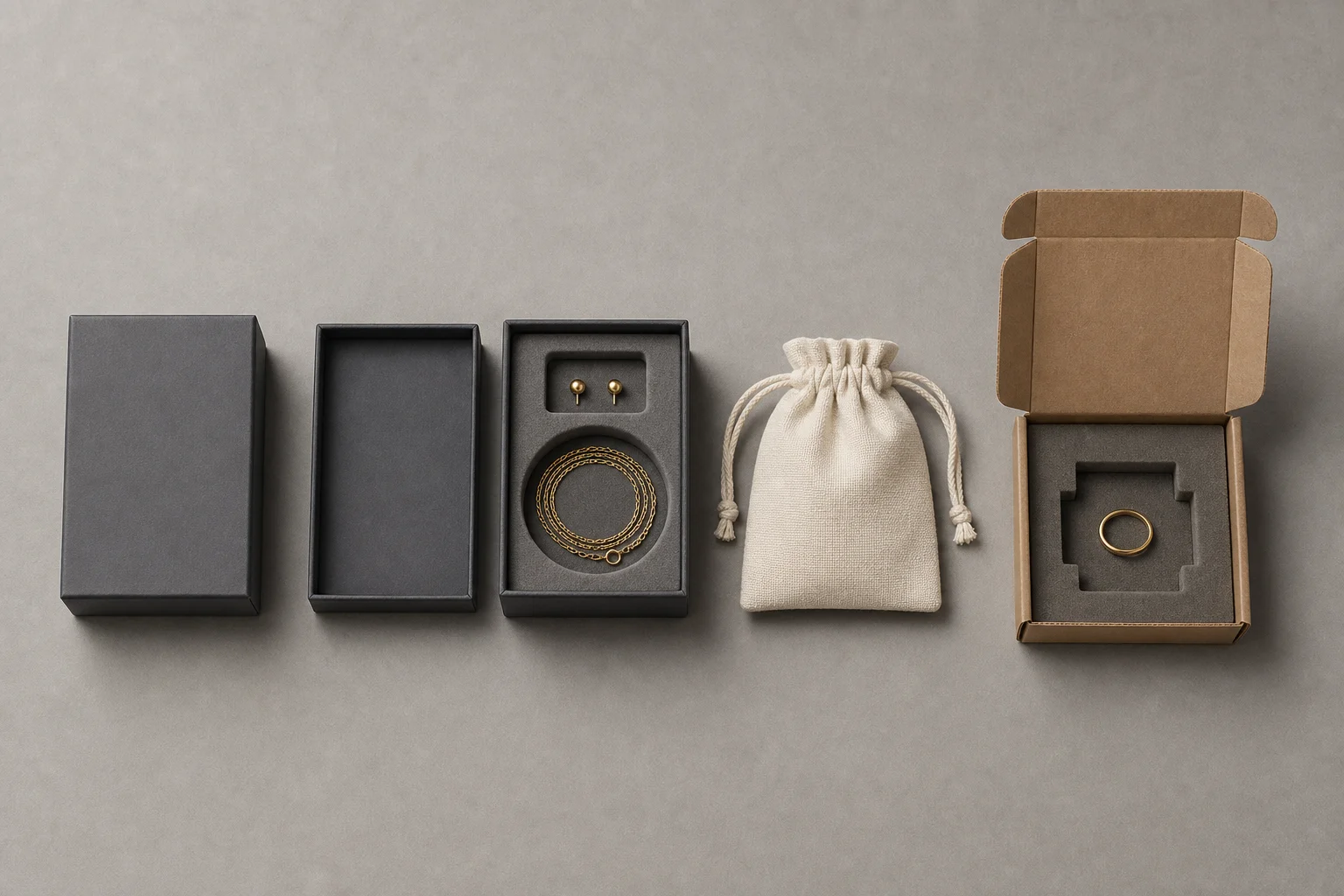
Identical outsides, different insides — the constraint a blind box adds to a packaging brief
A jewelry blind box specification defines a container that is identical on the outside while the payload varies from unit to unit. The same definition covers a jewelry mystery box sold as a one-off, the subscription format where a jewelry mystery bag arrives monthly, and the sealed drawstring format used for lucky bags surprise jewelry at retail events.
The packaging is not decorated per product because the product is not known when the box is printed. Artwork, size and structure have to be fixed first, and the contents are then chosen to fit. Everything that follows comes from that reversal.
Four constraints appear that a known-payload brief never has to resolve: a single cavity that must accept the largest likely piece and still hold the smallest without rattle, an outer surface that carries brand identity without naming a product, a seal that shows whether the unit has been opened, and a payload mass that is a range rather than a number.
Quick Answer: Specify a blind box or mystery bag against the two ends of the payload range, not the average. Protection performance is governed by payload mass and cushion area, and the drop heights a parcel meets in the small parcel network are tied to package size, so a container approved on one sample weight has been approved for one condition only. Name the heaviest and lightest expected payload in the brief, and test both.
In ordinary blind box jewelry work the outer carton, the insert and the artwork survive as constants while the jewellery inside is drawn from a pool. That is efficient on a production line and unstable as an engineering case, for one reason: a cushioning system does not have a single performance figure.
Cushioning is usually described by a dynamic buffer curve, and the curve is U-shaped. At low loading the cushion does not deform under impact, so the item experiences high acceleration. At a middle band the cushion deflects and the acceleration drops. Beyond that band the cushion bottoms out and stops cushioning at all. The same box therefore protects well, badly and not at all across a payload range that a buyer might reasonably describe as “small pieces and sometimes a set”.
Two consequences follow for any jewelry mystery box. First, an insert qualified at one payload is qualified for that payload only, so the range has to be tested at its extremes. Second, the lightest unit is not automatically the safest: below the working band the cushion never engages, and the piece takes the full deceleration.
Brand Background: The evidence here is documented third-party packaging research rather than a single order, and neither study was run on jewellery. One is a cushioning study from Ming Chi University of Technology and National Taiwan University of Science and Technology, published in Applied Sciences in 2021. The other is a distribution measurement from the Department of Packaging Science at Rochester Institute of Technology, published in the International Journal of Advanced Packaging Technology in 2019. One describes what the box does to the contents; the other describes what the network does to the box.
The Packaging Challenge: A specifier writing a known-payload brief has one weight to put on the drawing. A specifier writing for a mystery box jewelry line has a distribution instead. Read side by side, the studies show that range moving two variables at once — the response of the cushioning and the severity of the handling environment.
The Procurement Decision: The first study ran an in-package drop test across three factors at four levels each: drop height at 30, 60, 90 and 120 cm, static stress — product weight divided by cushion area — at 5, 15, 25 and 35 g/cm², and cushion thickness at 3, 6, 9 and 12 ply, with five repetitions across 320 experiments. The second instrumented regular slotted C-flute containers with tri-axial recorders and ran 13 round trips through small parcel ground transport, varying weight at fixed size in one phase and size at fixed weight in another.
The Solution: Both studies replace a single headline number with a relationship: the cushioning work establishes which variables govern protection and how tightly they predict it, while the field work establishes which of those the network is sensitive to.
Measurable Results: The cushioning model reached an R² of 94.1% on drop height, static stress and cushion thickness, and its validation on a 12,360 g product put predicted impact strength at 46.86 G against 47.65 G measured, inside the 95% confidence interval. In the field study, boxes of identical size weighing 52.4, 33.1 and 16.5 lb averaged 16.4, 13.9 and 9.6 in of drop height with no significant difference by weight (P > 0.05), while boxes of identical weight in 6×6×6, 16×16×16 and 24×24×24 in sizes averaged 12.8, 6.3 and 4.8 in — a significant difference by size (P < 0.05), the smallest container recording over twice the number of shock events of the larger ones. Shipping location was not significant.
Both studies point the same way: the brief has to name a range and a worst case rather than a value.
The field study found something a specifier can act on. The test standards in wide use take only packaged product weight as the determinant of drop height, while the measurement showed weight producing no significant difference within a fixed container size and size producing a significant one.
For a mystery box jewelry bulk programme this is more than a technicality. Units are frequently shipped in the same outer size whatever they hold, so the container that most needs its test height revisited is exactly the one whose contents change while its dimensions do not.
What the standards assume | What the measurements showed | What it means for a variable-contents pack |
|---|---|---|
Test drop height is set from product weight | Weight made no significant difference at fixed size (P > 0.05) | A weight-based test height does not track the payload range being packed |
Container size is not a test variable | Size changed mean drop height significantly (P < 0.05) | A fixed outer size needs its own justification, not an inherited one |
One qualification covers the product family | Cushioning is governed by static stress, drop height and thickness together | Approval must be repeated at each payload extreme |
Once the payload is a range, five lines do the work that a single weight figure used to do.
Brief line | Why it is needed |
|---|---|
Payload range in grams, heaviest and lightest, not an average | Static stress is a function of weight, so the two ends define the case |
The cavity size for the largest expected mystery box jewelry pieces | The insert is tooled once and has to admit the biggest item |
A retention rule for the smallest expected item | An oversized cavity lets a light piece travel and strike the walls |
Cushion thickness stated in ply or millimetres | Thickness is one of the three variables that govern the result |
One validation run at each end of the range | A single run characterises one condition, not a family |
Two further lines belong in the order rather than the drawing. The seal has to be specified as single-use, because a mystery format cannot be re-closed and re-sold, and the outer face has to be specified as content-agnostic so that no artwork ever refers to a piece that a particular unit does not contain.
The sequence from brief to approved sample, including where an insert is signed off, is set out in the guide to the custom jewelry packaging wholesale sourcing guide.
The format choice is decided by how much variation the insert can absorb.
Format | How it absorbs variation | Best suited to | The trade |
|---|---|---|---|
Rigid lidded box, universal cavity | One moulded insert with a large well and a shallow lip | A jewelry mystery box in the mid price band | A very small piece sits loosely without a retention lip or top pad |
Drawstring pouch | Fabric conforms to whatever it holds, with no tooling | jewelry mystery bag and bulk mystery jewelry bags programmes | Nothing controls the position of the piece, so it must be thick and the piece wrapped inside |
Foam-filled mailer | Foam cut to a stepped cavity that takes two or three size bands | mystery box jewelry pieces bulk runs shipping straight to consumers | Efficient for a range, but the cavity only covers the bands it was cut for |
Across all three, the reveal matters as much as the protection. A mystery box jewelry unit is opened once, and the second a buyer lifts the lid is the only moment the packaging performs for the customer rather than for the courier. Structure should therefore be specified as single-opening: enough rigidity to survive transit, no mechanism that implies reuse.
What the format buys:
One outer specification and one print run serve an entire product range instead of one SKU.
Slow-moving pieces can be cleared into a single format without new tooling or new artwork.
The unmarked outer makes the reveal repeatable, which supports subscription and event formats.
Fulfilment stays simple because the packer never chooses packaging, only contents.
What it costs:
Protection has to be validated at both ends of the payload range, so testing costs more than a single run.
A universal cavity is a compromise: it fits everything and holds nothing optimally.
The seal is single-use, so returns cannot be resold as new units.
Weight variation inside one carton size affects postage brackets and freight cube planning.
Q: Why is the lightest unit not the safest?
A: Because a cushion has to be loaded to work. The buffer curve is U-shaped: below the working band the material does not deform, so the piece takes the full deceleration, and above it the cushion bottoms out.
Q: Can one insert serve a whole range?
A: Within limits. A stepped or stepped-and-lipped cavity can accept two or three size bands, but the retention rule still has to be stated for the smallest item or the piece will travel.
Q: Should the outer carry a product image?
A: No. Any artwork that names a piece will be wrong for some proportion of units. Brand identity belongs on surfaces that are true for every unit.
Q: Does a heavier mystery box get dropped harder?
A: In the field measurements weight made no statistically significant difference at a fixed container size, while size did. The useful planning variable was how large the parcel was, not how heavy.
Q: How many validation runs does a range need?
A: Two as a minimum, one at the heaviest payload and one at the lightest, at the drop height the brief assumes. The middle of the range is the least likely place for a failure to hide.
A blind box or mystery bag is the one format where the payload is a distribution rather than a value, and that change moves both sides of the protection problem. Published cushioning research identifies payload mass and cushion area as one of three variables that govern impact strength, and published field measurements show the small parcel environment responding to container size rather than weight, while the common test standards key drop height to weight alone. The practical instruction for a specification is therefore narrow and testable: state the lightest and heaviest payload, tool one cavity that admits the largest piece, write a retention rule for the smallest, specify a single-use seal, and run the validation at both ends of the range instead of the average.
Utouch Packaging produces blind box and mystery bag packaging across rigid, pouch and mailer formats, specified around this framework — a payload range stated on the order, one cavity qualified at both ends rather than one sample weight, and artwork confined to surfaces that are true for every unit. For wholesale and custom enquiries, visit the Utouch Packaging contact page or reach the export team through Xiamen Yu Touch Imp. & Exp. Co., Ltd.
