
Views: 0 Author: Site Editor Publish Time: 2026-09-15 Origin: Site


Article Intro: Heart-shaped jewelry boxes sit at the shaped end of rigid packaging: the outer profile is die-cut to a silhouette — a heart, a butterfly, an egg, a fan, a diamond — and then wrapped and lined like any other rigid box. For jewelry brands the shape is a tooling and hand-assembly decision rather than a printing one, which is why a shaped box carries a die cost, a higher unit price and a longer sample cycle than the same box built as a rectangle. This guide covers the shapes buyers actually order, where the extra cost comes from, the cheaper window-and-insert alternative, and the specification list a shaped-box RFQ should carry.
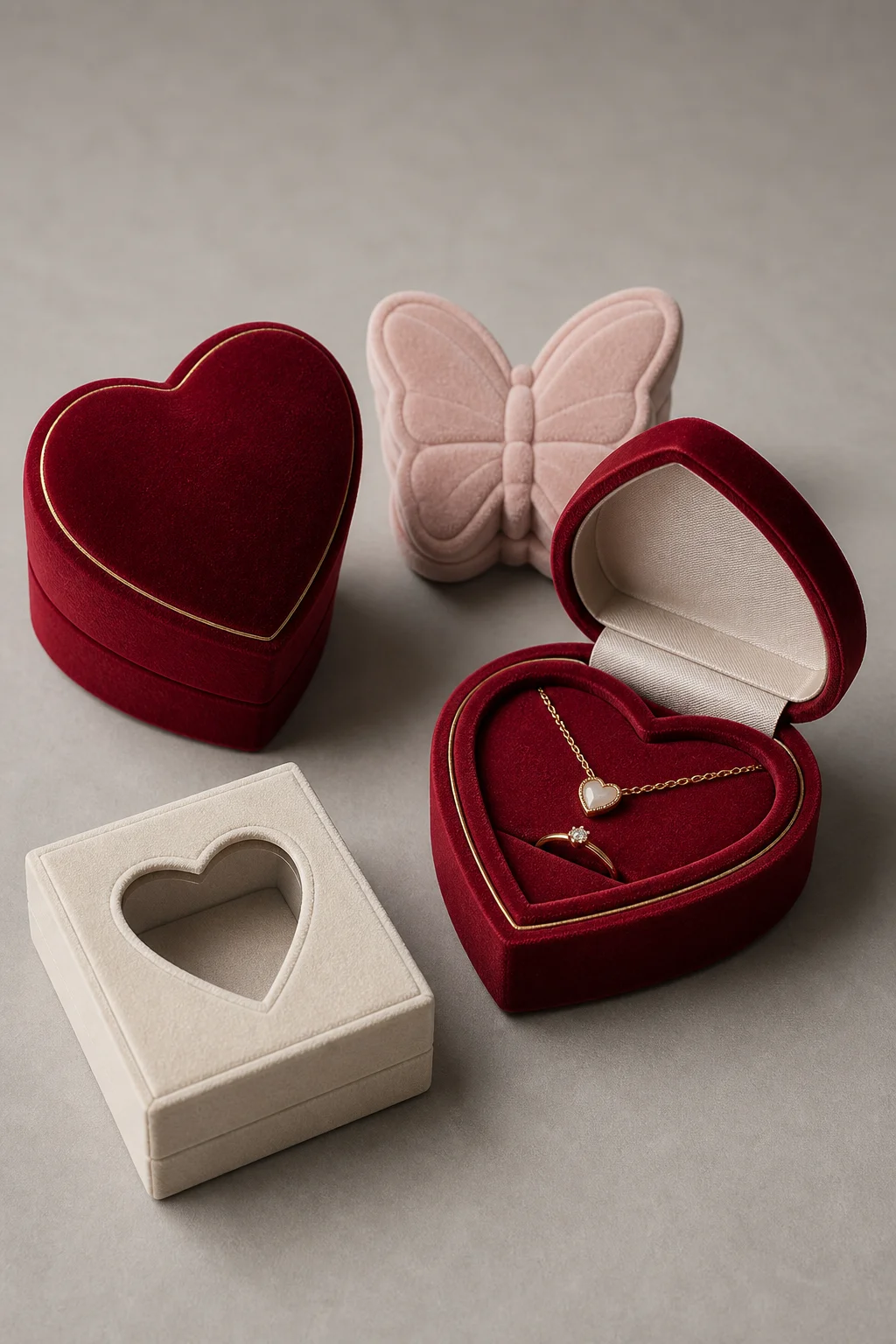
Four formats from one idea — shaped heart box closed and open with a heart-cut insert, a butterfly silhouette, and a rectangular box with a heart window
A heart-shaped jewelry box is a rigid box whose outer silhouette is cut to a non-rectangular profile. Everything above that silhouette is standard rigid box manufacturing: a greyboard body, a wrap in paper, velvet or leatherette, an interior lining and an insert. Three things change, and they are the three that decide the price: the cutting die that forms the outer edge, the wrapping that has to be folded by hand around the curve, and the interior, which is either an insert cut to a non-rectangular cavity or the same insert used in a rectangular box.
Two different products are sold under the same words, and buyers often compare them by accident. The first is a true shaped box: the outer body itself is a heart. The second is a rectangular box carrying a shaped element — a die-cut heart window in the lid, a heart-cut insert, or a shaped display card. Both read as heart packaging on a product page and both are legitimate, but only the first needs a shaped die, so the two sit in different price bands. The image above shows all four formats side by side.
Shaped boxes belong to gifting and occasion lines rather than to the everyday retail line, and they are normally bought as a hero format — one or two silhouettes for Valentine’s, bridal or spring — or for two-piece sets, where a ring and a pendant share a single heart and the interior becomes a shaped insert with more than one station.
Six silhouettes cover most shaped jewelry orders. The tooling and assembly column is where the real cost difference sits.
Shape | Silhouette and construction | Typical use | Tooling and assembly load |
|---|---|---|---|
Heart | Symmetrical two-lobe profile, lid and base cut to a matching outline; fabric hinge or clamshell | Valentine’s, anniversaries, engagement and bridal gifting | Moderate die, hand-wrapped curved edges |
Butterfly | Multi-lobe profile with wing returns, clamshell construction | Spring and Mother’s Day gifting, fashion and children’s lines | Most complex common die, heaviest hand work |
Egg or oval | Continuous curve with no corners, lid-and-base or clamshell | Easter and spring promotions, pearl lines | Simple die, slow wrapping on a continuous curve |
Diamond or rhombus | Angular four-point profile with sharp returns | Bridal, diamond-set lines, premium retail | Sharp points need reinforced corners |
Fan or scallop | Arc profile on a straight base edge | Heritage and Asian-market gifting | Moderate die, stable base |
Rectangle with shaped window | Standard rigid box with a die-cut aperture in the lid | Any line that wants the look without the outer tooling | Standard box tooling plus a window die |
Two shapes dominate actual orders: the heart for gifting and the diamond or rhombus for bridal, with the butterfly close behind for spring. The remaining silhouettes usually appear as a second format inside a seasonal line rather than as a mainline product.
A shaped box is not a rectangle with a different outline, and the price gap comes from five places that are worth understanding before the drawing is sent.
The cutting die. A shaped die is a one-off tooling charge quoted separately from the unit price, and it sets the economic minimum for the order. A reorder reuses the die; the first order carries it.
Hand wrapping. No machine folds a heart. The wrap is applied by hand around the curve, and the labour scales with the number of lobes and points — which is why a butterfly costs more to build than a heart of the same area.
Material yield. A shaped silhouette nests poorly on the sheet and on the wrap, so more material is lost per box than from a rectangular layout. The waste is invisible in the sample and visible in the price.
Packing and freight. Shaped boxes do not stack flush. They need a carton insert or divider, and a carton holds fewer units per cubic metre, so freight per unit rises even when the unit price has not moved.
Structural limits. The closure is simplified. A magnetic closure needs a straight edge to seat against, and a heart has none, so shaped boxes default to a fabric hinge, a two-part lid and base, or a clamshell, with ribbon tie and elastic loop as the common decorative closures.
The practical conclusion is not that shaped boxes are overpriced but that they are a different product. A brand comparing a heart box against a rectangular box of the same footprint is comparing a hand-built format against a machine-folded one.
The cheapest route to a shaped presentation keeps the outer box rectangular and puts the shape inside it or on the lid. Three versions cover most briefs:
Heart window in the lid. A standard rigid box with a die-cut aperture, optionally backed with film. The customer meets a heart without the brand paying for a shaped body, and the box still stacks and packs normally.
Shaped insert. The insert itself — foam, EVA or a velvet-covered board — is cut to the heart, so the piece sits inside a shaped cavity under a standard lid. This is the version that reads as sculpted on opening.
Shaped display card. The card carrying the earrings or pendant is cut to the shape and travels inside any box. It is the format most small brands start with, because the tooling is limited to a card die.
The trade-off is about timing rather than quality. A window or an insert delivers the shape at the moment of opening, while a shaped outer box delivers it on the shelf and in the customer’s photograph before the box is ever opened. If the packaging has to stop a scroll or hold a display position, the outer silhouette does that job; if it has to hit a price point, the insert achieves the same reveal behind a standard lid.
Six items decide whether a shaped quote comes back right:
The silhouette drawing. Supply a vector outline in AI, PDF or EPS — not a photograph and not a sketch. The die is cut to the drawing, so the drawing is the specification. If the brand has only a reference image, the shape has to be redrawn and approved before tooling starts.
Two sets of dimensions. Give the outer size at the widest and tallest points, and the inner cavity dimensions separately. A shaped box is measured differently from a rectangle, and confusing the two is the most common cause of a piece that does not fit.
Height and lid depth. Total height, base depth and lid depth as three figures, especially where a necklace has to sit above a ring.
Interior. Shaped insert, ring groove, necklace hooks, elastic or a shaped platform — and whether the interior is one piece or a tray plus a card.
Closure and edge treatment. Fabric hinge, clamshell or lid-and-base; ribbon tie or elastic loop. The wrap finish at the point of the heart or the wing tip is specified here, because that is where hand wrapping is most visible.
Logo placement and tolerance. A shaped profile has less flat area, so the mark normally sits at the centre of the lid face or on a shaped interior plate rather than along an edge. Because curved edges are wrapped by hand, agree the visible tolerance in writing before tooling rather than after the first carton.
Three schedule facts separate a shaped order from a rectangular one.
The die is quoted once per silhouette and reused for every later order, which is why the second production run is materially cheaper per unit than the first. A brand that expects to return to a shape should keep the die number and the approved drawing on file rather than treating tooling as a disposable cost.
Sampling runs in two stages. The first is a structural sample cut to the drawing and checked for lid-to-base alignment and insert fit before anything is wrapped; the second is the finished, wrapped sample. Skipping the structural stage is how a shaped box reaches production with a lid that does not sit flush.
Minimum order quantities for shaped boxes are driven by the die and the hand wrapping rather than by the material, so the economical quantity is the one that spreads the tooling. The number differs by shape and by supplier, and it should be quoted against a specific silhouette rather than asked for in general. Lead time carries the same two extra steps — die making and hand wrapping — on top of the standard rigid box schedule, so a shaped order needs a longer runway than a rectangular one, most of all inside a peak season.
The silhouettes follow occasion demand rather than fashion. The heart peaks at Valentine’s Day and Mother’s Day, the butterfly and the egg at spring and Easter, and the diamond or rhombus runs year-round because bridal is not tied to a date.
Two consequences follow for planning. First, a shaped seasonal order has to be confirmed earlier than a rectangular one, because the die sits on the critical path and no amount of rush on the wrap recovers a late die. Second, the seasonal shape is usually rerun rather than retired: brands that commission a heart die tend to use it for several years, so the silhouette should be designed as a reusable format with locked artwork rather than as a one-off seasonal gimmick.
A shape that has already run for two seasons is best treated as a permanent format. Keeping the drawing and the artwork unchanged means the second and third orders arrive identical, which matters more for shaped packaging than for rectangles — a heart that is a few millimetres different from last year is noticeable in a photograph.
Three practical points when buying shaped packaging:
Treat the die as an asset. Record the silhouette drawing, the die number and the approved sample together, so a reorder does not restart tooling or re-approve a shape that was already signed off.
Approve the structure before the decoration. Sign off lid-to-base alignment and insert fit on the unwrapped structural sample, then approve the wrap colour and the logo on the finished sample. Two checkpoints catch nearly every shaped-box defect.
Specify the packing with the box. Shaped boxes need a carton insert or divider and hold fewer units per carton than rectangles, so asking for the units-per-carton figure alongside the unit price is what turns a shaped quote into a landed cost. The sourcing fundamentals — minimums, sampling, tiered pricing and supplier qualification — are covered in the 2026 B2B sourcing guide for small and growing brands.
Q: Are heart-shaped boxes more expensive than rectangular boxes?
A: Yes, for three structural reasons: the shaped cutting die, the hand wrapping around the curve, and the poorer material yield of a shaped silhouette. Packing also costs more per unit because shaped boxes do not stack flush.
Q: Can I get the heart look without paying for a shaped die?
A: Yes. A die-cut heart window in a standard lid, a heart-cut insert under a rectangular lid, or a shaped display card all deliver the shape. The outer silhouette is the only version that shows the shape on the shelf before the box is opened.
Q: What determines the minimum order for a shaped box?
A: The die and the hand-wrapping operation rather than the material. The economical quantity is whichever spreads the tooling, so the minimum should be quoted against a specific silhouette rather than as a general figure.
Q: What artwork do I need to supply for a shaped box?
A: A vector outline of the silhouette in AI, PDF or EPS, plus the outer dimensions at the widest and tallest points and the inner cavity dimensions. A photograph or a rough sketch has to be redrawn and approved before a die can be cut.
Heart-shaped jewelry boxes are the shaped end of rigid packaging: a die-cut outer silhouette, a hand-wrapped curve and an insert cut to a non-rectangular cavity. The shape adds value where it is used deliberately — as a hero format for Valentine’s, bridal or spring — and adds cost in five predictable places: the die, the hand wrapping, the material yield, the packing density and the simplified closure. Brands that want the look without the tooling have a cheaper path in the shape window, the shaped insert and the shaped display card, which deliver the same reveal inside a standard box. Either way, the decisions that matter are made before production: a vector silhouette, two sets of dimensions, a structural sample approved before the decoration, and a die treated as a reusable asset rather than a one-off fee.
Utouch Packaging manufactures custom shaped jewelry boxes — heart, butterfly, egg, fan and diamond silhouettes in velvet, paper and leatherette — together with die-cut shaped inserts, heart-window lids and shaped display cards, with structural samples approved before wrapping and dies kept on file for reorders. For wholesale and custom enquiries, visit the Utouch Packaging contact page or reach the export team through Xiamen Yu Touch Imp. & Exp. Co., Ltd.
