
Views: 0 Author: Site Editor Publish Time: 2026-10-10 Origin: Site


Article Intro: A faux leather jewelry pouch looks like the simplest object in a packaging catalogue: two panels, one seam, one cord. The material is what makes it difficult. A coated fabric is a textile with a polymer skin bonded to it, so the surface the needle meets, the surface that takes a fold and the surface that takes a logo are coating rather than fibre. This guide follows the pouch through the three points where that difference decides the finished object.
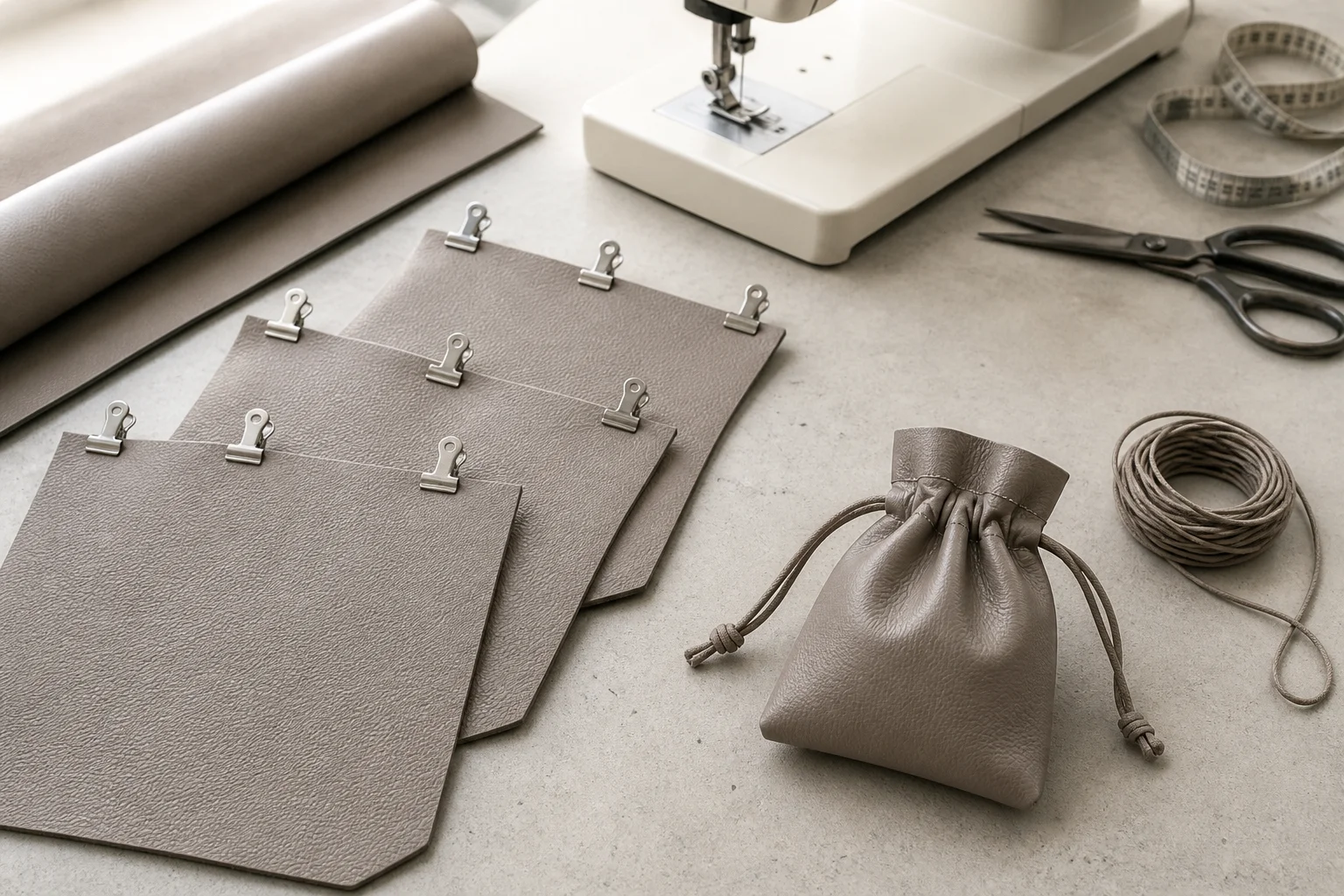
Cut panels of coated faux leather are clipped rather than pinned before the pouch is sewn; the finished pouch shows the turned, topstitched top edge and cord channel.
A faux leather jewelry pouch is a pouch whose outer face is a coated fabric: a textile backing with a polymer coating applied to it, usually polyurethane and sometimes PVC, with a grain pressed into the coating while it is still soft. The material is sold as PU leather, faux leather or pleather, and it is the coating — not the backing — that the customer sees.
The pouch is not a box. There is no board core to hold a shape, so the finished geometry comes from two things only: the seam that joins the panels and the closure that gathers or covers the opening. It is also not a velvet, suede or cotton pouch, because those are pile or woven fabrics with no polymer skin. A mark pressed into fibre sinks in; the same mark on a coated surface sits on a continuous skin.
Quick Answer: A faux leather jewelry pouch is a coated textile cut and sewn into a bag. Three things decide whether it looks right: how the coating behaves under the needle, how it behaves at a fold, and how the open edge is closed. Because the coating is a skin on a fabric, much of the sewing rulebook used on cotton reverses.
Factor | Coated faux leather | Woven cotton or twill | Pile: velvet or suede |
|---|---|---|---|
Visible surface | A continuous polymer skin with pressed grain | Interlaced yarns | Cut or looped fibre pile |
Where the shape comes from | Seam and closure only | Seam and closure only | Seam plus the body of the pile |
Behaviour under a needle | Punches a hole that stays open | Parts yarns; the hole closes | Buries the hole in pile |
Behaviour at a fold | Skin is stretched; can whiten and crack | Fibres reorient and recover | Pile hides a soft fold |
How an edge is closed | Turned under, bound, or raw edge coated | Turned under or overlocked | Turned under; often bound |
Main failure mode | Crease marking and edge lift | Fraying and seam slippage | Pile flattening and shade rub |
The last line is the procurement consequence: a coated pouch rarely fails by tearing. It fails by showing where it was folded and by the edge coming away from the coating — both settled before a stitch is sewn.
The coating is smooth and slightly elastic, so it behaves differently at three points of the sewing line. Against the machine bed and under the presser foot it has less friction than a woven fabric, which lets panels creep between needle and feed. The answers are a walking-foot machine, lighter foot pressure, and clips rather than pins.
The needle is the second decision. On a woven fabric the point separates yarns and the hole closes behind it; through a coating there are no yarns to separate at the surface, so the needle punches a hole and the hole remains. A leather-point needle makes a cleaner cut; a needle too fine for the assembly bends and skips.
Cut panels are the third point. A coated fabric has crease memory: a panel folded back on itself in storage keeps that fold. Panels that will become the visible face are therefore rolled rather than folded, and cut in one direction so the grain runs the same way across the pouch.
Note on sourcing: This is documented third-party research, not a transacted order. Two published sources sit behind it: a 2016 seam study on leather by Hasan, Limon and Arefin in the International Journal of Current Engineering and Technology (pages 205–209), and ISO 32100:2018, which covers flex resistance of coated fabrics. Between them they measured the two quantities a pouch specification has to fix: how much stitching a seam should carry, and what repeated folding does to a coated surface.
What was tested. The seam study took chrome-tanned leather of 1.00 mm, cut with an LR90 needle, and joined it into a stitch-and-turn seam at four stitch densities — 3, 4, 5 and 6 stitches per centimetre — using four constructions: lock stitch 301, chain stitch 401, zig-zag 304, and a combination of 401 and 304. Material, machine and thread were held constant, and seam strength was measured by ASTM D1683.
What the studies found. Seam strength rose as stitch density rose, but only up to a point; beyond it, more stitching stopped helping. The best overall seam performance came from a 301 lock stitch at 3 stitches per centimetre, and the 401 with 304 combination at the same density also gave significant strength. Separately, ISO 32100:2018 assesses flex resistance on the folded specimen, taking its appearance after a specified number of flex cycles as the measure.
What it means at specification stage. Two values have to be written down rather than assumed: stitch density, which has an optimum instead of a habit, and the seam type by name. And since flex resistance is judged by the appearance of a folded specimen, the fold becomes a testable property — which puts fold radius, storage condition and minimum temperature into the order itself.
Stitch density is quoted as stitches per centimetre, and it is the first thing to fix. The published leather trial found strength rising with density and then levelling, which matches workshop experience: a very dense line of stitches perforates the material along the seam and turns the seam into the tear line.
Seam choice | What it gives | What it costs |
|---|---|---|
Lock stitch, medium density | Holds if one stitch breaks; the standard choice for a pouch | Slower than chain stitch; more thread |
Chain stitch | Faster, and slightly elastic along the seam | A broken end can run; less suited to a stress point |
Dense stitch line | Higher strength up to the optimum | Perforation line; visible needle holes on a coated face |
Topstitch on the coated face | A deliberate decorative line | Cannot be unpicked without leaving holes |
Where the seam sits matters as much as how it is made. On a woven pouch a seam can be pressed flat and largely disappears; on a coated pouch the needle holes stay open, so a seam on the visible face stays legible. Keep the structural seam on the lining side.
A fold asks the coating to do something the backing underneath is not doing. When the material bends, the coating outside the bend is stretched while the backing behind it is compressed, and the two are bonded, so the skin must absorb the difference. A soft fold at a generous radius spreads that demand; a sharp fold concentrates it on one line.
Two conditions make the fold worse. Repeated folding along the same line works the coating until it whitens and can crack — which is why flex resistance for coated fabrics is measured on the folded specimen rather than on a flat piece. Low temperature stiffens the coating, so a crease that survives handling in a warm room can crack in an unheated warehouse.
Storage is the third condition. A coated panel keeps the last fold it was given, and once a crease has set it will not press out. Pouches shipped flat under weight arrive with a fold across the visible face; pouches shipped rolled or lightly filled arrive without it.
The open edge of a coated pouch cannot be handled the way a woven edge is. Turning a woven edge under hides the raw material inside the fold; turning a coated edge under produces a ridge, because the coating adds thickness the backing alone does not have. Three routes are used, and each fails in its own way.
A turned and topstitched edge is the most common. A bound edge, where a tape wraps the raw edge, hides the coating's cut face and adds a colour line; the risk is that a tape which does not bond well to a low-energy coating lifts at the ends. A raw edge finished with an edge coat is the lightest-looking option, because nothing is folded, but the paint has to match the coating in colour and gloss, or the mismatch reads as a line drawn around the pouch.
The edge decision also sets the closure. A drawstring channel needs a hem deep enough to carry the cord without pulling the turned edge open; a flap needs a clean top edge because the flap is what the customer opens first. Only one route should be used on a single pouch.
Advantages | Trade-offs |
|---|---|
A dense, uniform surface with a repeatable grain | Crease marks are permanent and cannot be pressed out |
Wipes clean; resists dust better than pile | Needle holes stay open, so seam placement is visible |
Colour matches across panels far more closely than dyeing | Low-temperature flexing can whiten or crack the coating |
Debossing and foil sit on a smooth skin, so fine detail holds | Edge treatment is a separate step that can lift or mismatch |
Reads as leather at arm's length without a leather price | No structural protection; the pouch does not hold a box shape |
Seven lines carry a quotation to the point where it can be checked on arrival.
Specification line | What to state |
|---|---|
Coating and backing | Coating type and colour; backing construction, since tear strength follows the backing |
Grain and finish | Grain pattern and gloss level, approved on a physical swatch |
Seam | Seam type named, and stitch density in stitches per centimetre |
Fold and crease | Where folds are allowed, and that the visible face must arrive uncreased |
Edge route | Turned and topstitched, bound, or raw with edge coat; colour matched |
Closure interface | Channel depth for a cord, flap tolerance, or zip end anchoring |
Temperature | Minimum temperature in transit and storage at which the coating must stay intact |
A wider sourcing framework — MOQ tiers, tooling and lead-time structure across formats — is set out in the custom jewelry packaging wholesale guide for small and growing brands.
Is a faux leather jewelry pouch the same as a PU leather pouch? In practice, yes, and the label is not a specification. PU leather, faux leather and pleather all describe a coated fabric. What a buyer needs to fix is the coating type and colour, the backing construction and the grain.
How long does a coated pouch last? The coating does not wear through the way a pile flattens. Its life is set by how often it is folded and at what temperature, so a pouch kept open in a drawer behaves differently from one folded flat into a parcel.
Can a coated pouch carry a logo? Yes, because heat debossing and foil sit on a smooth skin rather than sinking into fibre, so fine detail holds. The limit is the fold: a mark placed across a fold line will distort, and a deep deboss can thin the coating at its edges.
Why does the seam on a coated pouch show so clearly? Because the needle punches a hole in a continuous skin and the hole does not close. On a woven fabric the point parts the yarns and they recover; there are no yarns at the surface of a coating to recover. Keeping the structural seam on the lining side is the usual answer.
Should a coated pouch be shipped flat or filled? Shipped flat under weight it arrives with a crease across the visible face, because the coating keeps the fold it is given; shipped rolled or lightly filled, it arrives without one. The storage condition belongs in the order.
Faux leather jewelry pouches are made from a coated fabric, and that one fact reorganises the process. The surface is a polymer skin bonded to a textile backing, so the needle leaves a hole that stays open, a fold stretches the skin over a compressed backing, and an edge cannot simply be turned under the way a woven edge can. Stitch density is a chosen value with an optimum — a published leather seam trial found strength rising with density only up to a point — and flex resistance on a coated fabric is assessed on the folded specimen and judged by appearance. The two failures a buyer will actually see are a crease that will not press out and an edge that comes away from the coating, and both are decided at specification stage.
Background on structures, materials and production sits with Utouch Packaging. A coated pouch programme can be discussed with the team through the contact page; wholesale enquiries are handled through the storefront, Xiamen Yu Touch Imp. & Exp. Co., Ltd.
