
Views: 0 Author: Site Editor Publish Time: 2026-10-15 Origin: Site


Article Intro: A diamond-set piece inverts the usual brief for jewellery packaging. In most categories the box is the aggressor: it can dull a finish, imprint a lining, or press against a soft stone. Diamond is the hardest material the package will ever hold, so wear runs the other way, and the lining, the lacquer, the plating and the neighbouring piece are what must survive. This guide treats the category as a contact problem: which points touch what, which surfaces survive repeated placement, and which lines belong in the specification.
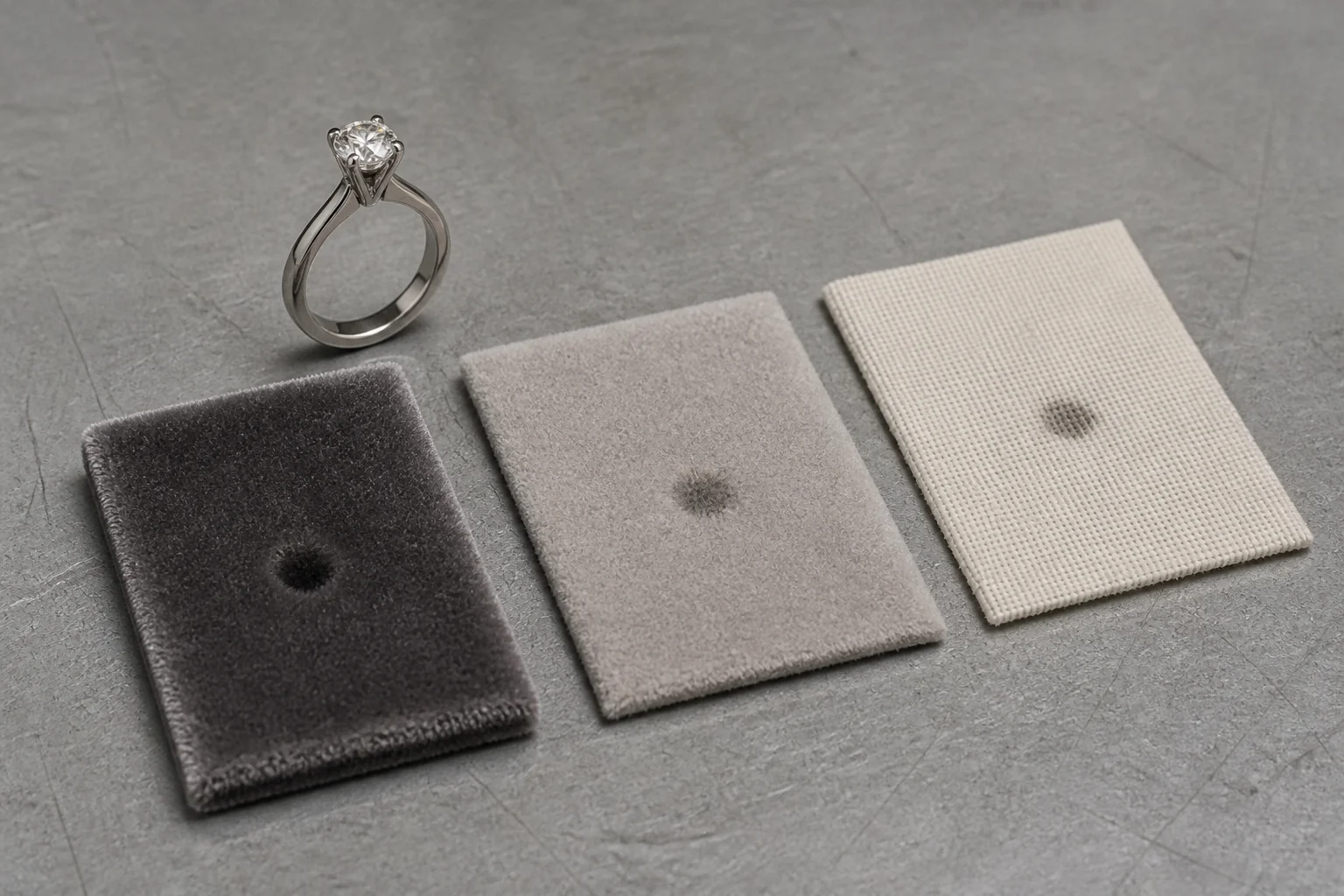
One stone, three interior surfaces: raised pile, a flocked face and a flat weave each record the same repeated contact in a different way.
Diamond jewelry packaging is the group of boxes, fitted interiors and pouches specified for jewellery whose principal stone is the hardest material the package will ever contain. It covers rigid boxes with a cut interior, compartmented trays, fabric and zip pouches, and the card elements that hold a grading report. What separates it from general jewellery packaging is the direction of wear: the packaging has to stay intact in the presence of the stone, not merely keep the stone intact inside the packaging.
Orders arrive in three shapes. A single-piece box holds one ring or pendant. A compartmented tray holds a small assortment, which is where stone-to-stone contact first appears. A pouch closes around one piece, and it is the format in which a stone touches something soft for longest.
Quick Answer: Diamond packaging is specified around the stone rather than the occasion. What matters is the interior surface under repeated contact, the separation between pieces, and the load points that hold a top-heavy setting steady — because the surface that fails is the one the stone rests on.
Hardness and toughness are different properties, and diamond sits at opposite ends of the two scales. It resists scratching better than any natural material and is only moderately tough: hardness is uneven along different crystal directions, and the weak directions are where it chips rather than deforms. A pearl is softer than almost everything around it, so the risk there runs from the packaging toward the jewel. Diamond reverses the flow. Nothing in a normal box marks the stone, so loss accumulates on the other side of the contact: the lining pile, the lacquer on a board edge, the plating on a hinge, the neighbouring piece.
Acceptance criteria shift as a consequence: an inspection of a diamond order checks the surfaces the stone has already met, not the stone itself. Pile flattened in a band, a lacquer edge with a pale scratch, a plated part rubbed bright — one event, all visible before the piece is worn.
Repeat count then separates a bench sample from production. A sample is placed once, while a piece in a cabinet is lifted daily and a pouch may open a hundred times before the customer sees it twice. Pressure is high precisely because the contact area is small, so surviving one placement proves nothing about the year.
The contact map is short, and each point behaves differently because each presents a different edge. Which one takes the load depends on how the piece is laid down, not on how the interior was drawn.
Contact point | Meets in a closed box | Damage shows as | Controlled by |
|---|---|---|---|
Girdle edge | Pile, board face, divider | A rub line through the pile | Pile height, divider clearance |
Prong tips | Whatever the piece rests on | Marks in a set pattern | Orientation and relief depth |
Pavilion and culet | The recess floor | One deep dimple | A void beneath the stone |
Shank inner face | Slot walls, recess base | Two parallel rub bands | Fit tolerance |
Chain links and clasp | Loose lining in a pouch | Clumped pile, bright plating | Chain retention, lining choice |
A pendant on a chain is the hardest case to hold: the stone hangs and the chain arrives folded, so part of the assembly is unrestrained, and whatever restraint exists is tested where the chain leaves the recess.
Interior surfaces are usually discussed by feel. For a diamond order the useful question is what the surface looks like after a few hundred loadings, because that is the state a customer eventually opens.
Route | Under repeated contact | Protects well | Does not protect |
|---|---|---|---|
Raised cut pile | Closes over a light touch, flattens in a permanent band | Appearance; hides first contacts | Nothing structural |
Flocked short pile | Fibre detaches before the adhesive body yields | Fine recesses and tight radii | Loose fibre ends near adhesive |
Flat woven or satin-faced | Holds shape; contact reads as a sheen change | Consistency over large areas | Impact absorption; shows every touch |
None of the three is wrong; the route follows the format. A recess cut around a single setting suits raised pile, a compartmented tray suits flocked, and a pouch suits a woven face. What matters is that the choice is recorded with the load path it was made for, so a later substitution reads as a change rather than a saving.
A diamond piece is small in footprint and heavy at the top of it. A ring stands on a band thinner than the setting above; a pendant carries its mass near the bail. Laid on a flat bed, the assembly finds its own balance and rests where the drawing did not intend. The remedy is a recess supporting the piece at two or more defined points with a void under the stone, so the load is carried by metal rather than by one facet edge.
Retention follows the same logic. A recess deep enough to stop the piece tipping also grips it during removal, so depth and clearance are tuned together: too little and the piece tips onto the stone below, too much and the customer lifts it against the lining. Keeping one production piece for a drop check settles depth before a tool is cut, and a custom jewelry packaging programme built this way normally states the retained piece beside the drawing.
The grading report is the second object in the box and the one most often placed without thought. It is stiff card with an edge, usually stored in a pocket that presses on the same interior the piece occupies. Two rules keep it harmless: the pocket must close without transmitting pressure to the recess, and the report must not slide into the space the stone occupies when the lid shuts.
What these two sources are. Both items summarised below are published third-party findings, not jobs handled by this supplier. An impact trial run for a diamond-industry technology company appeared on the Rapaport trade blog in August 2021. A gemmological feature on chipping was published by the Gemological Institute of America in May 2016.
How the impact trial was built. A four-prong white-gold basket stud holding a 0.50 ct diamond was placed in a rotating tumbler fitted with coarse ceramic impact surfaces, set to present twelve impact events per minute, with a 1.5 m drop taken as the working equivalent.
Where the failure appeared. After 100 impact events the prongs showed serious damage. The trial ran on to metal failure, and at 3,069 impact events the diamond and the basket separated. Checked afterwards under a binocular microscope, the diamond carried no damage: a girdle described as medium to slightly thick had resisted every event without chipping. The same source lists diamonds stored together and allowed to touch, and loose stones striking one another in stone papers, among the common causes of damage.
What the findings change in a box. The trial states the reversed-wear thesis as measurement: the hardware failed long before the stone, and the component that survived was the one the package exists to protect. The gemmological feature supplies the other half, describing hardness that is uneven along crystal directions and illustrating a 1.05 ct diamond with a chip running from its girdle to its culet. Its figures put the gap in scale: fracture toughness for diamond is given as roughly 5,000 erg/cm² along the cleavage planes and over 8,000 in the hardest direction, against 225,000 for nephrite. The reading for a specification is narrow — separate pieces so contact cannot happen, and stop treating the stone as the part needing protection.
Residue carried in from finishing. A setting is finished with loose abrasive media, and a dry setting can release a trace onto the pile below. The mark is small and directional, and it becomes a complaint because it cannot be removed without wetting the piece again.
Stacked plated components. Hinges, magnetic plates and clasps are often handled in stacks before assembly. Plated parts resting on each other transfer a bright rub mark long before the box sees a stone, and the interior gets the blame.
Pile crushed before use. Interiors stored compressed, or shipped with the lid under load, arrive with the pile already flattened in bands. The customer cannot tell this from wear caused by the piece, so the batch reads as a quality fault, not a packing fault.
Contact between pieces. Divider walls are sometimes dropped for a cleaner look, on the assumption that each piece sits in its own dip. In a tray that travels a dip is not a restraint, and stone against stone is the one mechanism packaging can eliminate outright.
What it buys | What it costs in the order |
|---|---|
A few defined load points can be drawn and checked, so the interior is verifiable | Tooling is per-piece; a recess fits one design only |
Separating pieces removes the one wear mechanism that cannot be tolerated | Dividers reduce the visual openness some brands want |
A stated surface and retention depth make a batch repeatable | More lines to agree; every substitution becomes visible |
The report pocket can sit where it cannot press on the recess | A separate pocket adds a board layer and depth |
The category tolerates a wide material range | Colour and finish are still set by the metal and occasion |
A specification for this category is short. Six lines carry most of the risk, and each exists because removing it produces a failure that is hard to attribute later.
RFQ field | What goes in it | What it prevents |
|---|---|---|
Interior surface | Route, fibre type, pile height | The surface records the wear |
Lining abrasion | Method and result, e.g. Martindale under ASTM D4966 | Turns a soft lining into a number |
Coating scratch resistance | Method for a lacquered face, e.g. ISO 1518-1 | A lacquer edge is easily marked |
Piece separation | The barrier and clearance between pieces | Stone-to-stone contact is a total loss |
Retention | Load points, void under the stone, retained sample | Depth stays consistent across tool changes |
Report compartment | Its position, and the pressure path from the lid | The only other stiff object in the box |
Two of the six lines are test methods rather than materials, deliberately. A lining, a lacquer and a plating are all bought to a price, and the only way to stop a cheaper substitution changing the wear outcome is to state the performance required rather than the material name.
Does a diamond box need a softer lining than a pearl box? Not softer in absolute terms. It needs a lining that recovers after point contact, because the contact area is small and the pressure concentrated. A lining chosen for softness alone can hold the imprint longest.
Can two stones share a compartment if they are the same size? Size does not govern contact. Two pieces of identical dimensions still meet whenever the box is tipped, and published industry guidance lists storing diamond jewellery together among the recognised causes of damage.
Is a slot sufficient to hold a ring in place? A slot restrains a band; it does not hold a setting upright or keep the stone clear of the base. Where the piece is top-heavy, the recess must carry it on defined points with a void below the stone.
How many placements should a bench sample survive? One is not informative. The number belongs in the specification beside the test method, so supplier and buyer measure the same thing rather than agreeing on an impression.
A diamond order inverts the assumptions that govern most jewellery packaging. The stone will not be marked by the box, so the box is what has to be designed around the stone: a few load points, a void beneath the setting, a surface that recovers after repeated contact, and separation between pieces that removes the one wear mechanism which cannot be engineered around. The published evidence assembled above points the same way, with hardware failing at a measured impact count while the stone survived intact, and with contact between stored pieces named as a recognised cause of damage. Read the specification as a set of contact decisions, keep a retained sample so depth means one thing, and the wear that reaches the customer is the wear that was designed.
Rigid boxes, fitted interiors and pouches for diamond-set jewellery are developed and produced by Utouch Packaging. A specific interior can be quoted against a piece and a drawing through the contact page, and volume terms for a box, tray or pouch run are listed on the storefront at Xiamen Yu Touch Imp. & Exp. Co., Ltd.
