
Views: 0 Author: Site Editor Publish Time: 2026-10-12 Origin: Site


Article Intro: A mesh bag is the one soft packaging format whose performance is decided by what is missing from the fabric. The openings are the product: they set what can escape, what can breathe and what a buyer can see, and they decide how the edge has to be finished. This guide works from the opening outward, through the ways mesh is made, the cut and bind problem it creates, and the lines that belong in an enquiry.
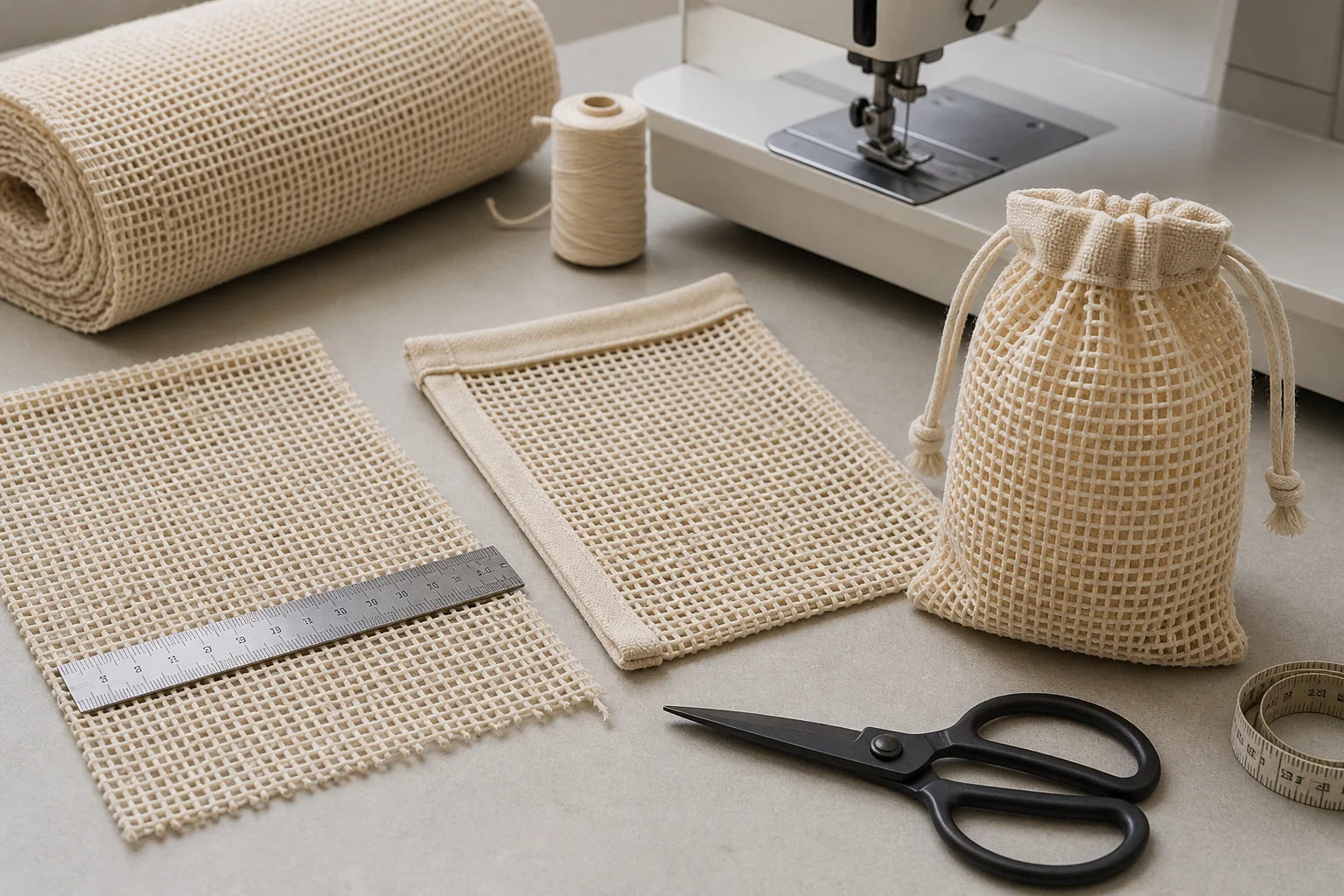
A bound edge and a solid top band do what open mesh cannot: hold the cut, carry the load, and give the drawstring something to run in.
A mesh bag is a bag whose body is an open grid rather than continuous cloth. Its defining measurement is not weight or yarn count but the opening: how wide each gap is and what share of the surface is actually hole. Everything the bag does well or badly follows from that number.
The format sits between a pouch and a basket. It holds small items without sealing them away, lets air and water through, and shows the contents without a window. The trade: the same openings let small objects out, and a cut edge has nothing solid to unravel into.
Quick Answer: Mesh is specified by opening size and open share, not by fabric weight. Those values decide what the bag is good for and how the edge must be treated, because heat cutting works only on synthetic mesh; cotton mesh must be bound or folded.
Two mesh bags can be made from the same yarn at the same weight and behave completely differently, because the openings differ. A tighter grid traps small items and reads almost like cloth; a wider grid holds bulk and lets everything under a certain size fall through. Weight and fibre are shared, so neither explains the difference.
Opening size also sets the job. Below roughly a millimetre the openings stop behaving like a sieve and act as a breathable membrane, which is why fine mesh is used where dust must stay out and air must move. Above a few millimetres the bag becomes a container that drains, and the contents stay visible from every angle.
A second effect is easy to miss. An open grid has far less material in the load path than solid cloth of the same footprint, so a mesh bag reaches its tear point earlier, and at the opening edges rather than at a seam. Strength here is how much solid material surrounds each hole — the open-area figure read the other way round.
Openings are produced in three ways, and the method decides whether the grid stays square under load or drifts out of shape.
Method | How the opening forms | Behaviour under load | Where it fits |
|---|---|---|---|
Leno weave | Warp threads twist around each other between picks, locking the gap | Opening holds its size; grid stays square | Cotton and other spun yarns |
Warp-knit mesh | Loops are knitted into a net, so the grid is formed by the loop path | Flexible, stretches with the contents | Synthetic mesh, laundry and wash use |
Extruded net | Polymer is extruded as a continuous net, not made from yarn | Fixed grid, no fraying, cannot be sewn like cloth | Rigid protective netting |
The distinction matters most at fibre level. Leno is the route open to spun cotton, because the twist stops the gap closing when the cloth is pulled. A warp-knit or extruded mesh depends on synthetic polymer, since the net is formed rather than woven. Asking for a cotton mesh bag with a heat-sealed edge asks for two things from different material families, and the specification has to choose one.
Where the evidence comes from. What follows is published research, not an order handled here. Two documents carry it: a 2012 study of pore measurement in woven fabrics by Angelova in the Central European Journal of Engineering, and ISO 9237:1995 on measuring how readily air passes through a fabric.
How the openings were measured. Fourteen greige samples of 100 % cotton, plain and twill, were photographed under a microscope, and one hundred openings were sized on each using an area formula built on thread density and mean thread diameter.
What the measurement produced. The results were not tightly grouped. The authors report that the spaces between threads are extremely irregular in size and shape, and that single readings spread far beyond the limits of the standard deviation, plain constructions more widely than twill, through uneven yarn diameter and the beat-up action of the loom.
The performance side, and its method. Openness governs how freely air crosses the material, which the authors tie to comfort, thermal behaviour and the precision of filter and barrier fabrics. ISO 9237:1995 sets out how that is measured: a method for the permeability of fabrics to air, applicable to most fabric types, including industrial fabrics, nonwovens and made-up articles.
What it changes in an opening specification. A stated opening size is a target, not a description of every hole. Two bags can carry the same nominal figure yet differ in how tightly their openings cluster, and the wide ones decide what escapes and where a tear begins. Naming opening size, fibre and edge treatment makes a specification testable; a weight alone does not.
Choosing an opening is choosing the job, so the two belong in one decision.
Opening | What passes through | Typical use |
|---|---|---|
Very fine, under 1 mm | Air and moisture only; dust and small parts held in | Jewelry pouches and dust protection |
Fine, about 1–2 mm | Air and water; small findings stay inside | Delicate jewelry and small components |
Medium, about 3–5 mm | Water and crumbs drain; larger items remain | Soap and toiletry bags |
Coarse, over 8 mm | Loose material falls through freely; contents fully visible | Produce and bulky produce carrying |
Open with an inner liner | Passes air but blocks small parts | Mixed contents on one bag |
The line worth stating plainly is the one about small parts. A bag offered for jewelry has to name the opening size, because a chain or a loose finding falls through a coarse grid and is gone. Where the open look is wanted but that risk is not, the usual answer is a coarse outer mesh with a fine inner liner, which keeps the look and moves retention to a second layer.
An open grid behaves differently from cloth the moment it is cut. Cloth cut across keeps its threads partly locked by the crossing yarns; a mesh has far fewer crossings holding each edge, so the outer row opens up and the edge begins to unwind.
Synthetic mesh has an escape route: the cut is sealed with heat, by hot knife or ultrasonic cutter, melting the polymer and fusing the opening closed. Cotton cannot use it, because natural fibre chars rather than fusing, so a cotton mesh edge has to be physically contained.
Two treatments contain it. A binding strip folded over the raw edge and stitched through captures the loose grid in a solid tape. A double fold turns the mesh back on itself and stitches it down, which is lighter and keeps the opening pattern visible to the very edge. Binding is sturdier where the edge also takes load.
Closing the bag runs into the same problem from another direction. A drawstring needs a channel, and a channel needs a solid strip to fold over and stitch. Mesh cannot form that strip itself, so the usual construction adds a solid band across the top and runs the cord inside it. That band holds the cord, shapes the mouth and takes the pull when the bag is carried.
An open grid is a poor printing surface, for a reason that has nothing to do with ink quality: a large share of the surface is not there. Ink laid on mesh falls through the openings or bridges them and breaks up as the bag flexes, so fine type or a detailed mark cannot be read on the grid itself.
The workable routes all put something solid under the mark. A solid fabric panel at the top band is neatest, because the band already exists for the drawstring and can carry a printed or woven area. A stitched patch or woven label does the same job as a separate piece and can sit where the bag is handled most. Where a mark must run across the mesh body, the logo has to be simplified to survive an interrupted background.
Because the bag is already open, a printed solid panel reads as intentional rather than added, and the contrast between panel and grid does most of the visual work without a second colour.
What it gives you | What to plan for |
|---|---|
Contents are visible without a window panel | Small parts can fall through a coarse opening |
Air and moisture move freely, so damp items dry in the bag | Fine dust passes out as easily as it passes in |
Loose material drains away on its own | The same opening lets material in as well as out |
Less material per bag than an equivalent solid pouch | Tear resistance is lower and failure starts at the openings |
The grid pattern is itself a design surface | A cut edge cannot be heat sealed on cotton |
Six lines take a mesh bag from a general request to something a sample can be checked against.
Element | What belongs in it |
|---|---|
Opening size | The gap width, and what share of the surface is open |
Fibre and mesh type | Cotton leno or synthetic warp-knit, named explicitly |
Edge treatment | Bound, double folded or heat sealed, and why |
Closure | Solid top band with cord, or an open mouth |
Marking | Printed band, stitched patch, woven label, or none |
Contents and load | What goes in, the weight, and whether small parts are involved |
Buyers running a first mesh programme beside other formats can start from the wholesale sourcing guide for custom packaging, which covers order tiers, tooling and what a change of format does to lead time.
What opening size is right for a jewelry pouch? Fine enough that the smallest piece in the range cannot pass through — an opening under about two millimetres, or a coarse mesh paired with a fine inner liner. Choose against the contents, not the look of the bag.
Can a cotton mesh bag have a heat-sealed edge? No. Heat sealing melts the edge, and cotton chars instead of fusing. A cotton mesh edge has to be bound with a strip or folded and stitched; neither is optional if the bag is to survive handling.
Is a mesh bag stronger or weaker than a solid pouch? Weaker in tear terms, and it fails in a different place. Less material sits in the load path, and the openings are where a tear begins, so the solid material around each hole carries the load.
Can mesh bags be printed? A mark can be applied, but not directly across the grid. The workable approach is a solid top band, a stitched patch or a woven label, with a logo simplified to survive an interrupted surface.
Why do mesh bags smell less than solid pouches? Because the openings do not trap what a solid pouch traps. Air moves through and moisture leaves, so a damp item dries instead of sitting in a closed space. The same openness is why a mesh bag offers no barrier protection.
A custom mesh bag is designed by its openings. Opening size and open share decide what the bag holds in, what it lets out and how much material remains to carry a load, and they also decide the edge, because an open grid cannot be heat sealed once the fibre is cotton. The construction choices follow in a fixed order: how the opening is formed, how the cut edge is contained, how the mouth is closed, and where a mark can sit on a surface that is mostly gap.
Background on how open structures are built and specified is published by Utouch Packaging. Openings, edge treatments and closure options for a specific brief can be raised through the contact page, with volume pricing held on the storefront at Xiamen Yu Touch Imp. & Exp. Co., Ltd.
