
Views: 0 Author: Site Editor Publish Time: 2026-09-16 Origin: Site


Article Intro: Envelope jewelry packaging covers two products that share one folding flap: the soft fabric envelope pouch — suede, velvet or microfiber with a stitched edge — and the flat paper or board sleeve that carries a piece as a retail wrap or a mailer. Neither uses a lid, a zip or a drawstring, so both are priced by material area and stitching time rather than by tooling. This guide covers the formats that are actually ordered, how the four common materials behave at the fold, where an envelope beats a rigid box and where it does not, and the sizing and printing limits worth settling before an order is placed.
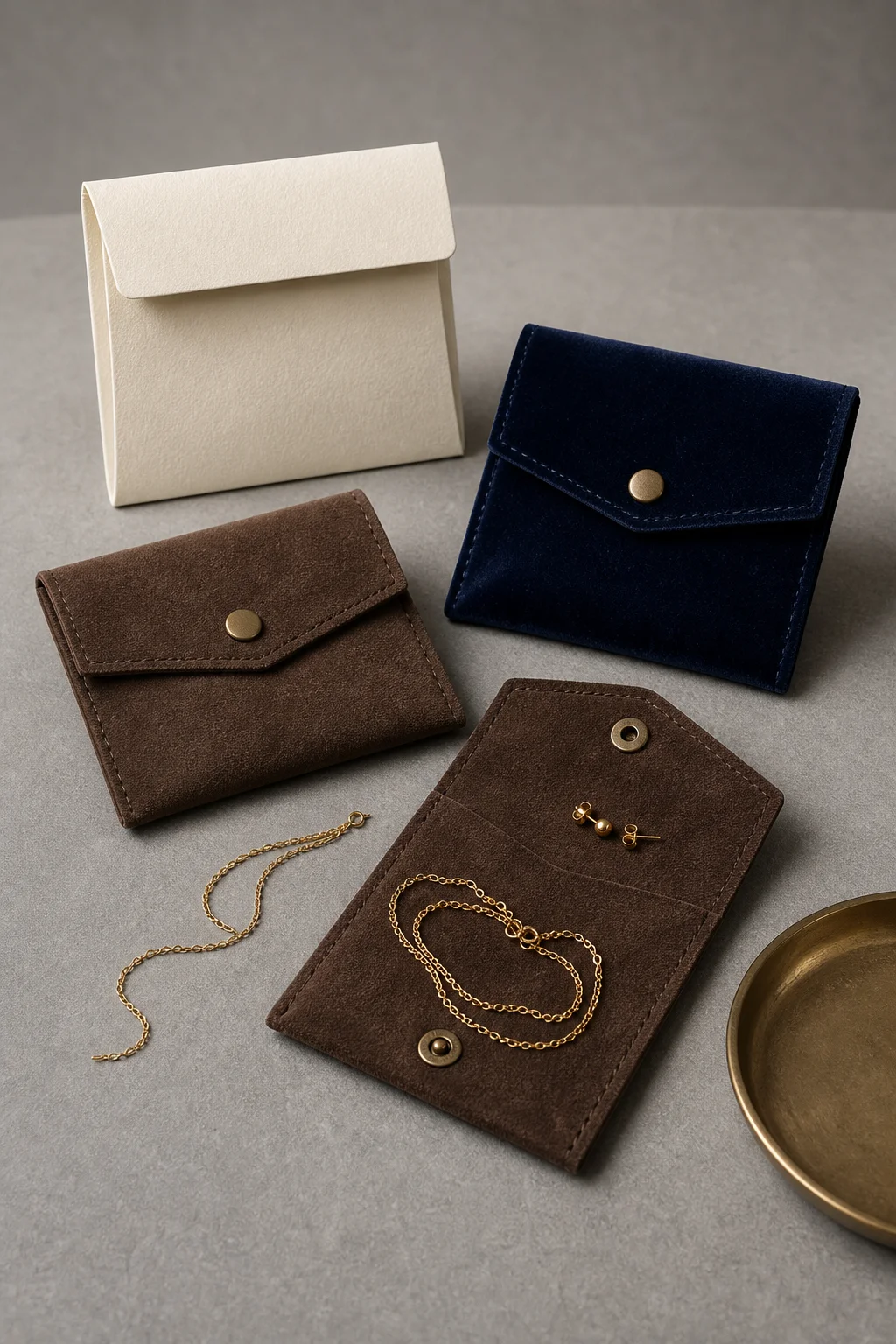
One construction, four materials — a closed suede envelope pouch, the same pouch opened flat around a necklace and studs, a navy velvet envelope pouch, and a cream paper sleeve
Envelope jewelry packaging is any pack closed by a single fold-over flap rather than a drawstring, a zip or a rigid lid, and in practice the term covers two products. The first is the fabric envelope pouch: the flap is cut as a continuation of the back panel, folds forward across the mouth of the bag and fastens with one snap, a hook-and-loop patch, a magnet or a ribbon tie, and the body is a rectangle, a square or a shallow gusseted pocket with a stitched edge. The second is the paper or board sleeve — folding carton board, kraft or a textured art paper — cut in one piece with a tuck flap, optional side gussets and optional tissue or foam lining.
Both formats are ordered for three reasons: a soft, finished presentation at the lowest cost per unit in the category; flat storage and shipping, so a carton holds far more units than it holds rigid boxes; and a flap that reads as a gift, which suits occasion and bridal lines. Neither immobilises a fragile setting the way a rigid box with a fitted insert does, and that trade-off settles most specification questions below.
Quick Answer: Envelope packaging for jewelry is the least expensive way to give a piece a finished, gifting-ready presentation and the flattest way to store and ship it. Choose the fabric envelope pouch when the piece needs a soft finish and a branded touch, the paper or board sleeve when the piece travels inside an outer carton, and a rigid box when a fragile setting must not move inside the pack.
Five constructions cover almost every envelope inquiry. A flat flap costs less material and less stitching than a gusseted body, and that gap appears directly in the unit price. A jewelry envelope packaging programme normally settles on two of them: one format for the standard range and one for gift sets.
Format | Construction | Typical use | Relative cost |
|---|---|---|---|
Flat flap envelope | Two panels and one fold-over flap, closed by a snap or a ribbon tie | Rings, studs and single pendants; the cheapest branded pouch | Lowest |
Gusseted envelope | Side and bottom gussets, flap across the short edge | Necklaces and bracelets that need depth | Moderate |
Envelope with inner pocket | Flap plus a stitched divider or card slot inside | Two or three-piece sets; a card travelling with the piece | Moderate |
Paper or board sleeve | Single-piece folded sleeve, tuck flap, optional side gusset | Retail wrap and mailers; pieces shipped inside an outer carton | Low |
Lined envelope | Fabric or board envelope with foam, EVA or a suede-lined interior | Pieces that need a shaped cavity inside a flat format | Highest |
A custom jewelry bag envelope is specified either as a repeat of a size the brand already buys or as a size cut around a piece with unusual proportions. The second needs a sample before production: a flap that reads well at 9 × 12 cm can look thin and unstable at 15 × 20 cm.
Four materials account for nearly all envelope volume, and each behaves differently at the fold — the point of weakness in every construction, because a flap is folded once in production and again by the customer.
Material | Hand and finish | Behaviour at the fold | Best for |
|---|---|---|---|
Suede | Matte brushed nap, warm to the touch | Folds cleanly, holds a crease, edges stitch without fraying | A suede envelope jewelry pouch for gifting and bridal |
Velvet | Short dense pile, deep light response | Shows press marks at the fold; needs a wider seam allowance | A velvet envelope jewelry pouch for premium and occasion lines |
Microfiber | Fine low nap, even surface, anti-tarnish options | The most predictable fold and the cleanest print surface | Logo-led programmes and higher volumes |
Paper or board | Kraft, uncoated art paper, textured board | Scores and folds mechanically; the score keeps a tuck flap square | Retail sleeves and mailers |
Two notes follow. An embossed envelope microfiber jewelry pouch holds a deeper, cleaner impression than the same artwork on velvet, because velvet pile compresses under pressure and springs back unevenly — which is why a crisp debossed logo is usually quoted on microfiber, suede or paper. And small envelope paper bags for jewelry are die-cut and scored from a flat sheet, so a change to the flap depth costs a new scoring die while a change to the artwork does not.
The comparison is not about quality; it is about which job the packaging has to do.
Where the envelope wins:
Cost per piece. No greyboard, no wrapping, no fitted insert and no box tooling. At 500 to 2,000 units per design it is usually the only format that keeps presentation spend proportional to a low unit price.
Packed volume. Envelopes ship flat or nearly flat, so freight per unit is a fraction of a rigid box at the same piece count.
Softness and gifting. A suede or velvet flap presents a chain or a stud without an insert, in the format customers photograph — a pouch on a table beside a gift note.
Speed of change. With no structural tooling, a new size or flap depth moves through sampling faster than a rigid box.
Where the rigid box wins:
Protection of a fragile setting. A fitted insert holds a stone clear of surfaces; a flat pouch lets a piece move.
Shelf presence. A rigid box stands and stacks; an envelope lies down unless it is propped or cradled.
Rigid branding area. A lid face takes foil, embossing and a large logo; a flap takes a smaller mark at an angle.
Perceived value at the top of the line. Above the mid tier, buyers still expect a box; the envelope then works as the inner wrap.
Many brands end up using both: an envelope pouch as the inner wrap and the shipping-safe layer, and a rigid box or sleeve for the highest retail price points.
An envelope gives less flat, stable area for decoration than a box lid, so print decisions are made earlier. Four points decide what is possible.
Flap geometry. The flap is the natural branding position, but it narrows towards the point or the tuck edge. A mark in the widest part stays clear of the fold; a mark across the fold distorts every time the flap opens.
Method by material. Foil stamping and debossing hold best on microfiber, suede and coated paper; screen print is the most opaque on velvet and dark suede, where a foil mark can sink into the nap.
Seam clearance. The stitched edge runs a few millimetres inside the trim, so artwork must stop short of that line.
Interior branding. The inside of the flap and the inner pocket carry care text or a small mark at no extra panel cost.
On paper and board sleeves the same logic applies through scoring: decoration stays away from the score lines, and any window sits on the flat front panel rather than the tuck side.
Envelopes are quoted on external dimensions and bought on internal ones, and confusing the two is the most common specification error here: the usable opening is smaller than the outside by the seam allowance on each side and by the flap overlap, so a pouch quoted at 9 × 12 cm does not accept a 9 × 12 cm card.
Three sizing habits remove most of the risk:
Give a piece and a fit, not just a number. Send the dimensions of the largest piece the pouch must hold plus the clearance wanted around it; a chain with a clasp needs more than a flat card in the same footprint.
Work from the standard ladder first. Necklace pouches commonly sit in the 9 × 12 cm band, bracelet pouches a step wider, stud and ring pouches smaller. Starting on a standard size keeps a programme on an existing knife.
Decide the gusset before the sample. A pouch that must hold a coiled chain or a bangle needs a gusseted body; specifying depth after the first sample normally means re-cutting the pattern rather than adjusting it.
For envelopes for jewelry boxes — the version that wraps a piece inside an outer box rather than replacing it — the pouch is sized to the insert it sits in, so the box interior is the real constraint and should be confirmed first.
An envelope wedding jewelry gift packaging bag is the clearest example of the format doing work a box cannot: it can be personalised per guest, ordered in bride-party quantities, and handed over already closed rather than assembled on site. The usual brief is a suede or velvet pouch in the palette of the event with a ribbon or tuck closure.
Two planning points decide whether that order runs smoothly. Personalisation across a set of names is a print-run question rather than a design question, and the practical approach is one plain pouch design with the personalised element carried on a small card or tag inside. And because a wedding date does not move, the order has to clear printing and stitching well before the event, not merely before the shipping window.
Three commercial facts separate an envelope order from a box order.
Tooling is minimal and only rarely new. A pouch programme on a standard size uses an existing cutting knife, so the only new cost is artwork and, on paper sleeves, a scoring die if the flap is unusual. That is why envelope minimums are set by material and stitching rather than by a tooling charge, and why a first order can be quoted at a far lower quantity than a rigid box at the same design stage.
Sampling is short but not optional. One sample confirms flap depth, snap position and finished size on the actual material, and both fabric and paper need it because a suede flap and a board tuck flap behave differently at the same dimension.
Decoration drives the schedule, not the bag. Cutting and stitching move quickly; foil, screen print, debossing and personalisation are the steps that add days. Ask for the lead time split between plain and decorated so the difference is visible. The wider sourcing fundamentals — minimums, sampling, tiered pricing and supplier qualification — are set out in the 2026 B2B sourcing guide for small and growing brands.
Q: Is envelope packaging cheaper than a rigid jewelry box?
A: Usually yes, by a wide margin: there is no greyboard body, no wrapping, no fitted insert and usually no box tooling. The envelope is priced by material area, stitching and decoration, so it stays proportional at low volumes where a rigid box does not.
Q: What is the difference between a jewelry envelope and a jewelry pouch?
A: In this category the words overlap. A jewelry envelope is specifically a pouch or sleeve closed by a folding flap, while a pouch may also close with a drawstring or a zip. The distinction matters when ordering, because the closure rather than the shape is what changes the pattern and the cost.
Q: Which material prints a logo best on a flap?
A: Microfiber holds a debossed or foil mark most consistently, followed by suede and coated paper. Velvet compresses unevenly under pressure, so fine detail is best screen printed on velvet rather than foil stamped, and dark suede usually needs a high-opacity method as well.
Q: How do I specify the size correctly?
A: Send the dimensions of the largest piece the pouch must hold, the clearance needed around it and whether a gusset is required for depth. The supplier then quotes an external size whose internal opening meets that requirement — quoting only an external number is how pouches arrive too small.
Envelope jewelry packaging is the flat, stitched end of the category: a single fold-over flap instead of a lid, a stitched or scored edge instead of a wrapped board, and a price that follows material area rather than tooling. Five formats cover most orders, from the flat flap envelope to a lined envelope with a shaped interior, and four materials — suede, velvet, microfiber and paper — decide how the flap behaves at the fold and which decoration will hold. The format loses to a rigid box on protection, shelf presence and branding area, and wins on cost per piece, packed volume, gifting feel and speed of change; many programmes end up using both. The details that decide whether an order arrives right are settled before production: an internal size that fits the piece, a gusset decision made up front, artwork kept clear of the fold and the seam, and a sample confirmed on the material the order will actually run in.
Utouch Packaging manufactures custom envelope jewelry packaging — suede, velvet and microfiber envelope pouches, gusseted and pocketed versions, and paper or board sleeves — alongside rigid boxes and dust bags, with samples confirmed on the production material and standard sizes run from existing knives. For wholesale and custom enquiries, visit the Utouch Packaging contact page or reach the export team through Xiamen Yu Touch Imp. & Exp. Co., Ltd.
