
Views: 0 Author: Site Editor Publish Time: 2026-09-11 Origin: Site


Article Intro: Blank and engravable jewelry packaging is the unbranded base of the packaging market — boxes and bags with no logo, made to be printed, engraved, or labeled by the buyer. For small brands, makers, and resellers, blank packaging is the entry point: order a small quantity, personalize it in-house, and only move to full OEM production when the brand is ready. This guide covers blank formats, engravable materials, engraving methods, the OEM comparison, and the wholesale notes for buying unbranded packaging well.
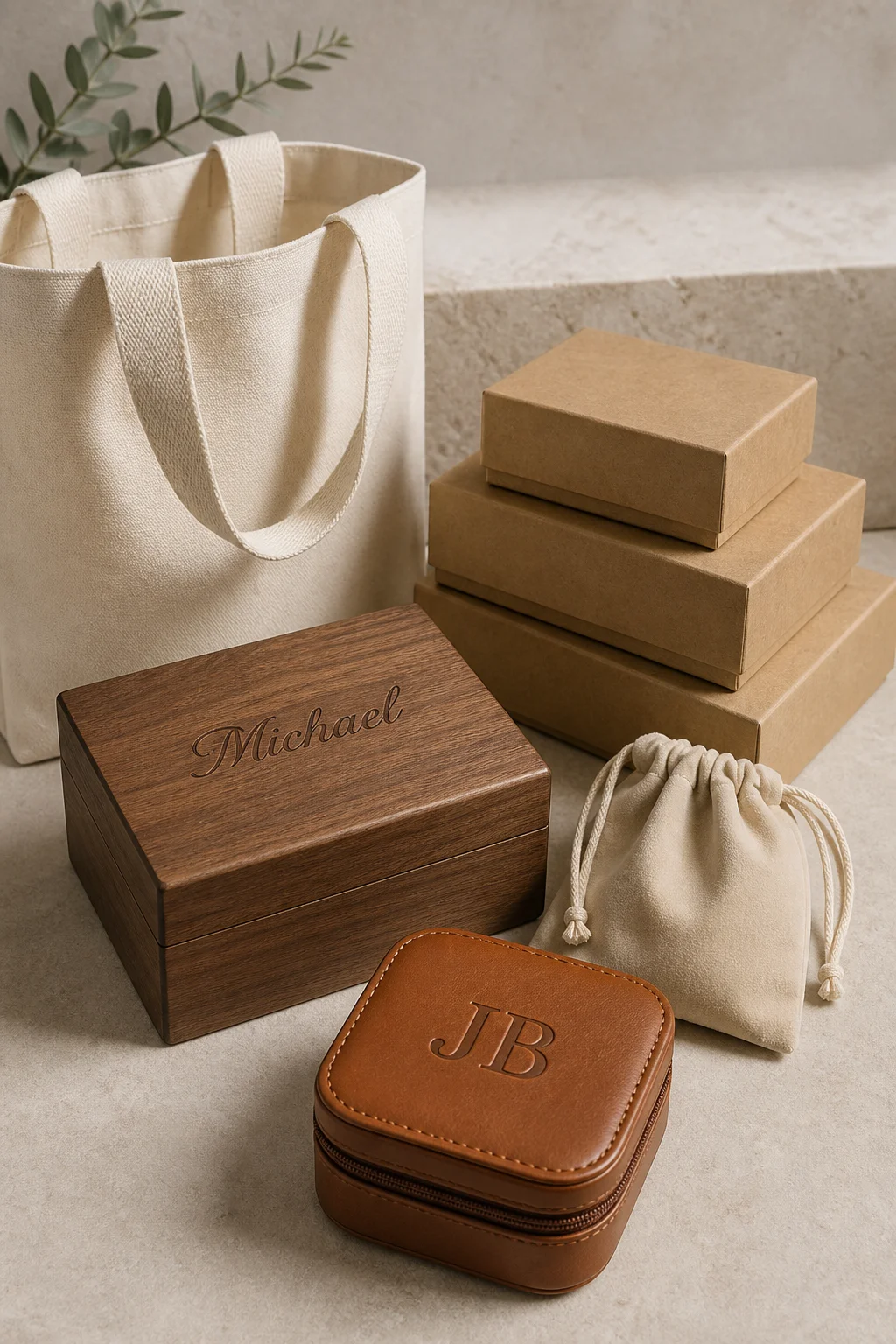
The unbranded base — blank boxes and bags, and an engravable lid
Blank packaging is produced without branding: no foil, no print, no embossed logo — the box or bag arrives as a clean base that the buyer finishes. Engravable packaging is the same logic applied to materials that accept permanent personalization: wood, leather, metal plates, and coated boards that take a laser or engraving tool cleanly.
The two categories overlap. A blank jewelry box may be intended for in-house printing, or it may be chosen precisely because its lid is engravable — a blank wooden box that becomes a personalized gift. The unifying idea is control: the buyer supplies the brand, the packaging supplies the surface.
Blank and engravable packaging answers four buyer situations:
The small-batch start: A maker launching on a marketplace needs packaging now, not after a tooling cycle — blank boxes and bags ship from stock, and MOQs start low.
The in-house personalization line: With personalized jewelry orders reported to have grown by about 27%, and the customized jewelry market projected around $42.25 billion in 2026, sellers increasingly personalize the piece and the packaging together — a name engraved on the box lid is part of the product.
The printing or craft upgrade path: A blank organic cotton drawstring bag with logo stamped by the seller, a blank kraft box heat-stamped at a local shop, a blank ring box hand-lettered for a market booth — blank packaging moves the customization cost to where it is cheapest.
The OEM runway: Buyers order blank first, prove the format, then convert to full OEM production with branding once volumes justify the tooling.
Global demand for personalization supports the trend: the personalized gifts market is projected to grow at a compound annual rate of about 11.9% from 2026 to 2033, and gift wrapping products at about 7.53% a year through 2035 — the wrapping and the personalization grow together.
Not every material engraves well; the base has to match the method:
Material | Engraving result | Best for |
|---|---|---|
Wood and bamboo | Deep, high-contrast laser engraving; premium natural look | Engravable jewelry box blanks, gifts |
Leather and PU | Debossed or burned marks; soft, understated finish | Engravable jewelry pouches and rolls |
Coated paperboard | Clean foil or laser marks on the coated surface | Blank jewelry boxes finished locally |
Metal plates | Precision engraving; plates applied to any box body | Nameplates, travel case lids |
Velvet and fabric | Limited — works with patches and tags, not direct engraving | Engravable jewelry pouch with tag |
The engravable jewelry box blank is the format most often specified: a wooden or coated-board box with a clean, flat lid area sized for a name, monogram, or short message. The lid geometry matters more than the material list — a recessed or oversized lid makes every engraving look deliberate, while a domed or busy lid fights the engraver.
The method follows the material and the volume:
Laser engraving: The in-house standard for small and mid volumes — clean on wood, coated board, leather, and metal plates, and the method most compatible with one-off personalisation.
Heat stamping and foil: The finish for paperboard and PU at volume, applied by a local finisher where a heated die is economical.
Debossing and embossing: The leather route — a mark pressed into the surface for a subtle, premium read that suits engraved pouches and travel cases.
Hand finishing: Calligraphy, paint, and hand-set tags for market and craft lines, where the personalization is the product.
Blank supply covers the whole packaging line, so a small brand can source one unbranded set:
Blank boxes: Rigid, kraft, and wooden boxes with clean lids for printing or engraving — the blank jewelry box is the anchor of the line, available in the standard sizes that match stock inserts.
Blank bags: A blank cotton canvas tote bag for retail and market use, and a blank round cotton canvas bag for smaller pieces — both printable by the seller.
Blank pouches: Cotton, velvet, and satin drawstring pouches with clean surfaces for tags or stamping, including the engravable jewelry pouch in leather and PU for debossed names.
Travel formats: A travel jewelry case engravable at the lid — the personalization that turns a travel case into a gift.
Ordering one blank set across boxes, bags, and pouches keeps the unbranded line consistent and consolidates the freight.
Blank and OEM are two ends of the same decision:
Blank: Stock formats, low minimums, no tooling, the buyer supplies the branding. Fastest to shelf, lowest commitment.
OEM jewelry box and oem cotton bag production: Custom formats and branding produced to the buyer's specification — an OEM cotton bag carries the buyer's label as ordered, with tooling, plates, and print setup as part of the order.
The middle path: A blank format with a stock insert, plus one custom element — a printed sleeve, a stamped tag, a personalized plate. Many brands run this middle path for years, because it keeps the tooling cost near zero while the packaging still looks made for them.
The pouch-level version: A jewelry pouch oem order applies the same logic at the smallest scale — the pouch produced to the buyer's specification, branded or left clean, so the soft packaging matches the box program without a second supplier.
The rule of thumb: stay blank while the branding changes often and the volume is modest; move to OEM when the format is settled and the volume carries the setup cost.
The blank market exists because two large buyer groups need packaging before they need branding. Marketplace sellers — the Etsy-scale shops that sell one piece at a time — buy blank boxes and pouches in small quantities and add their own finishing: a printed sticker on the lid, a stamped tag on the drawstring, a handwritten note. Market and craft sellers buy blank kraft boxes, stamp them at the booth, and treat the packaging as part of the stall's handmade look.
Both groups share the same constraint: the packaging has to be right on the first order, because reordering mid-season breaks the look. The practical answer is standardisation — choose two or three blank formats in fixed sizes, keep the insert dimensions constant, and add personalization on top. A line that runs one blank box size and one blank bag size covers most pieces, and a reorder arrives identical to the first.
Personalisation usually happens in one of three places, and the packaging choice follows:
In-house: The seller engraves, stamps, or prints the blank after the sale — the packaging stays blank in stock, and personalization happens per order. This suits made-to-order lines, where the engraved lid is part of the product.
At the finisher: A local engraver or print shop applies the mark in batches — practical where a heated die or a laser is not worth owning, and where the seller wants a consistent mark across the line.
At the packaging supplier: The blank is finished during production for larger runs — the point at which blank packaging becomes OEM packaging, with the brand applied under production control rather than by hand.
The workflow choice is a volume decision more than a quality decision: personalization bought per order costs more per unit but carries no inventory risk, while production finishing costs less per unit and locks the design. Most growing lines start with in-house finishing, move to a local finisher as orders steady, and convert to production finishing once the quantity justifies it.
Two practical notes for buyers new to the blank market:
Confirm the finishing surface: Ask what the lid and bag surfaces accept — coated or uncoated, how the blank organic cotton drawstring bag with logo printing behaves after washing, and whether the wood lid is sanded and ready to engrave. The blank market is not uniform, and the surface is the specification that matters.
Order samples before the run: A blank box that fits the insert and engraves cleanly is the whole purchase. Test the print or engraving on the actual sample, not on a similar product.
The sourcing fundamentals — minimums, lead times, and supplier qualification — are covered in the 2026 B2B sourcing guide for small and growing brands.
Q: What is the difference between blank and OEM packaging?
A: Blank packaging is a stock format with no branding; OEM packaging is produced to your specification with your branding. Blank starts at lower minimums; OEM carries setup cost but delivers a finished, branded format.
Q: Which material is best for engraving a jewelry box?
A: Wood and coated board give the cleanest contrast, leather and PU the softest premium mark. The decisive factor is the lid surface — flat and clean engraves well, domed and busy does not.
Q: Can I print on blank packaging myself?
A: Yes — that is the point of blank stock. Test the method on a sample first: heat stamping, screen printing, and laser engraving each behave differently across coated board, canvas, and leather.
Blank and engravable jewelry packaging is the unbranded base that lets a small brand start now and personalize later — a blank jewelry box or bag from stock, printed, stamped, or engraved as the line grows. The format sits under a personalization market expanding at roughly 11.9% a year, and under a customized jewelry market of about $42.25 billion in 2026, where the package and the personalization are often one purchase. The practical rules hold: match the material to the engraving method, confirm the finishing surface, sample the blank with your own print, and move to OEM only when the format has earned the tooling.
Utouch Packaging supplies blank and engravable jewelry boxes, bags, and pouches alongside full OEM production, with samples for print and engraving tests before any run. For wholesale and custom inquiries, visit the Utouch Packaging contact page — the team responds with format guidance and tiered quotes.
