
Views: 0 Author: Site Editor Publish Time: 2026-09-22 Origin: Site


Article Intro: Anti-tarnish jewelry packaging is not one product but a stack of barriers. Silver darkens because sulfur compounds in the air reach the metal and form silver sulfide on its surface, and packaging exists to slow that reaction before the piece reaches the customer. The materials that do the work are unglamorous: a sealed polyethylene bag, an acid-free tissue wrap, a treated interleave, a desiccant. What decides whether they work is what a conservator checks first — how well the enclosure is sealed, and what else inside it is emitting gas. This guide covers how tarnish forms, which materials prevent it, which cause it, and how to specify anti-tarnish packaging.
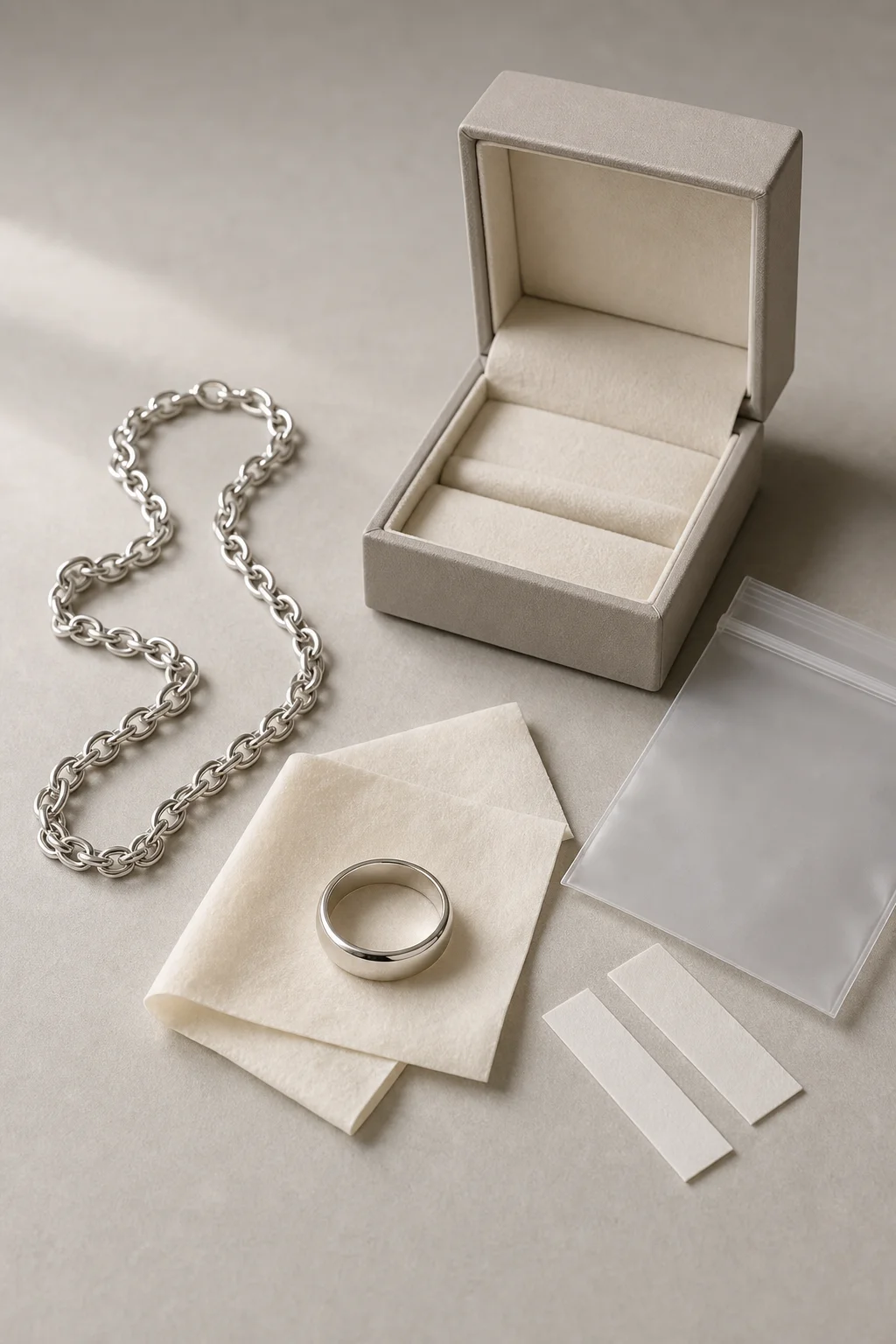
The working parts of an anti-tarnish system — barrier pouch, tissue wrap, treated insert, and a box interior that emits nothing
Anti-tarnish jewelry packaging is any system built to slow the reaction between a metal surface and the sulfur compounds around it. In practice it is not a single material but a stack: a barrier that keeps polluted air out, a wrap that keeps the metal off that barrier, and often an insert that absorbs the sulfur still getting through.
The stakes are commercial. Silver that arrives dull reads as used, and a customer who polishes a new necklace more than once in the first month rarely blames the alloy. Because the reaction runs continuously and begins at extraordinarily low concentrations, packaging is the one part of the supply chain that can be specified to control it.
Quick Answer: Seal the piece in a barrier bag, wrap it in acid-free tissue first, and keep every material inside that enclosure free of sulfur emissions. The 100–10–1 rule of thumb from the Canadian Conservation Institute shows the scale: 200 ppb of nitrogen dioxide in outdoor air typically falls to about 20 ppb inside a building, and to about 2 ppb inside a sealed enclosure. The seal does the heavy lifting; the insert is the refinement, not the foundation.
Four mechanisms explain almost every tarnish complaint that reaches a packaging supplier.
Sulfur gases at vanishingly low concentrations. Preventive-conservation guidance from the Canadian Conservation Institute states that silver exposed to only 0.1 microgram per cubic metre of hydrogen sulfide — 1 part per billion — will typically tarnish within a year, and that this level is common indoors.
Copper inside the alloy. Sterling silver is 92.5% silver and 7.5% copper, and it is the copper that reacts with sulfur to form the silver sulfide that reads as tarnish. Higher-copper alloys darken faster.
Humidity above a threshold. Guidance prioritises avoiding relative humidity above 65%, with a moderate 40–55% band adequate for most metals; for silver alone, conservation advice recommends below 50%. Moisture does not create tarnish on its own, but it accelerates the reaction and carries contaminants to the surface.
Hands and residues. Fingerprints leave chloride salts and fatty acids that concentrate at the contact point, and chloride salts have been shown to penetrate cotton gloves, which is why nitrile is the handling standard for polished metal.
The consequence for a specification is counter-intuitive: a well-sealed bag of the wrong material can be worse than an unsealed bag of the right one, because an enclosure concentrates whatever its materials emit.
Brand Background: A collection-level case from the National Archaeological Museum in Madrid, which displays more than 13,000 objects across 40 galleries, including silver and jewelry holdings that must stay bright in a polluted city. The evidence is a documented third-party study published in the journal Heritage in December 2025.
The Packaging Challenge: Conservators could not simply clean the silver, since every polishing cycle wears the original surface: tarnish had to be prevented, not removed. The open question was which part of the enclosure did the work: sulfide levels in the galleries were expected to explain the damage, but nobody had measured the inside of the display cases against the surrounding room over a full year.
The Procurement Decision: The team selected four display cases from two manufacturers — airtight designs and designs with far lower airtightness — and added coupons in the open gallery as a control. Tarnish was quantified by three methods (colour measurement, weight change and galvanostatic reduction) while temperature, humidity and six gaseous pollutants were logged by passive samplers.
The Solution: Enclosure design emerged as the dominant variable. Average relative humidity held at a stable 35%, and inside that narrow band humidity did not track tarnish, so the difference had to come from the cases. The corrosion layer agreed: airtight cases produced mostly silver sulfide, while coupons in the lower-airtightness case and the open gallery also carried silver chloride and silver sulfate that the sealed cases excluded.
Measurable Results: Annual corrosion rates landed between the IC1 (very low) and IC2 (low) categories, and coupons in the non-airtight case corroded at less than half the rate of those left in the open gallery. Hydrogen sulfide concentration alone did not explain the pattern, pointing the authors to airtightness, the materials and fittings inside each case, and cleaning products used nearby. The lesson for a jewelry specification is to buy the seal first, then audit everything that sits inside it.
Most brand specifications stop one step short here: a sealed pouch is a promise, and the felt, foam and adhesive inside it decide whether the promise holds.
Four routes cover nearly every brief and stack.
Route | What it does | Best for | Limitation |
|---|---|---|---|
Sealed barrier bag | Blocks polluted air from the metal | Every silver or brass piece in transit or stock | Defeated by any emitting material packed inside it |
Acid-free tissue wrap | Separates the metal from the barrier and from other pieces | Polished pieces and chains before packing | Not a barrier on its own; it slows, not stops, the reaction |
Treated interleave or insert | Absorbs or neutralises sulfur that still gets through | Long shelf life, wholesale stock, retail display | A consumable with a service life to be scheduled |
Desiccant | Holds humidity down inside a sealed enclosure | Humid climates, sea freight, tropical retail | Does nothing about sulfur, but a barrier also traps moisture |
The first route is the one most brands skip, and the cheapest: a jewelry ziplock bag in low-density polyethylene is the example conservation guidance names, because polyethylene heat-seals into a usable barrier for a few cents a unit. The treated route is where the branded options sit — a treated anti tarnish jewelry pouch, an anti oxidation jewelry pouch, or a strip tucked into a box. The antistatic polymers in anti oxidant jewelry bags are the strongest and dearest version, reserved for high-value goods and long storage rather than every shipment.
Where a gift needs presentation more than shelf life, a pvc jewelry pouch or clear plastic jewelry bags protect against dust and contact cheaply, but neither is sealed, so both are a handling layer rather than a tarnish barrier.
Because an enclosure concentrates whatever is inside it, the material list matters as much as the seal — and conservation guidance is direct about what to keep away from silver.
Material | What it emits | Where it hides |
|---|---|---|
Wool and wool felt | Sulfur-containing gases; emissions rise from 0.03 to about 1 microgram per cubic metre between dark and sunlight | Traditional felt liners; pouches sold as velvet over a wool base |
Rubber gaskets and fittings | Sulfur-based gases | Case seals, elastic loops, some drawstring stops |
Untreated wood and board | Formic and acetic acid, aldehydes and peroxides; a wood crate measured 80–3,000 micrograms per cubic metre of acetic acid | Wooden boxes, unsealed board inserts, reactive cardboard |
Acid-type silicone sealants and adhesives | Acetic acid | Case gasketing and glued-in liners |
Fresh emulsion or oil-based coatings | Acetic acid, ammonia and peroxides | Painted boxes, newly finished displays |
The list explains a pattern easily misread as a quality problem. A custom velvet jewelry pouch or a velvet jewelry pouch with logo built on polyester velvet is neutral; the same construction on wool-backed felt is not. Because a buyer cannot tell one from the other by hand, the specification must name the fibre, not the finish. Suede follows the same rule: a suede jewelry gift bag in chrome-free polyester suede behaves, while leather suede with a reactive tannage is a risk. A soft velvet jewelry pouch with ribbon is no safer than a plain one; only the substrate and the adhesive decide that.
Two cheap counter-measures matter. First, interleave: clear polyester film between the metal and any wood, board or coated surface breaks direct contact. Second, wrap before sealing, so the metal never rests against a barrier surface that picked up contaminants during handling.
Advantages of specifying a sealed anti-tarnish system:
Complaints are reduced at the source, because the reaction is slowed where it starts rather than corrected after the customer opens the box.
Wholesale stock sitting in a distributor's warehouse for months keeps a predictable shelf life, and one barrier-and-insert combination can cover an entire silver range.
The incremental cost per unit is small next to the value of the piece being protected.
Drawbacks to plan for:
Consumables expire, so treated inserts and desiccants need a replacement schedule.
Sealed enclosures restrict access, and every inspection means breaking and remaking the seal.
Barrier materials add bulk and change the unboxing sequence, and auditing fibre content and adhesive chemistry takes effort, because suppliers rarely volunteer either.
Three questions separate a supplier who can deliver an anti-tarnish specification from one who can only quote a pouch.
What is the barrier material, named by resin? Low-density polyethylene is the baseline; metallised and coextruded barriers perform better and cost more. "Plastic bag" is not an answer.
What is the exact fibre of the lining, and what adhesive holds it? Polyester velvet, polyester suede and taffeta are safe defaults; wool felt and acid-cure silicone adhesives are not.
Is the insert treated or plain? Treated papers and polymers are consumables with a stated service life.
On minimums the familiar pattern holds: logo printing on pouches and inserts typically starts at 200-500 pieces, while custom-dyed or Pantone-matched materials run 1,000-5,000 and need a dye sample before production, with bulk production three to four weeks after approval. As a public reference for the consumable layer, treated anti-tarnish strips retail around $10 for a pack of 20 and treated tabs at $6.50 for 100 (2026 list pricing from a specialist supplier) — a modest addition to a unit cost that usually sits well under a dollar for a printed pouch at volume (illustrative). For a full framework comparing fibre, barrier, insert and volume tier, see the 2026 B2B sourcing guide for small and growing brands.
One planning note belongs in the budget: anti-tarnish protection is specified per shipment, not per range, because the barrier is consumed when the order ships. A brand selling through a stockist should also expect the stockist's storage to undo part of the work, which is why over-specifying the barrier beats promising a shelf life nobody further down the chain can guarantee.
Q: How long does anti-tarnish packaging actually protect silver?
A: It depends on the barrier, the seal and the storage conditions rather than on the packaging alone. Treated-product suppliers claim protection measured in years, and a museum study held corrosion to the low range over a full year, but an unsealed pouch in a humid room will show tarnish far sooner. Treat any single figure as a claim to test against your own storage, not as a guarantee.
Q: The velvet pouch that came with a piece looks luxurious — could it be causing the tarnish?
A: Possibly, if the pile sits on a wool or wool-blend base, because degrading wool emits sulfur-containing gases. Polyester velvet and polyester suede are neutral alternatives. The finish tells you nothing; the fibre and the adhesive do.
Q: Is a sealed bag enough on its own?
A: It is the largest single gain, and also the easiest to cancel out. A sealed enclosure holds humidity as well as pollutants, so a desiccant belongs inside it, and any emitting material packed alongside the piece will be concentrated rather than diluted.
Q: Can anti-tarnish packaging be branded?
A: Yes, and branding does not usually conflict with the protection. A logo printed on the presentation box, the outer sleeve or a card inside leaves the barrier untouched, because the printed element sits outside the sealed layer. Avoid printing directly onto the barrier with a solvent-based ink and then repacking, since that puts a fresh ink film inside the enclosure.
Anti-tarnish jewelry packaging works on a single principle: tarnish is caused by sulfur compounds reaching the metal, so the specification has to control what touches the piece and what travels with it. That means a real barrier rather than a decorative bag, an acid-free wrap between the metal and the barrier, a desiccant to hold humidity down inside the seal, and an audit of every lining, board and adhesive that will be enclosed with it, because wool, rubber, untreated wood and acid-cure adhesives all emit the very compounds the packaging exists to exclude. The evidence base is unusually strong, and most of it comes from museum conservation rather than from marketing: silver tarnishes at hydrogen sulfide concentrations around one part per billion, a sealed enclosure can cut pollutant ingress by an order of magnitude, and a one-year study of sealed museum cases found airtightness to matter more than sulfide concentration alone.
Utouch Packaging produces custom jewelry packaging that can be specified around this framework — barrier pouches, polyester velvet and suede linings, printed boxes, die-cut inserts and tissue wrap — with the fibre, the barrier resin and the insert confirmed before production. For wholesale and custom enquiries, visit the Utouch Packaging contact page or reach the export team through Xiamen Yu Touch Imp. & Exp. Co., Ltd.
