
Views: 0 Author: Site Editor Publish Time: 2026-10-18 Origin: Site


Article Intro: A small jewelry box is not a large one reduced on a photocopier. Board thickness, hinge walls, crease widths and magnet size stay at their absolute values while the box around them gets smaller, so every fixed dimension takes a larger share of the panel that carries it. This guide follows the dimension chain from the outer face to the content it has to hold, and it leaves the commercial side of small boxes - pricing, order quantity and shipping arithmetic - to the articles that already cover it.
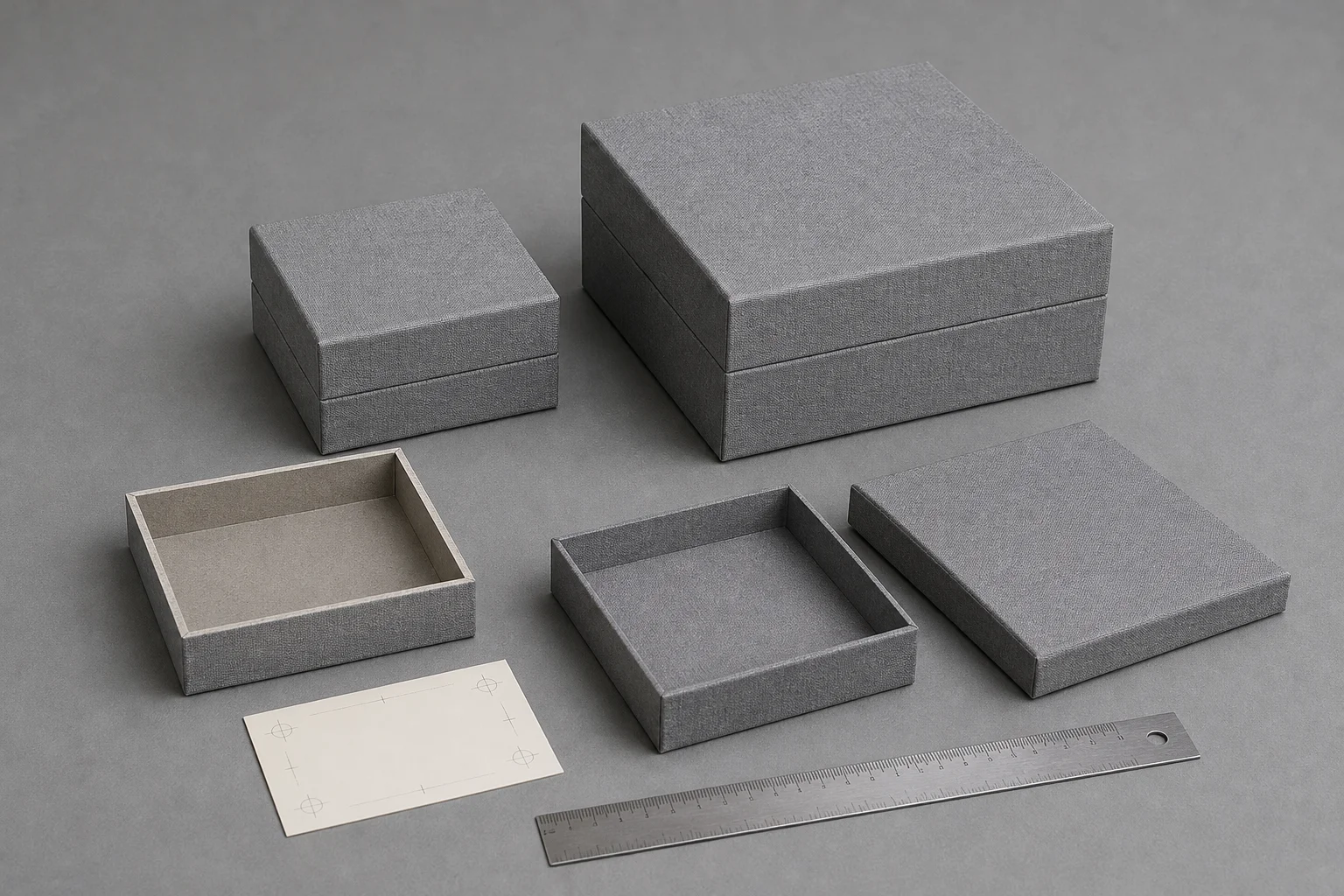
The same box in two sizes, with bare board shells and a blank measurement card: the wall keeps its absolute thickness while the face around it changes.
A small jewelry box - a mini jewelry box on most briefs - is a rigid or semi-rigid box built for one item or one pair, roughly where the finished box sits comfortably in a palm. The useful definition is a ratio, not a number: a box is small in the engineering sense when the thickness of its own wall is a significant fraction of the face it forms.
Quick Answer: Shrinking a box keeps the millimetres of wall, hinge and crease and removes the room around them. What decides whether a small box closes cleanly is therefore the absolute allowances written on the drawing, not the overall size, and they have to be stated item by item rather than inherited from a general tolerance class.
Two clarifications belong here. First, "small" describes the box, not the buyer: programmes aimed at small businesses, low minimums and single-maker stores are a different subject, and a box can be small for a large brand. Second, the commercial case for small boxes is real but arithmetic, and it is not what decides whether the lid shuts.
Two boxes can carry the same geometry and behave differently, because geometry is a ratio and manufacturing is not. Halve a box in every direction and each face keeps a quarter of its area, while the wall stays exactly as thick as it was.
The same applies to every bought-in absolute: the hinge board, the magnet, the rivet, the turn-in allowance, the crease channel, each sized for structural reasons that do not shrink. A magnet strong enough to hold a lid closed is strong enough for any lid, and is simply larger relative to a small one.
The consequence is not that small boxes are harder to make in general. It is that the tolerances available for error shrink faster than the box does. An allowance that is generous on a 200 mm face can consume most of a 50 mm face, and a deviation that reads as normal on a large lid can read as a misfit on a small one.
There is also a construction limit rather than a tolerance limit: below a certain face size, a given board cannot be turned into a corner without the corner dominating that face, and the box has to change construction rather than be shrunk further.
The finished outer size of a box is the last number in a chain, not the first: each link takes its value from the one before it and contributes its own variation.
The chain runs inward from the outer face: cover, board, any lining or insert layer, the cavity, then the item. Each layer has a nominal value and a real one, and the layers are bought as materials with their own tolerances, so the difference is not proportional to anything. A stack nominal to within a fraction of a millimetre on a large box is the same stack on a small one, so the cavity absorbs a larger share of the variation.
That is why the cavity shows trouble first. If the chain is closed from the outside, the cavity is whatever is left over; if it is closed from the cavity, the outer size drifts and no longer matches the pouch or sleeve it was designed to sit in. The drawing must say which end of the chain is fixed, and most do not.
Two measurement points make the chain visible - the finished outer face and the cavity floor to the inside of the lid - and together they show where the variation accumulated.
The failures are not spread evenly over the box. They cluster where two absolute dimensions have to agree.
Interface | What has to agree | What the buyer sees |
|---|---|---|
Lid to base | The wall build-up, which is fixed, against a smaller opening | A lid that is loose on one batch and tight on the next |
Corner turn | The material that must be absorbed, which does not shrink | Rounded or bulked corners dominating a small face |
Hinge line | The hinge board and its clearance against a short lid | A lid that stands open past vertical or will not rest flat |
Insert to cavity | An insert made to its own absolute thickness | A slight lift of the lid, or the insert sitting proud |
Closure to face | A bought magnet or catch set against a smaller panel | A closure that is strong enough but visually oversized |
The three paths below are usually reported as cosmetic complaints, because that is what they look like in a stockroom. They are decided much earlier.
Path | What is happening | What is reported later |
|---|---|---|
Stacked allowance | Each layer sits at its own thickness, and the sum exceeds the cavity | A lid that does not sit flush, on every box in the batch |
Consumed clearance | A fixed clearance is spent on the first fit and then closed by variation | Binding or rattling that appears only on some units |
Construction limit | The board cannot form the corner cleanly at that face size | Corner definition that no inspection can recover |
The three paths need three different corrections: a revision of the chain, of the allowance, or of the construction. Applying one where the other is needed changes the cost of the box without changing the outcome.
Shrinking solves a real problem, and the problem it solves is not the problem it creates.
What it fixes is support and presentation. A ring, a pair of studs or a single pendant sits in a box that holds it without movement, so no separate filling or pillow is needed, and the item reads as the only object in the frame.
What it breaks is the room to be approximate. On a small box, production variation is a larger share of every dimension, so the drawing has to carry more information, the first article has to be measured rather than judged, and a change of board or lining is a dimensional change, not a cosmetic one.
Two things that sound identical are not. A box built with tight tolerances and a box built with thin material are different boxes: thin material makes a small box lighter and easier to close, and it shortens the corner turn, which may remove the construction limit entirely. That is a construction decision, taken before the tolerances are set.
What this section is, and what it is not. The value below comes from a peer-reviewed article on creasing and folding in BioResources (2017), reported as that article reports it. It concerns paperboard, not a jewelry box, and is used because it makes an absolute dimension visible.
The finding is a ratio: as reported in that article, the ratio of the crease channel to the board thickness should be about 3.5 for creases running in the machine direction, and between 3.5 and 4.0 in the cross direction. The channel width is therefore a multiple of the board thickness, which makes it an absolute dimension - change the board and the channel changes; change only the size of the box and it does not.
Now put that channel on a small face. On a wide panel it is a line; on a narrow panel it is a band across a measurable share of the face, sitting exactly where the panel has to fold. It is not a defect and cannot be optimised away - it is a fixed cost in surface area and in the radius the corner will accept.
That also explains a difficulty often blamed on the covering. A small box is judged on its corners, because a corner is a large share of a small face, and where the board sets a minimum radius no covering technique will sharpen it. Two drawings that differ only in size are therefore not interchangeable, even though every dimension is proportional.
A small-box drawing is judged by what it states, not by what it assumes. General tolerances are a convenience for dimensions nobody depends on; on a small box, most dimensions are depended on.
Item | What to state |
|---|---|
Chain anchor | Whether the outer size or the cavity is the fixed end of the chain |
Wall build-up | Each layer's thickness, separately, and the finished wall it produces |
Corner | The smallest radius the chosen board will hold, and the corner sample it refers to |
Clearances | The lid clearance and the insert clearance as nominated values, not as the remainder |
Closure | The catch or magnet size, and the panel it has to be centred on |
Measurement | Which two points the first article is measured at, and in what conditions |
A general tolerance class cannot judge which dimensions matter. ISO 2768-1, the general tolerances standard for linear and angular dimensions without individual tolerance indications, exists to simplify drawings where a class is enough; none of its four classes knows that a fraction of a millimetre is the whole interface on a small lid.
Where two features must align rather than merely fit, the language shifts from a dimension to a geometric control. ISO 1101, the standard for geometrical tolerancing of form, orientation, location and run-out, defines the symbols that say a face must be flat or a lid parallel to its base within a stated value. On a large box those controls are usually unnecessary; on a small one, parallelism between lid and base often decides whether the box reads as well made. The factory floor is where they stop being symbols: how a small box brief becomes a signed drawing on the factory floor is set out in that behind-the-scenes guide.
Item | What to agree |
|---|---|
Reference sample | Which physical box is the reference, and which two dimensions define it |
Measurement route | The points measured, the instrument, and the conditions at the time |
Board change rule | Whether a change of board or lining requires a new sample or a dimensional review |
Closure feel | The lid effort that counts as correct, agreed by handling rather than by value |
Batch spread | How much variation between units in a carton is acceptable, and how it is checked |
The last two are what buyers and suppliers most often leave to interpretation, and they decide whether a complaint is a defect or a difference of expectation. Neither can be settled from a photograph.
Can a box simply be scaled down from an existing design? The geometry can be, and the drawing cannot. Ratios scale, but board thickness, hinge walls, crease widths and closures stay at their absolute sizes, so the allowances that made the larger box work are gone in the smaller one.
Is a small box always harder to make than a large one? Not always. A small box avoids some problems entirely: less panel to keep flat, less material to absorb at a corner, and less weight to carry. What changes is where the difficulty sits, and it moves from the panel to the interfaces.
Do tighter tolerances always improve a small box? No. Tightening a dimension that does not matter adds inspection cost without changing the fit. The useful work is choosing which dimensions the chain depends on, and then stating those precisely.
Why does the same design behave differently in a different board? Because the channel the board needs for a clean fold is a multiple of its thickness. A thicker board takes a wider channel and a larger minimum corner radius, and on a small face both are proportionally more visible.
A small jewelry box is a set of absolute dimensions inside a smaller frame, and that is the whole of its engineering. The wall, the crease channel, the hinge board and the closure keep their sizes while the face around them shrinks, so a fixed allowance occupies more of a smaller surface and the cavity absorbs more of the variation the chain produces. Published work on creasing makes the same point from a different direction: the channel a board needs is a multiple of the board's thickness, which means it follows the material rather than the size of the box. Anchor the chain, state the allowances, and measure the first article at the two points that reveal where the variation went.
Boxes, trays, cards and pouches, including small rigid boxes for single items, are produced by Utouch Packaging. A small-box project can be quoted from a drawing and an item dimension through the contact page; small-box programmes and their tooling are listed with Xiamen Yu Touch Imp. & Exp. Co., Ltd.
