
Views: 0 Author: Site Editor Publish Time: 2026-09-25 Origin: Site


Article Intro: Paper and kraft jewelry packaging looks like the simple end of the shelf, and it is often specified as though it were. What decides whether a paper box performs is the board grade and its caliper, how the surface takes print, and what the material does to the piece inside it for months on a stockist's shelf. This guide covers the cellulose family a jewelry line is built from, the print methods that work on uncoated stock, and the recyclability rules already shaping briefs for 2030.
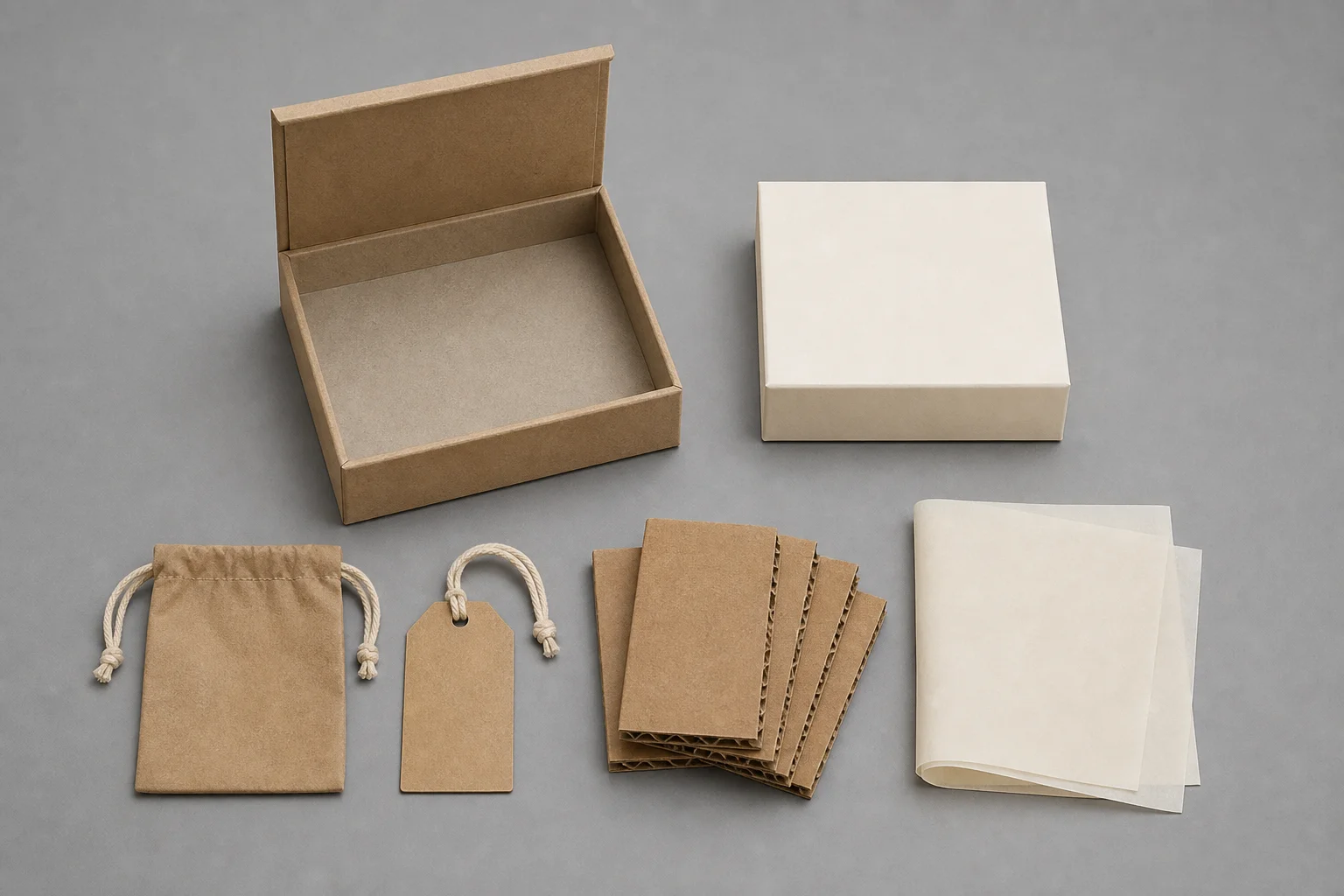
The cellulose family behind a paper line — rigid box, coated carton, kraft pouch, tag, corrugated board and tissue
Paper and kraft jewelry packaging is the family of boxes, pouches, tags, cards and wraps made from cellulose fibre rather than plastic, leather or woven fabric. Kraft is the unbleached sulphate-pulp member of that family, recognisable by its brown tone; the wider group also covers coated white boards, greyboard cores, corrugated boards and moulded pulp.
The distinction that matters commercially is structural, not chromatic. A rigid box earns its stiffness from a thick core board wrapped in a thin printed sheet, so rigidity and surface are separate specifications. A folding carton earns its stiffness from the fold, which is why the same paper behaves differently once creased.
Quick Answer: Match the board to the job. A rigid jewelry paper box specified for weight uses a 1.5–3 mm greyboard or chipboard core wrapped in a printed sheet, with 1.5–2 mm usual for jewellery. A folding carton line of kraft jewelry boxes is lighter and cheaper but carries less load. Uncoated kraft reproduces one or two colours well and full-colour artwork poorly, because the substrate under the ink is brown.
Five grades cover most jewelry paper box constructions, and they are not interchangeable: each is a different answer to the question of where stiffness comes from.
Grade | Typical range | What it carries | Where it fails |
|---|---|---|---|
Greyboard / chipboard core | Roughly 800–3,000 GSM; 1.5–3 mm as a box wall | The structure of rigid and set-up boxes | Edge crush under a thin wrap; weight |
Kraft board, unbleached | Light folding grades up to heavy tag stock | Cartons, sleeves, tags, kraft paper jewelry box builds | Limited colour fidelity; texture shows through |
Coated white board | Retail carton weights | Multi-colour artwork and photographic reproduction | Scuffs and burnishes visibly |
Corrugated E-flute and B-flute | Thin single-wall flutes | Mailers, shipper cartons, protective outers | Flute lines limit fine print |
Moulded pulp | Formed trays and inserts | Interior trays in a single material | Coarse surface; few finishes |
Two habits prevent most paper box failures. Name the core and the wrap separately, because a brief that says only "rigid paper box" leaves a supplier free to trade one against the other. Then name the caliper rather than the look, since two boards that photograph identically can differ by a millimetre of wall. The production sequence for these builds — core cutting, wrap registration, edge turning and interior fitting — is documented in the factory behind-the-scenes guide.
Brand Background: The evidence is documented third-party research rather than a single order: a laboratory study by the Heritage Science Lab at the University of Ljubljana with ZFB Zentrum für Bucherhaltung in Leipzig and the Institute for Sustainable Heritage at University College London, which appeared in the journal ChemPlusChem in December 2025.
The Packaging Challenge: Anyone specifying a board for long-term storage faces a claim that is hard to check: that a box made from the wrong material releases organic acids and other volatile compounds which attack whatever is stored inside it. The accepted screening method had been the Oddy test, which seals a sample with metal or paper coupons at elevated temperature and rates it pass, temporary or fail.
The Procurement Decision: The team assembled fifteen materials from five suppliers — virgin and recycled polypropylene, coated and uncoated cardboards, papers from agricultural residues and recycled coffee cups, bagasse paper, a naturally aged cardboard from the 1940s, and two modern lignin-containing corrugated boards — and tested them five ways, including pH, metal Oddy tests on silver, copper and lead, paper Oddy tests scored by degree of polymerisation, and ion chromatography.
The Solution: The methods disagreed, and the disagreement is the finding. Several materials failed the metal Oddy test, yet once acid emission was measured at room temperature over nineteen days and modelled as an equilibrium concentration inside a 4.61 litre two-part box, predicted levels sat well below the 100 ppb threshold in PAS 198:2012. Construction mattered too: coated cardboard boxes exchanged air at 0.46–2.57 air changes per hour against 2.65–10.82 for uncoated cardboard.
Measurable Results: pH across the samples clustered near neutral, between 6.43 and 7.34, while the 1940s cardboard measured 4.33 and was the only acidic sample. The authors concluded that a box material does not significantly contribute to degradation of the paper stored inside it at realistic temperatures, that the stored paper is itself the larger source of organic acids, and that Oddy testing at 60 °C and 80 °C needs re-evaluating for how it is applied to material selection.
The lesson is not that board choice is unimportant, but that it is a structural and printing decision rather than an emissions one.
Print method and board grade must be chosen together, because kraft absorbs and diffuses ink in ways a coated sheet does not.
Method | How it reads on kraft | Best for | Constraint |
|---|---|---|---|
Foil stamping | Metallic film sits on the surface with a hard edge | Lids, tags, sleeve fronts | Fibre texture telegraphs through fine strokes |
Blind deboss or emboss | Tone-on-tone relief, no added colour | A restrained craft paper jewelry box or tag | Low contrast; needs raking light |
Screen print | Opaque layer covering the brown substrate | One- or two-colour marks on a pouch | Thicker ink film, slower throughput |
Litho on coated board | Full-colour fidelity on a white ground | Retail cartons with artwork | Gives up the kraft look entirely |
Digital print | Short runs without a plate | Sample rounds, personalised orders | Unit cost falls slowly with volume |
The practical rule for a custom paper jewelry box, and for jewelry paper packaging generally, is that colour count should follow the board rather than the brand guideline. A three-colour logo reproduces cleanly on coated white board and shifts on kraft, where the ink sits partly on brown fibre. Brands wanting the kraft look and a legible mark do better with one foil or one screen-printed colour.
Two smaller decisions belong in the same conversation. Tissue is a printing surface too, so branding tissue paper packaging for jewelry should be settled before the box is quoted. And where a mark must be exact, the answer is normally a printed label or sleeve on coated stock applied to an uncoated box.
The emissions question resolves into four parts, and only one of them is about the board's grade.
Question | What the evidence supports |
|---|---|
Does the board release acids that damage the contents? | Acid emission measured at room temperature and modelled inside a sealed box sat well below the 100 ppb threshold used in PAS 198:2012 |
Is an old board a risk? | Storage history matters more than grade: a naturally aged 1940s cardboard measured pH 4.33 against 6.43–7.34 for current samples |
Does a coating help or hurt? | A coating slows air exchange — 0.46–2.57 air changes per hour against 2.65–10.82 uncoated — which also slows the escape of anything emitted inside |
Do standards cover a jewelry box? | ISO 16245 and ISO 23404 govern enclosures for paper documents; ISO 9706 sets permanent paper at pH 7.5–10.0 with an alkali reserve of at least 0.4 mol of acid per kilogram |
Read together, those four lines say something useful: a current paper box is not a corrosion hazard to a piece inside it, and the cheapest way to make a paper specification worse is to use board stored damp. Metal protection is a separate mechanism with its own material rules.
Advantages of building a line of paper boxes for jewelry around cellulose:
Recyclable in a single fibre stream, which is the direction EU rules already push and the reason eco paper jewelry packaging has moved from a niche request to a default question.
Low unit cost at volume and low material weight, so freight per thousand units is lighter than a lined rigid box in another material.
The kraft surface carries a visual position — natural, unbleached, restrained — without extra tooling cost.
Inserts, trays and wraps can come from the same fibre family, keeping the whole pack mono-material.
Drawbacks to plan for:
Colour reproduction is limited on uncoated kraft, so full-colour branding needs a coated board or a printed label.
Paper takes up and releases moisture, so stored board and finished stock both need dry conditions.
Uncoated surfaces mark and burnish more readily, which matters for retail handling.
A rigid paper box costs more than a folding carton at the same footprint, and the gap widens with board weight.
The regulatory direction is the strongest argument for specifying paper now. Regulation (EU) 2025/40 on packaging and packaging waste, adopted in December 2024, requires packaging placed on the EU market to be recyclable in an economically viable way by 2030, with design-for-recycling criteria and a grade band; the lowest grade phases out by 2038.
The consequence for a jewelry brief is a construction decision, not a paperwork exercise. A paper box with a paper insert, sleeve and tag recyclates as one stream. The same box with a plastic window, a foam insert or a laminated non-fibre wrap does not, however good the board beneath it is. Buyers aiming at EU retail should decide the insert and window before the board, because those two components set the recyclability grade.
Recycled-content and certification claims sit on top of that, and any such claim needs documentation from mill through to finished box naming which part of the pack carries it. On minimums the familiar pattern holds: logo printing on paper boxes and pouches typically starts at 200–500 pieces, custom-dyed or Pantone-matched materials run 1,000–5,000 with a sample approved first, and bulk production follows three to four weeks after approval.
Q: Is a kraft paper jewelry box strong enough for a heavy piece?
A: It depends on the construction rather than the material name. A rigid kraft-covered box with a 1.5–2 mm core carries a heavier piece comfortably, because the stiffness is in the core. A folding kraft carton of the same footprint will flex under that load, and the flex damages the surface of an enclosed piece.
Q: Can board emit something that damages silver or gold?
A: Acidic emission from current board grades is small at room temperature, and the enclosure material is not the main variable for metal protection. Tarnish on silver is driven by sulfur compounds rather than paper acids, so a silver range needs a barrier specification even when the box is paper.
Q: Is tissue paper packaging for jewelry recyclable?
A: Plain uncoated tissue recycles with the box. Tissue that has been foil-blocked, laminated or waxed does not, and neither does tissue carrying a heavy ink film. If recyclability is the goal, keep the tissue plain and brand the box instead.
Q: What should a brief specify first?
A: The insert, then the board, then the print. The insert decides what the piece cannot do inside the box, the board decides whether the box holds its shape, and the print is the only one that can be changed late without retooling.
Paper and kraft jewelry packaging is a materials decision wearing a colour decision. The board grade sets stiffness and load, the caliper sets how the box reads in the hand, the print method sets how much of the brand survives the substrate, and the insert decides whether the piece is protected and whether the whole pack stays recyclable. The third-party evidence on emissions points the same way: a current board does not meaningfully harm what sits inside it at realistic temperatures, an aged board can, and a coating slows air exchange in both directions. Specify the core and the wrap separately, decide the insert before the board, and treat the 2030 recyclability rules as a construction brief rather than a paperwork task.
Utouch Packaging produces custom paper and kraft jewelry packaging that can be specified around this framework — rigid boxes on named core boards, kraft folding cartons, pouches, hang tags, printed sleeves and fibre inserts — with the board grade, caliper, print method and insert confirmed before production. For wholesale and custom enquiries, visit the Utouch Packaging contact page or reach the export team through Xiamen Yu Touch Imp. & Exp. Co., Ltd.
