
Views: 0 Author: Site Editor Publish Time: 2026-09-29 Origin: Site


Article Intro: Two jewelry boxes leave the same factory in the same wrap at the same cost, and only one may be a regulated children's product. The box decides nothing; the intended user decides. Once that user is a child, the questions move from price to evidence — whether a magnet can come loose, what the lining and the print release, and what the age label says. This guide sets the boundary and lists what belongs on the order.
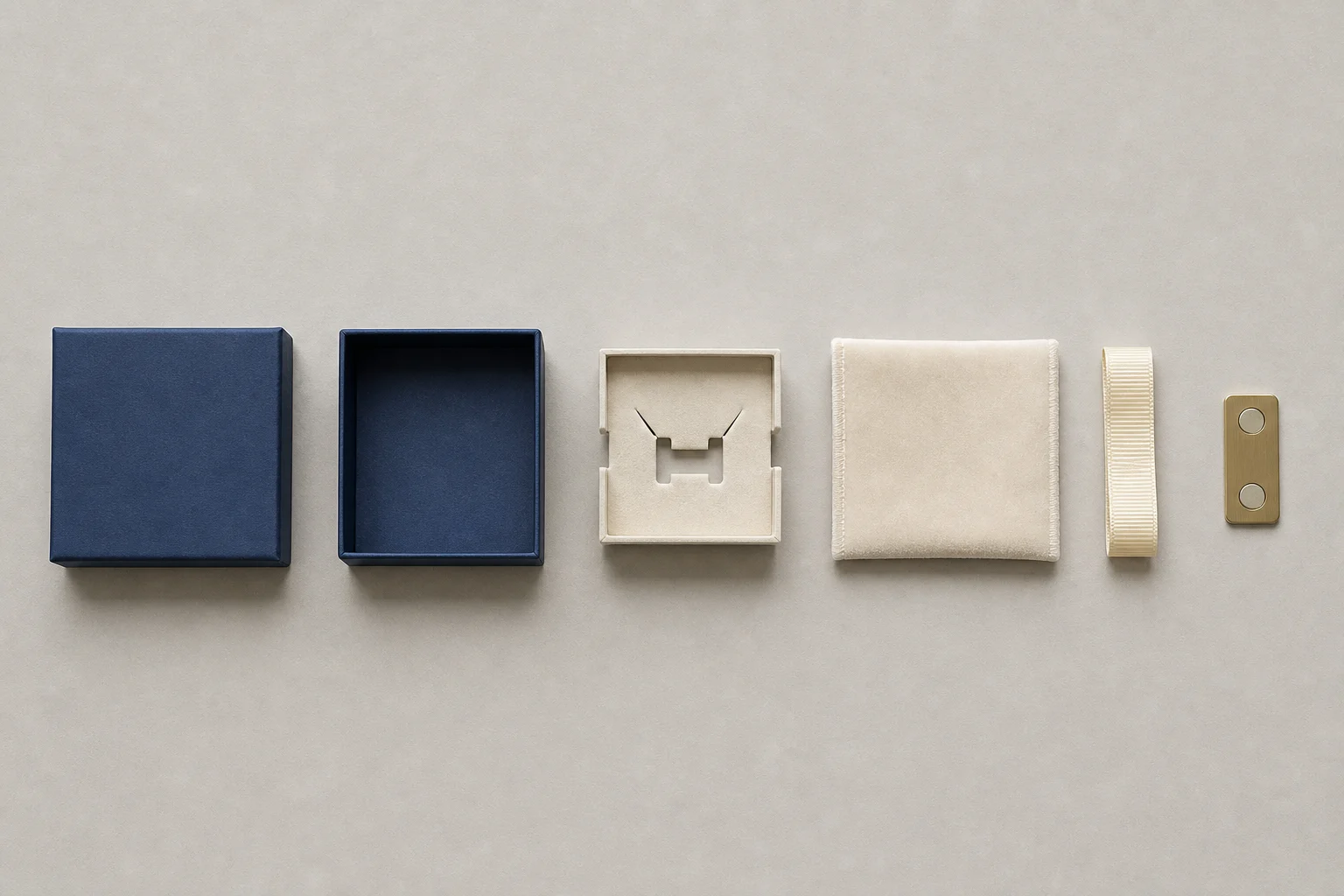
Separated like this, each part becomes a component with its own question
A children's jewelry box is not defined by being small. Size, colour, material and price decide nothing. The trigger is the intended user — whether a product is designed, marketed or intended for a child. ASTM F2923 is the safety specification for children's jewelry for children aged twelve and below, and it covers mechanical hazards, restrictions on chromium, cadmium and nickel, and age labelling and warning guidance. Adult jewelry sits under ASTM F2999 instead. Toys follow a third path, ASTM F963, which the Consumer Product Safety Improvement Act incorporated by reference.
One construction can therefore occupy two rule systems. A rigid box described as packing for adult jewelry is not a children's product; the identical box in a set headed jewelry box for girls or jewelry box for kids plausibly is. The bill of materials did not move — the audience did. A jewelry box for women and a small jewelry box for women carry no children's obligations while an identically built girls jewelry box may.
Quick Answer: A jewelry box becomes a children's product when its intended user is a child. Three things then carry hard requirements: the intended age band, any loose or separable magnet, and any surface a child could mouth. Colour, format and print method stay commercial decisions.
These instruments overlap by recipient, not by material, and reading them as one children's regulation leads buyers to test the wrong thing.
Intended user | Instrument | What it governs | Where a number appears |
|---|---|---|---|
Children's jewelry, aged 12 and below | ASTM F2923 | Mechanical safety, substances, age labelling | Chromium, cadmium, nickel |
Toys, broadly under 14 | ASTM F963 via 16 CFR 1250 | Toy mechanical and chemical safety, magnets included | Small parts cylinder; flux index method |
Magnet products, children's jewelry included | 16 CFR Part 1262 | Loose or separable magnets in jewelry and entertainment products | Flux index below 50 kG² mm² |
Adult jewelry | ASTM F2999 | Substances, mechanical requirements, warnings | Chromium, cadmium, nickel |
Toys on the EU market | EN 71-3 under 2009/48/EC | Element migration, part of CE marking | Per-element limits, three categories |
Two rows matter to packaging. The magnet rule names children's jewelry, so a box with a magnetic closure is not automatically out of scope. EN 71-3 governs toy materials rather than jewelry, so kid jewelry set packaging can raise both questions at once. Listing copy as short as jewelry box kid signals the intended user.
What the evidence is: A multicentre study in BJS Open (2022) by the Paediatric Surgery Trainee Research Network, covering thirteen UK paediatric surgery centres and children under seventeen admitted between 1 October 2019 and 30 September 2020. Published third-party research, not a transacted order.
The problem it measured: Of 263 children identified, 146 (55.5 per cent) had swallowed magnets, 112 (42.6 per cent) button batteries and five (1.9 per cent) both. Median age was 4.8 years. One magnet usually behaves like any small smooth object; two or more can attract across bowel walls and trap tissue.
Where the paths diverged: Conservative management succeeded in 35 of the 38 single-magnet cases (92.1 per cent). Of the 108 children who swallowed more than one, initial management was conservative in 77 (71.3 per cent), endoscopic in nine (8.3 per cent) and surgical in 22 (20.4 per cent), with ten escalated later after a median of three days.
The measurable outcome: Among those 108, 51 (47.2 per cent) needed endoscopic or surgical intervention and 39 (36.1 per cent) went to surgery, including 28 laparotomies; bowel perforations occurred in ten children (9.3 per cent). The median number swallowed was 2.0, range to 76, and the commonest reason to operate was failure to progress on serial imaging, at 46.1 per cent.
What it changes: The authors called for regulation of magnet sales, noting that United States rules passed in 2012 were reversed in 2016 with a resurgence of cases. The packaging lesson is structural: a magnet a buyer can pick out with fingers is a component with a measured limit.
The Consumer Product Safety Commission approved a federal safety standard for magnets on 21 September 2022. The rule, 16 CFR Part 1262, took effect on 21 October 2022 for magnet products manufactured after that date. Its scope follows product purpose: items intended for entertainment, jewelry — children's jewelry is named explicitly — mental stimulation or stress relief, containing one or more loose or separable small-part magnets. Each loose or separable magnet that fits entirely within the small parts cylinder defined in 16 CFR 1501 must have a flux index below 50 kG² mm², read by the method in the ASTM F963 toy safety standard. A magnet that both fits the cylinder and reaches that flux index counts as hazardous.
Closure on the box | Does the trigger apply? | What the order must state |
|---|---|---|
Magnet encapsulated in the board, no finger access | Turns on whether it is loose or separable | Encapsulation method and board thickness |
Magnet in an open recess with a visible gap | Yes, on its face | Flux index figure and test method |
Press-stud or snap | No magnet | Nothing under this rule |
Ribbon, cord or elastic tie | No magnet | Nothing under this rule |
Adhesive magnetic strip or tape | Depends on retention | Retention behaviour; flux index figure |
Two exemptions matter. Toys already governed by ASTM F963 are exempt, since that standard addresses the same hazard, and products sold solely to educators, researchers or industrial users fall outside scope. Commission guidance also expects a General Certificate of Conformity for covered products, although the rule text does not require one.
Chemical requirements reach the packaging by the same route as the mechanical ones: the recipient. For toys placed on the EU market, EN 71-3 governs migration of certain elements and forms part of the CE marking requirements under the Toy Safety Directive, 2009/48/EC. It regulates nineteen element groups, among them aluminium, antimony, arsenic, barium, cadmium, chromium III and VI, lead, mercury, nickel, selenium and zinc, sorting materials into three categories: dry, brittle, powder-like or pliable; liquid or sticky; and scraped-off. Coatings, plastics, textiles, wood and metals fall in the third group. Extraction simulates gastric acid, and the extract is read by inductively coupled plasma.
Packaging element | Category under EN 71-3 | Why it lands there |
|---|---|---|
Foil stamping or printed coating | Cat. III, scraped-off | A coating removed by scraping defines the group |
Velvet, satin or cotton lining | Cat. III, scraped-off | Textiles are grouped as scraped-off material |
Rigid board core and outer wrap | Cat. III, scraped-off | Paper, board and coatings share the group |
Loose powder or glitter finish | Cat. I, dry and powder-like | The category names powder-like materials |
Liquid or gel insert finish | Cat. II, liquid or sticky | Liquid and sticky materials are category II |
The limits move. Soluble lead permitted in category I materials was tightened from 13.5 mg/kg to 2.0 mg/kg, so a two-year-old report is no substitute for a current one. In the United States the same elements arrive through other doors: California's Proposition 65 sets an oral maximum allowable dose level of 8.2 µg/day for hexavalent chromium and a no-significant-risk inhalation level of 0.001 µg/day, with arsenic at 10 µg/day, while nickel carries no numeric limit there. A lining and a foil stamp are therefore not freely interchangeable between an adult box and a child-facing one: both sit in the category that gets scraped.
Age grading decides which regime applies, so it belongs on the purchase order rather than only on the artwork. ASTM F2923 sets age labelling and warning guidance for children's jewelry alongside its substance restrictions, and ASTM F963 carries labelling requirements for magnetic products plus a cyclic soaking test for mouthpieces of mouth-actuated toys containing magnets.
The mechanical test that decides whether a component is a small part uses the cylinder in 16 CFR 1501.4: 2.25 inches, or 57.15 mm, long by 1.25 inches, or 31.7 mm, across the opening, a shape chosen to approximate the fully expanded throat of a child under three. A part that fits entirely inside it is a small part. On a kids jewelry music box that test reaches the parts a child could work free: a magnet behind a thin wrap, a decorative stud, a closing element on the lid.
The trade is timing, not safety against margin.
Advantage of specifying for the child recipient | What it costs |
|---|---|
A compliance file becomes a sales document with retailers | Testing and documentation sit before the first shipment |
Age-graded packaging cuts complaint and return exposure | One separable magnet can invalidate a clean file |
Keepsake and music-box formats support a higher unit price | A moving mechanism adds a second surface to assess |
One child-safe closure across SKUs lowers part count | Child-safe closures cost more than a simple tuck flap |
Naming the intended user stops the pack reading as a toy | Later format or artwork changes restart the paperwork |
A specification is adequate when a supplier can build to it without asking who the box is for. Six lines do most of that work.
Line on the order | Why it is required |
|---|---|
Intended user age band, in writing | It selects the instrument, not the artwork |
Magnet design: encapsulated or exposed | The rule turns on loose or separable |
Flux index figure for any separable magnet | Below 50 kG² mm² is the threshold |
Lining and coating named with their category | Textiles and scraped coatings share one category |
Age label wording fixed before the die is cut | Re-cutting a die to change a label is expensive |
One construction per market | Two builds double the evidence to keep current |
A supplier can answer these lines only if it controls the construction. One that cuts, wraps, lines and assembles on its own lines can state the encapsulation and the lining as built rather than as bought. The wider framework is in the inside the jewelry packaging factory guide to design, production and quality control.
Q: Does a kids jewelry box need testing if the jewelry inside is tested?
A: Possibly. Under 16 CFR 1262 the magnet rule names children's jewelry directly, so a magnetic closure is assessed on the box, separately from the piece.
Q: Is a magnetic closure banned on children's jewelry packaging?
A: Not banned; measured. A loose or separable magnet that fits the 16 CFR 1501 cylinder needs a flux index below 50 kG² mm².
Q: What is a flux index?
A: One figure combining magnet strength and size, read by the method in the ASTM F963 toy safety standard. Below the threshold, a swallowed magnet is less likely to attract a second through tissue.
Q: Does an adult jewelry box need the same file?
A: Generally not. Adult jewelry follows ASTM F2999, which carries substance and warning requirements but not the children's age-labelling framework.
Q: Can one box serve a child and an adult recipient?
A: It can be built to the stricter set, and many brands do. What cannot be done is to advertise it to both audiences while holding evidence for only the adult one.
What makes a kids jewelry box a regulated product is the recipient, not the box. Once the intended user is a child aged twelve or below, ASTM F2923 supplies the mechanical, substance and labelling framework, and three narrow requirements do the real work: the age band stated in writing, the loose-or-separable magnet measured against a flux index below 50 kG² mm² under 16 CFR Part 1262, and every mouthed surface assessed for element migration, with textile linings and scraped-off coatings sharing one category under EN 71-3. The evidence for why the magnet requirement exists is unusually direct: in the thirteen-centre study, 108 of 146 children with magnet ingestions had swallowed more than one, 36.1 per cent of that group went to surgery, and 9.3 per cent suffered bowel perforation, against a 92.1 per cent conservative success rate for a single magnet. For buyers the conclusion is compact: fix the age band before tooling, name the magnet design and its flux index, name the lining and coating separately with their category, agree the age label before the die is cut, and keep one construction per market. Utouch Packaging builds rigid boxes, pouches and jewelry sets to a stated construction, including encapsulated magnet closures and named linings, and can confirm the built specification against the lines above. For wholesale and custom enquiries, visit the Utouch Packaging contact page or reach the export team through Xiamen Yu Touch Imp. & Exp. Co., Ltd.
