
Views: 0 Author: Site Editor Publish Time: 2026-10-04 Origin: Site


Article Intro: A rigid box normally arrives built. A foldable rigid box arrives as a flat, pre-creased blank, and someone has to turn it into a box. That single change moves the last production step — and the last inspection — from the factory to the buyer's warehouse. This guide covers the three structures, the crease and joint that decide whether a folded box stays square, the magnet step, and what has to be written on the order when the buyer does the assembly.
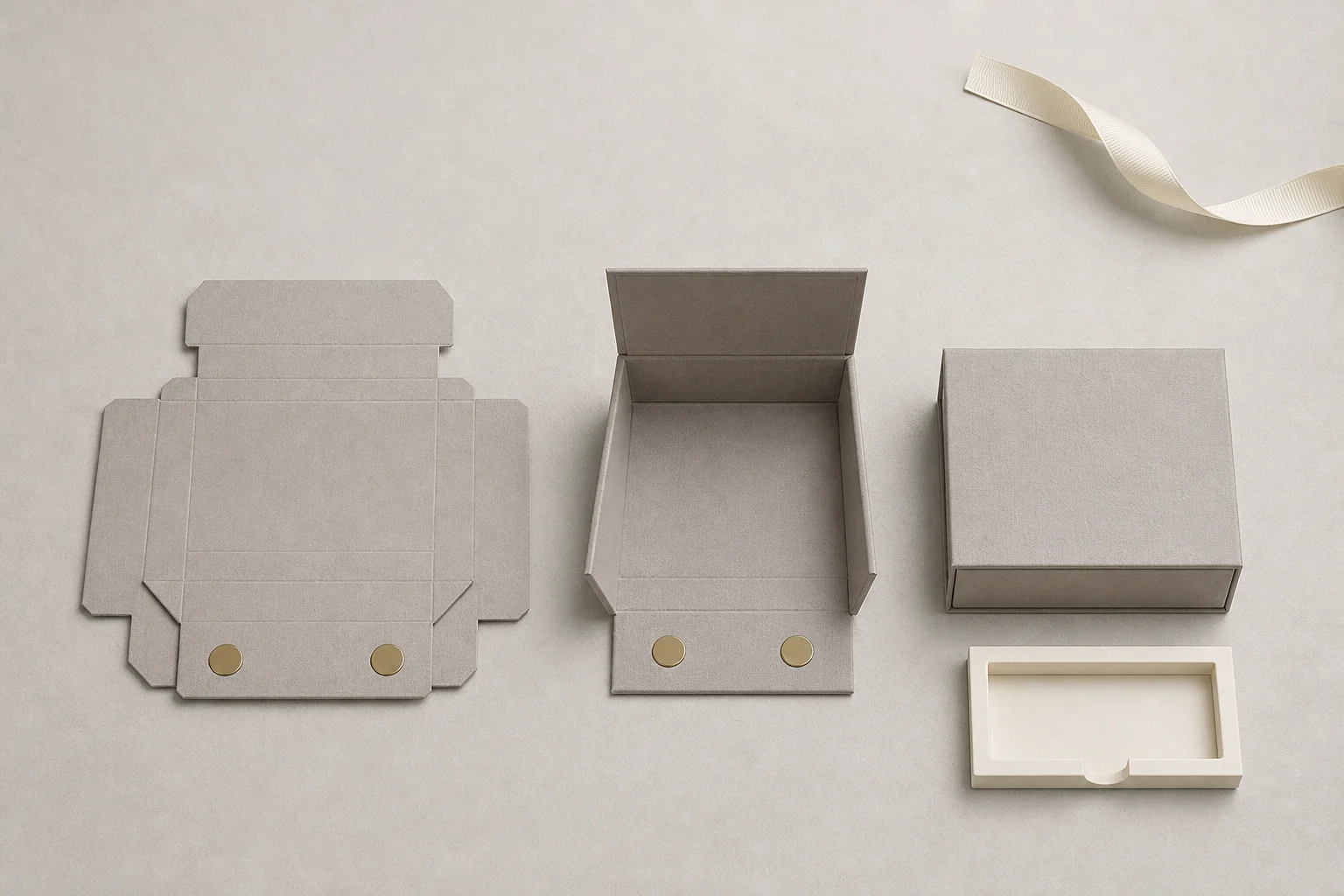
Flat, half-folded, erected — the same box at three points in its life
A foldable jewelry box is a rigid box delivered flat, pre-creased and partly built, which the buyer erects into its final three-dimensional shape. It is also sold as a collapsible, fold-flat and knock-down rigid box. It is not a folding carton: the wall is a rigid greyboard core rather than a single layer of paperboard, and the wrap, the liner and usually the closure hardware are already attached when the blank is packed. What travels flat is the box before it stands up.
The material is that of a permanent rigid box. What differs is a set of creases that let the board turn through a full fold without breaking, a joint that closes the shape, and a way of holding it closed — most often a pair of disc magnets. Because the box spends its export life flat, the crease and the joint carry the whole structure.
Quick Answer: A foldable jewelry box is a rigid box shipped flat and erected by the buyer. Three things decide whether it works: the crease, the joint and whoever does the assembly. Board grade, wrap and label are chosen exactly as for a permanent rigid box.
The three structures are often quoted as if they differed only in price. They differ in where the last manufacturing step happens.
Factor | Permanent rigid | Collapsible rigid | Folding carton |
|---|---|---|---|
Wall | Greyboard core, wrapped | Greyboard core, wrapped, pre-creased | Single paperboard sheet |
Delivered state | Erected | Flat blank | Flat blank |
Who erects it | Factory | Buyer or fulfilment partner | Buyer |
Assembled rigidity | Highest | High at the panels, weakest at the folds | Lowest |
Insert fit | Fitted at the factory | Fitted after erection, or supplied loose | Usually none |
Stacks flat | No | Yes | Yes |
Inspection state | Finished box | Flat stock, then buyer-assembled box | Flat stock |
The last row carries the procurement consequence: on a collapsible order the factory can inspect board, print, liner and magnets, but not squareness, lid fit or closure. Those exist only after erection, and they are exactly what a retail buyer will judge.
A crease is made by pressing a male rule into a grooved matrix, which delaminates and compresses the board along a single line so the panel can turn instead of breaking; depth is set by the matrix and the pressure. Published converting research is consistent about the direction of the error: too little pressure leaves a crease too shallow to fold precisely, and too much destroys the fibre bonding and produces cracking along the line.
Direction matters as much as depth. Board has a grain: folding along the machine direction produces long cracks running along that direction, while folding across it produces shorter cracks perpendicular to it. Printing is a further factor, because coated and printed board is less flexible at the crease, and an uneven ink film makes cracking worse. That is why the sample a buyer approves has to be a printed blank folded into shape: the defects the buyer cares about do not exist until the print is on the board and the board is folded.
Note on sourcing: The evidence below is documented third-party research, not a transacted order. It comes from a review of coated-board converting published in BioResources in 2023 by the packaging technology group at Lappeenranta-Lahti University of Technology in Finland, and from a foldability study of duplex board published in the Journal of the Korea Technical Association of the Pulp and Paper Industry in 2008 by the paper science group at Kangwon National University.
The problem. Both groups were studying the same defect: white-line cracking along a crease. It is the failure a fold-flat box cannot hide, because the crease sits on the outside of the finished box, under the customer's thumb. The Kangwon group framed it in production terms — cracking degrades the product and wastes material.
What they varied. The Finnish review collected trials that changed creasing rule width, creasing pressure, the presence of a matrix beneath the board, the printing state, and the fold direction relative to the board's grain.
What the trials measured. The most frequently recommended industrial creasing rule is 2 pt, which produced the lowest share of unacceptable trays — only 3%. Narrower rules reached comparable results, but only inside a very precise force range, outside which they cut through the coating. Creasing without a matrix is reported to leave a crease depth three times lower than creasing into one. Past a certain depth, further creasing force brings no further improvement in foldability. Separately, the peak bending moment during folding was observed before 20 degrees of rotation, and material density was found to affect creasing force more than material thickness does. The Korean study added the direction effect: folding along the machine direction produced long cracks along that direction, folding across it produced shorter cracks perpendicular to it, printing increased cracking, and an uneven ink film made it worse.
What it means for a buyer. A fold is a specified, testable property, not a visual accident. Crease rule width, board grade and print all interact, and the only sample that proves the result is a printed blank folded into its finished shape.
The joint is how a flat blank becomes a closed box: a lined hinge along one edge plus a closure. On a collapsible magnetic box the closure is a pair of disc magnets set into the board, and it only works if the poles face each other correctly once the box is erected. A pair that closes perfectly in a factory test can refuse to close if one magnet is seated with its pole reversed — a defect that appears in the buyer's hands, not the factory's. The closure therefore has to be proved on an erected sample, not a flat inspection.
The hinge is the other wear point. Its liner does work a permanent rigid box never asks of a liner: it is folded once in the factory, once or twice by the buyer, and again whenever the box is collapsed for a trip. A travelling retail kit — collapsed for a show, erected on the stand — is a multi-cycle application, so the hinge needs a stated fold-cycle count.
Erecting a collapsible box is a manual or semi-manual step, so the decision is not only about price. It moves the final quality gate. On an assembled shipment, the factory inspects the finished object and the buyer's receiving check is a confirmation. On a flat shipment, the buyer becomes the assembly station, and every erected box is a small production run of its own.
Two consequences follow. First, the reject definition has to be agreed before production: what counts as a mis-folded crease, a seam gap too wide, a lid that does not sit flush, a magnet that does not hold. Without it, a buyer's "this looks wrong" cannot be resolved against a specification. Second, the assembly step should be sampled rather than discovered at peak season — erect twenty units, time them and count the defects before the order is placed.
Insert fitting belongs to the same question. When a box ships without a fitted insert, the insert joins the buyer's assembly step, and its tolerance has to be specified against the internal dimension of the erected box rather than the dimension of the flat panel. Buyers who want to see how this division of work is handled on live programmes can review the custom packaging case studies and FAQ.
What folds flat also stacks thin, which changes two things a buyer owns directly: the shelf space the packaging inventory occupies, and the shape of the parcel sent on to a stockist or fulfilment centre.
On the parcel side, carriers bill on the greater of actual weight and volumetric weight, and the volumetric side is a function of the parcel's three dimensions. Reducing the height of a packed parcel can therefore change the billed weight even when the contents weigh the same.
The catch is that thinness must not be bought from the wall. A collapsible box made thin by reducing the greyboard ends up with a crease that cannot hold the erected shape, and the panel bows at the first sign of pressure. The profile decision and the wall decision are separate specifications, and the second one governs the first.
Advantages | Trade-offs |
|---|---|
Inventory stacks flat and takes a fraction of the erected footprint | Adds an assembly step and its labour to the buyer's own operation |
Lower inbound volume for the same unit count | Assembly defects surface after shipment, not before |
Rigid panels and rigid appearance in the finished box | Folds remain the weakest part of the structure |
Late customisation — inserts and cards can be added by market | Magnet orientation must be verified on the erected box |
Collapsible again for travel kits and pop-up retail | Repeated folding wears the hinge liner |
Six lines turn a collapsible quote into a specification that can be inspected. They cost nothing to write at enquiry stage and are expensive to add later.
Specification line | What to state |
|---|---|
Delivery state | Flat blank, or erected and re-collapsed |
Assembly owner | Factory, buyer, or fulfilment partner |
Crease and board | Board grade, crease rule width, fold direction relative to grain |
Closure proof | Erected sample that closes and holds; magnet orientation checked |
Reject definition | Written limits for seam gap, lid flush and mis-folded crease |
Insert interface | Insert tolerance stated against erected internal dimension |
For any box collapsed more than once, add the number of fold cycles the hinge must survive: a small number to agree and a difficult one to argue about afterwards.
Is a foldable jewelry box the same as a folding carton? No. A folding carton is cut and folded from a single sheet of paperboard. A foldable or collapsible jewelry box has a rigid greyboard core, a wrap and usually a magnetic closure; it simply ships before it is erected.
Is a collapsible box as rigid as a permanent rigid box once assembled? At the panels, close. At the folds, it is not: every crease is a line where the board has been compressed, so the corners and the hinge are where a collapsible box will first show wear.
Can the factory erect the boxes and still ship them compactly? Yes. A common arrangement is to erect the boxes, fit the inserts, inspect them and then collapse them again for shipment. It gives the buyer the assembled-state inspection without the assembled-state volume, at the cost of one extra handling step.
What is the most common failure on a fold-flat order? Cracking along the crease on the printed face, followed by a magnet pair that does not close because one magnet was seated with its pole reversed. Both are visible only on an erected, printed box.
Does a thin profile always reduce shipping cost? No. Volumetric weight is calculated from all three parcel dimensions, so a thinner but longer and wider parcel can be billed at the same figure. The profile has to be optimised against the carrier's measure, not against height alone.
A foldable jewelry box is a rigid box that has been designed to travel flat. The board, the wrap and the closure are unchanged from a permanent rigid box; what changes is that the crease, the joint and the magnet pair now carry the structure, and the last assembly step belongs to the buyer. The practical consequences are a much smaller inventory footprint, a quality gate that moves downstream, and a specification that has to name the delivery state, the assembly owner and the reject definition before production begins.
For buyers sourcing this format, the useful discipline is to approve a printed blank folded into its finished shape, to erect twenty units and time them, and to write down what "closed properly" means. For reference on materials, structures and production, see Utouch Packaging. Buyers who want to discuss a specific collapsible programme can reach the team through the contact page, and the storefront for wholesale enquiries is Xiamen Yu Touch Imp. & Exp. Co., Ltd.
