
Views: 0 Author: Site Editor Publish Time: 2026-09-26 Origin: Site


Article Intro: A drawstring jewelry pouch carries everything it holds through one stitched channel and one cord. That is the whole mechanism, and it is usually specified last — after fabric, colour and logo — even though the channel decides whether the pouch holds or frays open. This guide covers how the channel is built, how cord and ribbon are specified, and how the mechanism compares with other closures.
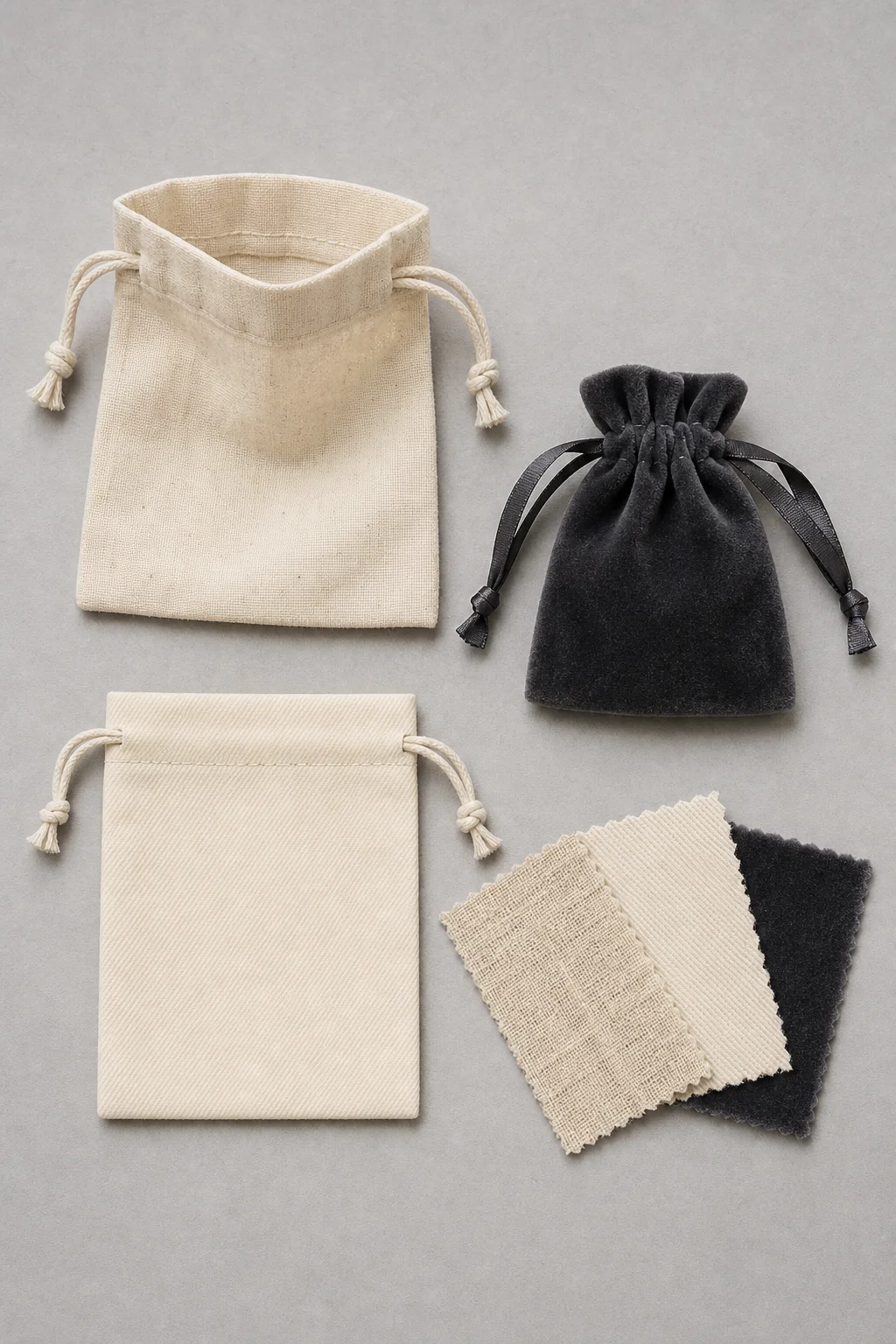
The mechanism in one frame — hem channel, cord, ribbon and the fabric bodies they close
A drawstring jewelry pouch is a fabric bag closed by a cord or ribbon threaded through a stitched channel around the opening. The channel is the working part and the fabric only the body: pulling both cord ends gathers the opening against itself, and the closure holds by friction rather than a fastener.
The absence of hardware is the format's advantage and its exposure. Nothing has to be aligned or tested, the pouch folds flat, and unit cost at volume is the lowest of any jewelry format (illustrative). One stitched seam then takes the full load of every pull.
A box is opened once and set down; a jewelry drawstring bag is pulled closed every time the piece is taken out, sometimes for years. A cotton drawstring bag sees far more cycles than a packaging brief assumes, and the channel seam carries every one.
Quick Answer: Specify the closure before the fabric. Choose the channel construction first, size the channel to at least twice the cord diameter, bartack where the cord leaves the bag, and name the cord's material and gauge rather than a colour from a swatch. A light cotton drawstring pouch suits inner packing; a heavier twill or velvet body suits retail.
Three constructions cover nearly every jewelry drawstring pouch, and they differ in labour, in achievable channel depth and in what fails first.
Channel build | How it is made | Relative cost | What it resists | Where it fails |
|---|---|---|---|---|
Single-fold hem | Top edge turned down once, one stitch line | Lowest | Light pulls and short use | Fold edge frays; channel can twist |
Double-fold casing | Edge turned twice, two parallel stitch lines | Mid | Repeated pulls; raw edge hidden | Stitch line pulls through a loose fabric |
Applied channel | Separate strip stitched onto the top edge | Highest | Deepest casing; exact control of both gaps | Adds a second seam and a visible band |
Two details decide most outcomes. The first is the exit gap, the short opening where the cord leaves the channel; it is the highest-stress point on the pouch, so the brief should ask for a backstitch or bartack there rather than a seam left to end naturally. The second is depth: a channel needs roughly twice the cord diameter, so a 3 mm braided cord sits in an 8–12 mm casing on the velvet drawstring jewelry pouch formats used for gift tiers.
Two more choices belong in the same brief. A pouch opened many times is normally built with two parallel stitch lines, because the second stops the channel rotating and keeps the exit gaps facing the pull. The draw itself is either single or double: a single channel carries one cord so both ends emerge on the same side, while two facing channels gather the mouth from both sides. A pouch built and pull-tested to these points — cut, hemmed, threaded, then loaded and opened before approval — follows the sequence recorded in the custom packaging case studies and FAQ.
Brand Background: The evidence is documented third-party textile research rather than a single order: a fabric and sewing study by researchers at the National Institute of Textile Engineering & Research in Bangladesh, published in February 2022 in Advances in Research in Textile Engineering.
The Packaging Challenge: A drawstring pouch closes by pulling a cord through a stitched channel, so the whole load of every pull passes through one seam. Buyers who spec by fabric weight and colour usually leave that seam unspecified, and the failure is rarely gradual: the channel tears where the cord exits, or the weave opens along the stitch line.
The Procurement Decision: The team wove two linen fabrics from identical yarn counts, Ne 18 warp and Ne 14 weft, at different thread densities — 61 ends and 53 picks per inch at 175 GSM against 80 and 74 at 200 GSM — then sewed each with superimposed, lapped and bound seams at 10, 12 and 14 stitches per inch, using single and double needle lock stitch and double needle chain stitch.
The Solution: The trial isolates variables rather than materials. The strongest construction was the lapped seam, at 170.89 N warp and 164.85 N weft. A stitch density of 12 per inch beat both 10 and 14, at 161.90 N and 155.44 N, and double needle chain stitch reached 164.82 N and 160.29 N against the lock stitches. Slippage settled the other half: the lapped seam moved least, the superimposed seam most.
Measurable Results: The two fabrics used the same yarn counts yet differed in raw strength by 284.81 N against 307.59 N, and the gap widened once sewn. The study concludes that seam strength and slippage depend on seam type, stitch type and stitch density, and on the fabric's ends and picks per inch. Read against a drawstring pouch the message is narrow: the fabric weight on the quote does not predict whether the channel survives.
That is the argument for naming the seam in the brief before the fabric is quoted.
Cord turns a fabric bag into a working closure, and it is usually the last thing a buyer thinks about.
Cord or ribbon | Typical gauge | Draw feel | Durability | Where it fits |
|---|---|---|---|---|
Braided cotton cord | 3–4 mm | Soft, gradual gather | Good; holds a knot well | cotton drawstring pouch formats, dust bags |
Twisted cotton cord | 2–3 mm | Firmer, keeps a set | Frays at the cut end unless tipped | Small pouches, rustic registers |
Polyester cord | 2–3 mm | Slick, tight gather | High; resists rot and stretch | Storage and transit use |
Waxed cord | 1.5–2.5 mm | Firm, holds position | Cut ends stay clean; wax dulls | Minimal premium pouches |
Satin ribbon | 6–15 mm | Glides, reads decorative | Underside pulls and dulls first | velvet drawstring pouch gift tiers |
Grosgrain ribbon | 6–15 mm | Firm, structures the mouth | Ribbed edge resists twisting | Structured pouches, printed branding |
Two habits prevent most cord problems. Name the gauge in millimetres rather than asking for standard cord, because the channel depth is derived from it and a thicker cord will not run in a finished casing. Then state whether the cord is braided or twisted: a braid spreads the pull across the channel, holds a knot and gives the soft gather a velvet jewelry drawstring bag is expected to have, while a twist is cheaper and opens at the knot as it ages.
Ribbon needs a wider channel than cord of the same visual weight, because ribbon folds rather than compresses on the turn — a velvet drawstring bag with a ribbon mouth needs a deeper casing than the same pouch closed with cord. Cord length follows the pouch: roughly four times the finished width opens the mouth fully without tails that tangle.
The cord end decides whether the closure can be used one-handed, and it is the only functional part a customer ever touches.
Cord end or stopper | What it does | What to watch |
|---|---|---|
Double knot | Keeps the cord from retracting into the channel | Standard and cost-free; needs a braided cord |
Heat-sealed or aglet tip | Stops a synthetic cord fraying at the cut | Essentially required on polyester cord |
Wooden or metal bead | Allows a one-hand pull and weights the tail | Small-parts consideration for gift use |
Barrel cordlock | Holds the mouth closed with no knot | Adds bulk; mainly a travel-format part |
Tassel | Decorative gather and a longer tail to grip | Length has to be checked so it cannot tangle |
The same component is the cheapest branding surface on the pouch. A custom jewelry drawstring pouch can carry dyed cord matched to the brand colour, a printed ribbon or a woven label stitched into the side seam, with no change to the mechanism. On minimums the familiar pattern holds: logo printing on pouches starts at 200–500 pieces, custom-dyed cord or ribbon runs 1,000–5,000 with a dye sample approved first, and bulk production follows three to four weeks after approval.
Why the format holds its position across almost every jewellery tier:
No separable hardware, so there is no clasp to fail or slider to jam.
The lowest unit cost of any jewellery format at volume, with shallow tooling.
It lies flat and compresses, so hundreds ship without a volume penalty.
Brandable at almost no unit cost, through cord colour or a printed ribbon.
What has to be accepted in exchange:
Security is friction only, so it is not a compliance or transit seal.
The channel seam carries the entire load, so an unspecified stitch type is the commonest failure.
It offers no structure and no crush protection, unlike a rigid box.
Gathering creases the fabric at the mouth, which shows more on coated finishes.
A drawstring is one of several closing systems a jewellery pouch can carry, and the right choice follows from use.
Closure | Opening speed | Security | Relative cost | Where it fits |
|---|---|---|---|---|
Drawstring | Fast, one or two hands | Moderate; friction only | Lowest | Dust bags, gift tiers, high-volume programmes |
Ribbon tie | Slow; has to be tied | Low | Low | Presentation tiers where the tying is the moment |
Snap-button flap | Fast, one hand | Moderate | Mid | Small velvet and suede pouches |
Zipper | Moderate | Highest of the soft formats | Highest | Travel, chains and valuables |
Elasticated mouth | Fastest | Low | Low | Inner bags and inserts inside a rigid box |
The drawstring's structural advantage is that no part of it can separate from the pouch. A slider can jam, a snap can lose tension and a frame can distort, but a cord in a sound channel has no failure mode other than the channel itself — which is why the channel, not the fabric, is where a specification should start. Buyers running drawstring cotton bags wholesale across several sizes usually settle on one cord gauge and one channel build, so a single approved sample governs every size.
Q: What fabric is best for a drawstring jewelry pouch?
A: The one whose weave holds a stitch. A tighter weave resists seam slippage better than a loose one of the same weight, which is why muslin, twill and canvas behave so differently at the same GSM. Choice then follows use: light for inner packing, heavier and matte for retail.
Q: How deep should the drawstring channel be?
A: Deep enough for the cord to run without binding — about twice the cord diameter, so an 8–12 mm casing for a 3 mm braided cord. A shallow channel will not close evenly; an over-deep one wastes fabric and hangs slack.
Q: Cord or ribbon, and does it change the price?
A: Cord is the working default and ribbon is the presentation upgrade. Ribbon costs more per metre, needs a wider channel and dulls faster on the underside it is pulled by, so it belongs on gift and retail tiers.
Q: How do I stop the cord end fraying?
A: Match the end treatment to the cord. Braided cotton holds a double knot, twisted cotton needs its cut end tipped or sealed, and synthetic cord should be heat-sealed or fitted with an aglet.
Drawstring jewelry pouches are a closure decision wearing a fabric decision. The channel build sets how deep the cord can sit and where the pull is taken, the cord or ribbon sets how the mouth gathers and how long the closure lasts, the end treatment sets whether it can be used with one hand, and the fabric only decides how the result feels. The third-party evidence points at the same place: the seam that carries the load is a specified, measurable part, and its performance depends on seam type, stitch type, stitch density and the fabric's thread count rather than on fabric weight alone. Write the channel and stitch into the brief before the fabric, and quote the same construction every time.
Utouch Packaging produces custom drawstring jewelry pouches and bags that can be specified around this framework — named channel constructions, braided or ribbon drawstrings, tipped or beaded cord ends, woven labels and printed ribbon — with the channel depth, cord gauge, fabric and end treatment confirmed before production. For wholesale and custom enquiries, visit the Utouch Packaging contact page or reach the export team through Xiamen Yu Touch Imp. & Exp. Co., Ltd.
