
Views: 0 Author: Site Editor Publish Time: 2026-10-11 Origin: Site


Article Intro: A cotton tote bag carries weight in a way a jewellery pouch never has to. The handle, the point where it meets the bag, the top edge, the body and the base form one chain, and the bag fails at whichever link is weakest. This guide follows that chain from the handle junction down to the base seam, and sets out what a buyer can specify.
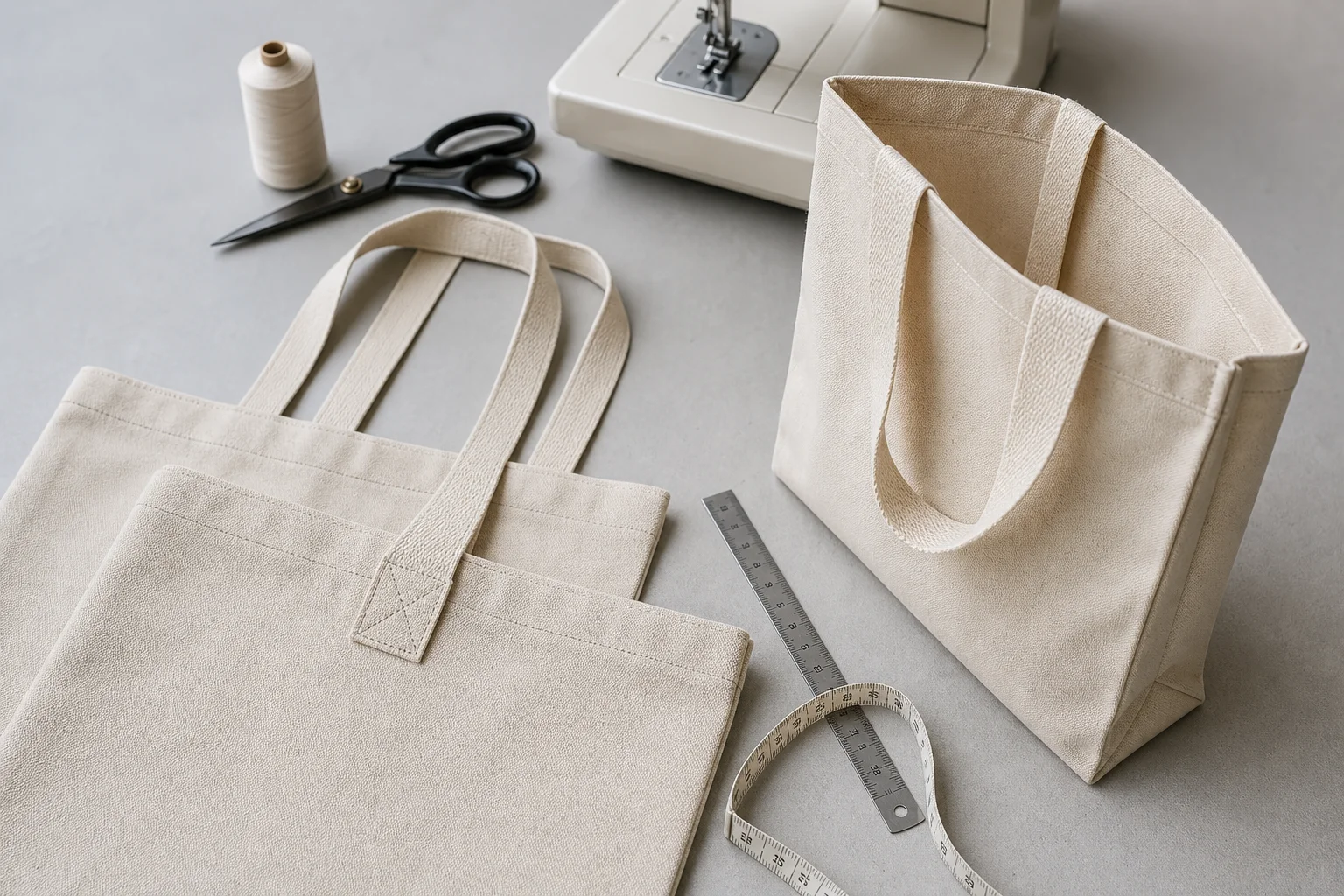
A box-X reinforcement at the handle junction spreads the load across a rectangle of fabric instead of concentrating it on one stitch line.
A load-bearing cotton tote bag is a woven cotton or cotton canvas bag built so that a stated weight can be carried repeatedly without the handle, the bag mouth or the base giving way. What defines it is not the cloth but the build: a reinforced handle junction, a top edge that resists stretching, and a base seam treated as structural rather than as a closing line.
The format is neither a pouch nor a box: there is no frame to hold it open and no heat-sealed joint to fall back on, so every load passes through stitches — which is also what makes it serviceable, since a failed joint can be re-sewn.
Quick Answer: The weakest point of a cotton tote is rarely the fabric but the handle junction and the base seam, and both are decided by how they are stitched. Stitch density has a threshold too: below it the seam is the weak link, above it the fabric becomes the limit.
The load path runs from the hand to the base in four stages: the handle, then the junction where it meets the body, then the top edge that keeps the bag mouth from stretching, then the base seam the contents rest on.
The junction is the critical stage for two reasons. It is the only place where the load arrives at an angle rather than in line with the fabric, so part of the force becomes a peel that lifts the handle off the surface instead of a tension that pulls along it. And it is small: a handle a few centimetres wide arrives on a panel many times that width, so the fabric around it carries far more load per unit area.
A longer handle amplifies both effects. Carried in the hand, the junction mostly sees tension; carried on a shoulder, the handle arcs and the junction sees more peel plus a sideways pull. That is why a shoulder tote needs a wider attachment than a hand-carried bag of the same size.
The handle is fixed by stitching, and the method chosen decides both the load the junction survives and the way it fails.
Method | How it is made | How it fails under load | Where it fits |
|---|---|---|---|
Single stitched row | One row across the top edge | Stitches pull out at the outer edge | Light promotional bags |
Double stitched row | Two parallel rows across the attachment | Load still concentrates at the row ends | General retail totes |
Box-X reinforcement | A square with an X over the junction | Resists tension and peel; fabric can still tear | Heavy-duty and multi-use totes |
Bar tack at the ends | A short, dense run at each end | Prevents unravelling but spreads no load | Paired with a box-X, not alone |
Handle wrapped into the seam | Handle runs down into the side seam | Transfers load into the seam, not the surface | Shoulder totes carried over distance |
Whichever method is chosen, the junction needs a second layer behind it. Stitching into a single thickness concentrates the tear at the stitch holes, because the needle line has already perforated the only material holding the handle. A reinforcement layer — a patch, a doubled panel or a woven tape — gives the stitches something to grip that is not the visible face, and that layer decides most junction failures.
Evidence base. The material below comes from published research rather than from any order handled here. It rests on two documents: a 2016 cotton seam study by Danquah and Gavor in the African Journal of Applied Research (Vol. 2, No. 2), and ISO 13935-2:2026, the standard method for seam maximum force.
What was tested. The study sewed a plain seam in 100 % cotton real wax printed fabric along the warp at 8 to 12 stitches per inch with polyester thread, and tested it on a Hounsfield H5K-S machine.
What the study found. Differences showed up in seam efficiency, strength and elongation, with twelve stitches per inch returning the highest values and eight the lowest. The crossover mattered more than the ranking: the fabric was stronger than the seam at eight, while at ten and twelve the seams were stronger than the fabric.
What the standard fixes. ISO 13935-2:2026 determines the maximum force of a sewn seam when the force is applied perpendicular to it — the grab test — on a constant-rate-of-extension machine. It applies to woven textile fabrics, is normally not applicable to coated fabrics, nonwovens or polyolefin tape yarns, and covers straight seams only; this edition adds a structural-seam definition and annex.
Where that lands in a specification. Stitch density has an optimum rather than a direction: past a certain point extra stitching stops buying strength, because the fabric is the limit and each needle line cuts into it. And the seams a tote depends on are rarely straight, so a straight-seam method needs a sampling plan naming the structural seam tested and how it is cut from the finished bag.
The base decides how much the bag holds; the base seam decides how much it carries. Treating those two questions as one is the most common specification error in the format.
Base type | How it is made | Load behaviour | Best suited to |
|---|---|---|---|
Flat base | One seam across the bottom | The whole load passes through one seam | Light, flat items |
Boxed base | Corners squared off and stitched for depth | The corner seam becomes the stress point | Box-shaped contents |
Gusseted base | Side and bottom folds let the bag expand | Volume is gained, but not strength | Bulk items of low weight |
Bound base | A tape wraps the base seam | Adds strength and hides the raw edge | Bags inspected before packing |
Doubled base panel | An extra panel turned into the seam | Spreads load over two thicknesses | Heavier contents |
A gusset is a volume decision, not a strength decision. It lets the bag open out, but the load still leaves through the same base seam, and if the fold is stitched through its full depth the needle line runs along the very fold the base wants to move on. Boxed corners work the other way: they remove volume and add a short, heavily loaded seam at each corner, which suits a stacked box but not a soft garment.
On a tote, the most useful number on the specification is stitch density, expressed as stitches per inch or per centimetre. The published cotton seam trial showed why it needs a value rather than an instruction: density below the crossover leaves the seam as the weak link, while density above it makes the fabric the limit and turns every needle line into a line of perforation.
Thread follows the same logic. A thread much stronger than the fabric does not make the junction stronger; it moves the failure into the cloth around the needle holes. A thread noticeably weaker breaks first and leaves a seam that looks intact while it opens. The two have to be selected together, and the study's own recommendation — that thread performance in seams deserves further work — signals that this pairing is not settled by one test.
At the stress points, three habits do most of the work. Both ends of every structural seam are locked rather than left to run, because an unsecured end is where a row begins to unravel. Reinforcement layers sit behind the junction and the base corners, so the stitching grips more than one thickness. And stitching on the visible face is planned in advance, since pressing hides the line, not the holes.
Handle drop is the distance from the top of the handle to the bag mouth, and it converts a carrying habit into a construction requirement. A short drop suits a hand-carried bag, where the handle works in tension. A long drop suits a shoulder bag, where the handle arcs and pulls sideways at the junction, adding peel.
Size follows a different rule, because volume and capacity are not the same thing. A taller bag holds more, but the load still arrives at the same junction, and a gusseted base adds volume without adding what the seam can carry. A bigger bag and a heavier carry are therefore two changes, not one: the base has to gain depth, and the junction has to gain width or a wrapped handle at the same time.
The practical consequence is that the intended load belongs in the enquiry as a number, together with the carrying mode. Stating the weight and how the bag is carried tells a supplier which junction geometry to quote, and gives both sides a figure that can be tested.
Why it works | What to watch |
|---|---|
Load travels through stitched joints that can be repaired | A stitch line cannot be moved without holes |
Woven cotton flexes at a fold instead of cracking | The top edge stretches unless the band is reinforced |
The reinforcement can itself be a design element | A dense stitch line perforates the cloth it reinforces |
Base construction can be chosen independently of fabric weight | A heavier cloth can under-perform a lighter one if the junction is poorly built |
Carrying capacity is set by geometry that can be specified | Junction strength and base seams cannot be judged by eye |
Six lines turn an enquiry into something that can be checked against the delivered bag.
Line item | What to put in it |
|---|---|
Intended load | The weight the bag must carry, as a number, and how it is carried |
Handle junction | The attachment method by name, plus the reinforcement layer behind it |
Stitch density | The value per inch or centimetre at the junction and at the base |
Base construction | Flat, boxed, gusseted or bound, with the seam treatment named |
Structural seams | Which seams are treated as structural, and how they are sampled for testing |
Care and delivery | Whether the bag will be washed, and how it must arrive packed |
MOQ tiers, tooling and how lead times are structured from one format to another are covered in the case studies and FAQ on custom packaging sourcing.
What is the strongest way to attach a tote handle? The two strongest options do different jobs. Wrapping the handle into the side seam transfers load into the seam and suits a shoulder bag; a box-X spreads the load across a rectangle of fabric and resists peel in both directions. Either way the layer behind the junction matters more than the stitch pattern.
How dense should the stitching be on a cotton shopping bag? Specify a density at or above the crossover, not the densest line possible. In the published cotton seam trial, twelve stitches per inch returned the highest values and eight the lowest, and the fabric was stronger than the seam at eight while the seams were stronger at ten and twelve.
Does a gusseted base carry more weight? It carries more volume, not more weight. The load still leaves through the same base seam, so the seam sets the limit.
Should a cotton tote bag be tested after washing? If the bag will be washed, the specification should say so. The seam study's authors recommend further work on seams after washing, which signals that a seam measured in one condition is not automatically a promise in another.
Can the same seam test be used on a coated or nonwoven bag? No. The method applies to woven textile fabrics, is normally not applicable to coated fabrics, nonwovens or polyolefin tape yarns, and covers straight seams only.
A custom cotton tote bag is not made strong by choosing heavy cloth. It is made strong by treating four stages of one load path as a single system: the handle, the junction where the load concentrates, the top edge that resists stretch, and the base seam that carries what the bag contains. The handle attachment decides how the bag survives the junction, the base decides what a cotton shopping bag can carry, and stitch density decides whether the seam or the fabric is the limiting part.
Reference material on construction, materials and production is published by Utouch Packaging. Cotton tote programmes are quoted on request via the contact page, and bulk terms sit on the storefront at Xiamen Yu Touch Imp. & Exp. Co., Ltd.
