
Views: 0 Author: Site Editor Publish Time: 2026-10-13 Origin: Site


Article Intro: A cotton bag built for dry jewellery and a cotton bag built for a leaky bottle use the same fabric and are a completely different product. Once the payload is wet, the softness that makes cotton good for a pouch becomes absorbency, and the construction has to be re-planned around a barrier the fabric cannot provide itself. This guide follows that one change outward, through lining systems, coatings, the seam that actually leaks, and the opening geometry that decides how usable the bag is.
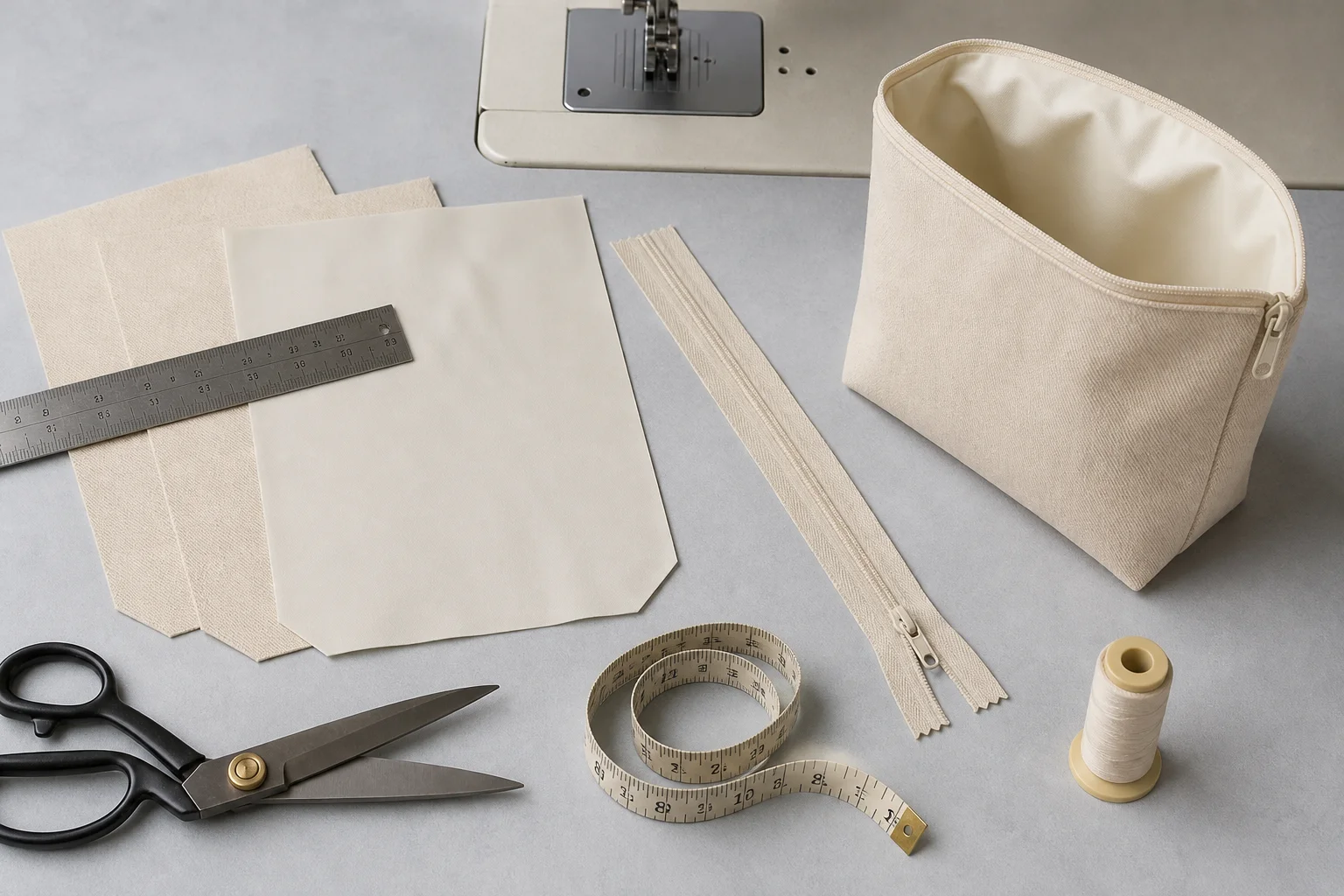
Shell panels, a coated lining panel, coil zip tape and an open boxed-base pouch: the four components that decide whether a cotton makeup bag survives a wet payload.
A cotton makeup bag is a soft, sewn bag whose shell is a woven cotton fabric and whose purpose is to carry cosmetics, toiletries or grooming tools rather than dry goods alone. What separates it from a jewellery pouch is not the shape but the payload: the contents are often liquid, semi-solid or powdered, and they travel in a bathroom, a gym bag or a suitcase, so the bag is expected to contain a mess rather than merely hold an object.
Two properties follow. The wall has to stop liquid and fine powder reaching the cotton, and the interior has to be recoverable — wiped, rinsed or laundered — without the bag losing shape. Cotton contributes the handle, the drape and the print surface; none of the barrier, so the barrier is always a second component.
Quick Answer: A cotton makeup bag works because of what sits behind the cotton, not because of the cotton. Either the fabric is coated or a liner is fitted inside it, and the liner's fitting method matters more than its material, because the leak path runs through needle holes rather than through the wall.
Cotton is hygroscopic, an advantage in a dust bag and a liability here. A spill does not sit on the surface; it is drawn into the fibre structure and travels sideways along the yarns, so a little liquid becomes a large, visible mark that sets and holds moisture long after the surface feels dry.
The second failure is slower. A bag that stays damp between uses develops odour and, in a warm humid climate, mildew — a problem storage conditions amplify and that no ventilation inside a closed suitcase solves.
The third is the one buyers notice first. Wet cotton loses body: the bag that stood open on a shelf at the start of a trip collapses into itself once used, and the opening folds shut. Powder behaves in the opposite way, migrating out through the weave as fine dust and staining the shell from inside, where it cannot be wiped off.
All three point at the same fix. Keep the liquid away from the cotton, and the cotton away from the payload.
Four builds are in common use, and the differences that decide how a bag behaves in service are the assembly differences, not the polymer names.
Build | What it keeps off the cotton | How it is assembled | Where it fits |
|---|---|---|---|
Drop-in loose liner | Liquid and powder; nothing crosses the liner wall | A closed pouch sits inside the shell; no needle passes through it | Where the strongest barrier and the easiest replacement matter |
Sewn-in full lining | Liquid, except along the seam line | Lining and shell are cut separately, joined at the mouth, turned in and topstitched | The standard single-wall finish |
Coated shell | Liquid on the coated face | The fabric is coated before cutting; cut edges are bound or the seam is sealed | The lightest build and the fastest to wipe |
Removable insert | Liquid; the insert carries the payload | A welded PEVA or TPU insert drops in and lifts out | Where the shell must stay wipe-clean and dry |
A sewn-in lining is the natural choice in volume: one construction step and a finished look. It is also the build that puts a needle line through the barrier.
Source. The material below is published research, not an order handled here. Two documents carry it: a 2017 paper in The Journal of The Textile Institute on coating cotton for combined waterproofness and vapour permeability, and ISO 811:2018 on how much water pressure a fabric holds back.
How it was made. The cotton was coated by a knife-over-roll technique with an aqueous dispersion of natural rubber latex, polyvinyl alcohol and starch. The best-performing formulation used natural rubber latex, 15 % aqueous PVA and tamarind kernel seed powder as the starch in a ratio of 1:3:0.3 with a sulphur curing system, then drying at 95 °C for five minutes and vulcanisation at 120 °C for two hours.
What it reported. That combination gave the most balanced improvement across waterproofness, breathability measured as moisture vapour transmission rate, coating adhesion, tensile properties, abrasion resistance and flex endurance, with the PVA responsible for the vapour behaviour and the starch promoting it.
Why the mechanism matters. Scanning electron microscopy showed PVA crystals forming clusters only a few microns across inside the rubber matrix. Those clusters act as conduits for moisture vapour while remaining an effective barrier to liquid water droplets — vapour out, spill in, from one layer.
How the claim is tested. ISO 811:2018 specifies a hydrostatic pressure method for determining the resistance of fabrics to penetration by water, and applies to all fabrics intended to be water resistant, whether or not they carry a water-resistant or water-repellent finish. Water resistance can therefore be specified as a measured head rather than an adjective, and that figure says nothing about vapour behaviour.
The zip path is a design decision, not a trim choice. Where the zip runs decides how far the bag opens and how much handling the seam takes.
Zip path | How it is cut and sewn | What it costs and where it fits |
|---|---|---|
Straight across the mouth | One straight seam; zip length equals mouth width | Cheapest to sew; the bag opens only as wide as the mouth, so packing is a squeeze |
L-shape | The zip turns one corner; the needle pivots through it | More handling at the corner, bulkier turn; opens flat on a counter |
U-shape | Two corners; the opening lifts clear of the contents | Heaviest zip build; best for a wash bag packed while open |
Zip with a guard flap | An extra strip is laid over the teeth | Adds bulk at the mouth; keeps the teeth from pressing on contents |
Then the base. A bag meant to stand on a hotel shelf needs a flat base with real depth: a gusset seam at each end, or a boxed base with the corners stitched across. Depth decides whether the bag stands or topples — too shallow and it folds under its contents, too deep and it becomes a bucket. State the depth next to the flat size, because a flat size alone does not describe a standing bag.
The fabric is rarely the leak. A needle punches a hole through every layer it meets, and a wet bag puts that line of holes under a head of liquid. Along a seam running low in the bag, the stitch line is simply the shortest path from inside to outside, and no coating on the face of the fabric closes it.
Three consequences follow. Seam placement outranks fabric choice, because a seam above the level the liquid reaches has nothing to leak. The drop-in liner wins on this one variable, since no needle ever passes through it — it is a pouch with its own closed perimeter. And a coated shell leaks at every cut edge and every penetration unless the edges are bound or the seam is sealed, which is why a coated bag and a lined bag are not interchangeable answers to one brief.
Where a sewn-in lining is required anyway, two details cut the exposure: turn the lining so the needle line is not the face touching the payload, and keep the lowest seam clear of the bag floor.
These are two maintenance promises and they suit different buyers. A coated or lined shell that wipes clean needs no laundry day and survives a rinse in a hotel bathroom. It also gives something up: a coated cotton bag is no longer a single-material textile, which changes what can be claimed about recycling it, and repeated washing degrades the coating long before the cotton wears out.
An uncoated cotton bag with a removable liner takes the opposite position. It can be machine washed, which is often what a spilled bottle needs, the liner can be replaced on its own, and the shell keeps a single-material story. The trade is two components and the extra cutting and sewing they cost.
Either way, two numbers belong in the specification rather than a conversation: the wash temperature the shell will survive, and the shade-change limit the fabric is expected to hold. Both are ordinary textile properties, checked before a bulk run rather than after a complaint.
Where it performs | What it demands |
|---|---|
Keeps spill and powder off the cotton shell | The barrier has to be designed in, not added later |
Vapour passes out, so damp contents do not sweat | A hydrostatic figure says nothing about vapour behaviour |
A removable liner lifts out for laundering | Two layers add cutting, sewing and unit cost |
A coated face wipes clean in seconds | A coated shell forfeits the single-material claim |
The bag stands open and packs flat | Base depth must be stated, or the bag topples |
Six lines settle the questions that otherwise surface after the samples arrive.
What to fix | What to write |
|---|---|
Payload | What goes in, and whether it is liquid, powder or both |
Barrier | Liner, coating or both, and which face the barrier sits on |
Liner fitting | Drop-in, sewn-in or removable |
Opening | Zip path, zip length and how wide the mouth must open |
Base | Flat size plus gusset or boxed depth |
Care | Wipe-clean or wash temperature, and the care wording |
Buyers assembling a first soft-goods programme alongside rigid formats can also look at the walkthrough of how a packaging brief becomes a made product, which follows sampling, production and inspection in order.
Does a cotton makeup bag need a lining? If the contents can spill, leak, smear or shed powder, yes. The alternative is to coat the fabric itself, but the two work differently, and a coating cannot be taken out and replaced the way a liner can.
Can a coated cotton bag be called water resistant? It can, if the claim carries a number. ISO 811:2018 sets out a hydrostatic pressure method for fabrics intended to be water resistant, so the defensible claim is a measured head rather than an adjective.
Why does a spill still get through a lined bag? It travels along the seam, not through the wall. Needle holes are the shortest path from the inside out, so a lining only acts as a barrier where the stitch line stays above the liquid or off the contact face.
Is a washable cotton bag better than a wipe-clean one? It depends on the mess. Washable suits liquids that need rinsing out; wipe-clean suits powder and paste; a removable liner delivers both without coating the shell.
What zip length should a toiletries bag use? Long enough that the mouth opens past the widest item, which for a standing bag usually means a path running down one end as well as across the top. A straight top zip sized to the mouth width is cheapest and most likely to frustrate the user.
Once the payload is wet, a cotton bag stops being a single material and becomes a system. The cotton provides the hand, the print surface and the washability; a second component provides the barrier; and the barrier's behaviour depends far more on how it is fitted than on what polymer it is made from. The leak, when there is one, runs along the stitch line rather than through the wall — which is why a drop-in liner outperforms a sewn-in one, and why seam placement belongs in the same conversation as material choice. The opening follows the same logic: a zip path and a base depth are both structural decisions, and both should be stated as dimensions, not adjectives.
Reference material on how soft formats are built and specified is published by Utouch Packaging. Lining, coating and opening options for a specific payload can be raised through the contact page, with volume terms held on the storefront at Xiamen Yu Touch Imp. & Exp. Co., Ltd.
