
Views: 0 Author: Site Editor Publish Time: 2026-10-07 Origin: Site


Article Intro: Buyers usually order cotton bags for jewelry by weight and colour, and two bags of the same stated weight then behave nothing alike. One abrades and pills, the other stays smooth. One holds its cut size after washing, the other does not. The variable behind those differences is the weave, and it almost never appears in a specification. Two published fabric structure studies isolate it, holding every other construction parameter constant.
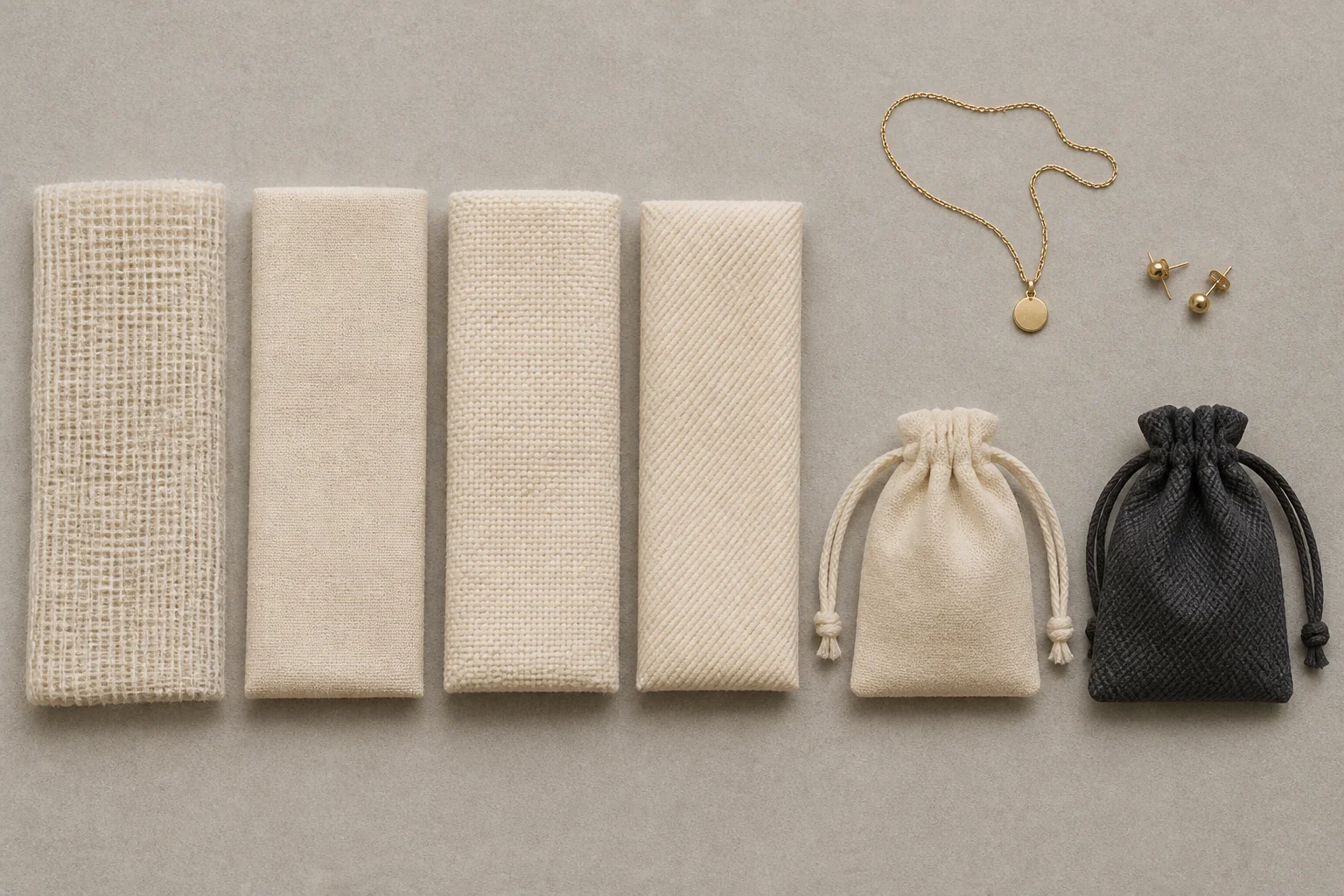
Four weave surfaces from the same fibre — the structure, not the weight, changes how each behaves
A cotton jewelry bag weave specification describes how the yarns interlace, not how heavy the cloth is. Weight is a mass measurement in grams per square metre. Weave is a structure — plain, twill, or a variation of either — defined by how often each warp yarn passes over and under the weft.
The two are independent. A plain fabric and a twill fabric can be woven from the same yarns at the same weight and still differ in abrasion behaviour, tear resistance and how much they shrink.
For a cotton fabric bag used as jewelry packaging, four properties matter more than mass: whether the surface abrades the piece, whether the cloth sheds fibre onto it, whether the fabric tears at the cord channel, and whether the bag still measures what was ordered after the first wash.
Quick Answer: Specify the weave, then the weight. Plain weaves — muslin, calico and canvas — resist abrasion, pilling and washing shrinkage better than twill. Twill resists tearing better and drapes more softly. Each is better at something, and the brief should say which property the bag is bought for.
The names are used loosely in trade, so it helps to separate what each describes.
Construction | Weave structure | Surface in the hand | What the structure does |
|---|---|---|---|
Muslin | Open plain, low thread count | Airy, gauzy, grid visible against light | Softest and most breathable; least cover |
Calico | Plain, medium thread count | Smooth and even, minimal texture | Best balance of abrasion and pilling resistance with a printable face |
Canvas | Plain, heavy yarns | Dense with a pronounced grid | Most compact and stiffest of the plain group |
Twill | Floats over two or more yarns | Diagonal rib you can feel | Lower interlacement; softer drape, higher tear strength |
Two structural measures describe the difference. The weave factor is the repeat span divided by the number of intersections: plain weave scores 1, 2/1 twill 1.5, 3/1 twill 2. The cover factor estimates how much of the surface is occupied by yarn rather than open space.
Plain weave has the most interlacement points and the lowest weave factor: more crossings mean more friction holding the yarns in place and fewer long floats lying exposed.
A buyer ordering a cotton calico storage bag or a white cotton muslin bag for stock is choosing between these structures whether or not the order says so.
Brand Background: The evidence is documented third-party textile research rather than a single order. One study tested the mechanical properties of cotton woven fabric across three weave structures, from Green University of Bangladesh, published in Advances in Research in Textile Engineering in 2017. The other measured dimensional stability after five washes across ten cotton fabrics, from University Goce Delchev in Shtip, North Macedonia, published in Tekstilna industrija in 2022.
The Packaging Challenge: A buyer comparing quotations sees a weight and a price per piece, and both are honest. Neither carries how the cloth behaves: whether a polished surface is scuffed, whether the fabric pills onto a stone, whether the cord channel tears, or whether the bag still measures what was ordered.
The Procurement Decision: The first held construction constant — the same 100 ends and 70 picks per inch, warp count 20 and weft count 10 over a 42-inch width, in greige cotton — and varied only the weave: 1/1 plain, 2/1 twill and 2/2 twill, tested at 65% relative humidity and 20 ± 2 °C. The second washed ten 100% cotton fabrics between 92 and 140 g/m² five times at 40 °C and measured dimensional change after every cycle.
The Solution: The result is a trade rather than a ranking. Reducing interlacements lowered tensile strength and abrasion resistance while raising tearing strength, drape and washing shrinkage. Both studies point the specification at the property the bag is bought for.
Measurable Results: At constant construction, warp-way tensile strength fell from 415 N in 1/1 plain to 405 N in 2/1 twill and 398 N in 2/2 twill, while tearing strength moved the opposite way, from about 13 N in plain to 19 N and 30 N in the two twills. Under Martindale abrasion neither plain nor 2/1 twill broke a thread; the 2/2 twill broke two or more. After 2,000 pilling revolutions plain rated 4 against 2 to 3 for both twills, and bending length fell from above 2 cm in plain to 1.7 cm in 2/2 twill. Total warp shrinkage ran from 0.26% to 2.6% and weft shrinkage from 0.26% to 1.56%, highest after the first cycle.
Both studies agree: the weave decides which failure the bag is protected against.
Shrinkage is the clearest demonstration. Across the ten washed fabrics it correlated with cover factor rather than weight, at R = −0.85 in the warp direction and R = −0.81 in the weft: fabrics with more open space between yarns moved further, because the yarns had room to close up. The weave factor correlated the other way, at R = 0.51 warp and R = 0.70 weft, so the longer the floats, the more the fabric shrank.
That is why a heavier bag is not automatically the safer one. Adding yarn mass raises cover factor, but it does not reduce interlacement, so it does not change how the surface behaves against a polished piece.
Measured property | 1/1 plain | 2/1 twill | 2/2 twill |
|---|---|---|---|
Tensile strength, warp way | 415 N | 405 N | 398 N |
Tearing strength | ~13 N | 19 N | 30 N |
Martindale abrasion | No threads broken | No threads broken | Two or more broken |
Pilling, 2,000 revolutions | Rating 4, slight | Rating 2–3 | Rating 2–3 |
Bending length, weft way | Above 2 cm | 2 cm | 1.7 cm |
Interlacement also explains why the same cloth can be strong one way and weak the other. In plain weave the warp yarns carry more strain from repeated crossing, which is why warp shrinkage exceeded weft shrinkage in all ten fabrics tested.
Abrasion is the first consequence. A bag is carried against a piece for a season, so the fabric with the fewest exposed floats resists that best. Plain weaves — muslin, calico and canvas — keep floats short; a coarse twill places more yarn on the surface where it can abrade a polished face.
Shedding is the second. Pilling is loose fibre tangling on the surface, and the ratings split plainly: 4 for the plain weave against 2 to 3 for both twills. For a bag holding a stone, that is fibre arriving on the piece rather than staying in the cloth.
Tearing at the cord channel is the third, where twill wins by the widest margin measured — about 13 N in plain against 30 N in 2/2 twill, because several yarns resist together where floats let them bunch. A twill cotton jewelry drawstring bag therefore survives harder pulling than a plain-weave bag of the same weight.
Dimensional stability is the fourth. Plain weaves shrank 0.26% to 2.34% in the warp direction, 2/1 twill 2.08% to 2.34% and 3/1 twill 1.82% to 2.6%, so a bag specified to the millimetre and woven in twill will not hold that specification after one wash.
The choice follows the piece. Muslin suits a light piece bought for a soft natural look. Calico is the default for an organic muslin cotton bag order that also has to carry a printed logo. Canvas suits heavier pieces and structured gifting. Twill suits bags where the cord takes real load — a custom twill cotton jewelry bag or a cotton twill packing bag in a dark colour — and a cotton twill bag quoted against a plain-weave equivalent on weight alone will look comparable and is not.
Once the weave is a variable rather than a trade name, a brief can state it and a buyer can check it.
What the measurement shows | What belongs in the brief |
|---|---|
Plain weave resists abrasion and pilling; twill does not | The weave named, plus which the order is buying: surface preservation or cord strength |
Twill raises tearing strength at the channel roughly two-fold | A channel construction matched to the weave, and a pull test on the finished bag |
Cover factor drives washing shrinkage, not weight | A stated shrinkage allowance, with the wash conditions it assumes |
Shrinkage is highest after the first wash, then falls | Pre-shrunk fabric if the cut size has to hold from delivery |
Warp shrinkage consistently exceeds weft | Separate length and width tolerances rather than one figure |
Verification needs nothing exotic. Ask for the weave to be named on the specification, for a production swatch rather than a development swatch, and, where the order repeats, for the cut dimensions to be re-measured after a wash. All three are ordinary requests, and all three fail when a weight figure alone has been agreed. The sequence from brief to approved sample, including where fabric approval sits in it, is set out in the guide to the jewelry packaging factory process.
What specifying by weave buys:
Abrasion, pilling and shrinkage stop being chance outcomes and become properties the brief names.
The trade between surface preservation and cord strength is made deliberately rather than by whichever fabric was quoted.
Tolerances can be set separately in each direction, matching how the cloth behaves.
What it costs:
Naming the weave narrows the fabric sources, so a quotation may move even when the weight is unchanged.
Choosing twill for cord strength gives up pilling performance a plain weave would have supplied.
Open plain weaves such as muslin need a tighter tolerance for the piece, because the surface sheds more fibre.
Verification needs a production swatch and a wash measurement, which adds a step before the first run.
Q: Is a heavier cotton bag always better for jewelry?
A: No. Weight raises cover factor, which helps dimensional stability, but it does not change how often the yarns interlace. A heavier twill still pills and abrades more than a lighter plain weave.
Q: Which weave should hold a polished piece?
A: A plain weave. Muslin, calico and canvas keep the exposed floats short, and in the tests above the plain fabric broke no threads under Martindale abrasion and rated 4 for pilling against 2 to 3 for both twills.
Q: When is twill the right choice?
A: When the cord carries real load or a softer hand is wanted. Tearing strength measured about 13 N in plain against 30 N in 2/2 twill, and bending length fell from above 2 cm to 1.7 cm.
Q: Should a cotton bag be washed before it is used?
A: If the cut size has to hold from delivery, yes. Shrinkage was highest after the first wash and then decreased, and plain weaves shrank up to 2.34% in the warp direction, so a pre-wash settles the dimension before measuring.
Q: Can a large order use one weave throughout?
A: Only if one property set serves every piece. Buying cotton muslin bags large enough for a full set differs from buying a twill pouch for a single chain, and one weave across the range means accepting what it gives up.
Cotton jewelry bags are bought on weight and behave according to weave. Two published structure studies isolate the variable: at constant construction, plain weave delivered higher tensile strength, better abrasion and pilling resistance and lower washing shrinkage, while twill delivered roughly double the tearing strength at the cord channel and a softer drape. Shrinkage tracked the cover factor and the weave factor rather than the weight figure, which is why a heavier bag is not automatically a safer one. The practical conclusion is short: name the weave in the brief, name what the bag is being bought to protect, and re-measure the cut size after a wash before the run is approved.
Utouch Packaging produces cotton jewelry bags across plain and twill constructions, specified around this framework — weave named on the order, the abrasion, pilling, tear and shrinkage properties stated rather than implied, and printed logo work matched to the surface the cloth actually presents. For wholesale and custom enquiries, visit the Utouch Packaging contact page or reach the export team through Xiamen Yu Touch Imp. & Exp. Co., Ltd.
