
Views: 0 Author: Site Editor Publish Time: 2026-10-17 Origin: Site


Article Intro: A fabric-covered jewelry box is made of two materials that behave differently, and the second is the one a buyer touches. This guide follows the covering rather than the colour: how a woven or coated facing is cut and wrapped, what happens at a corner where the textile turns a right angle, and why a covered panel changes dimension at a different rate from the board beneath it. The focus stays on that interface.
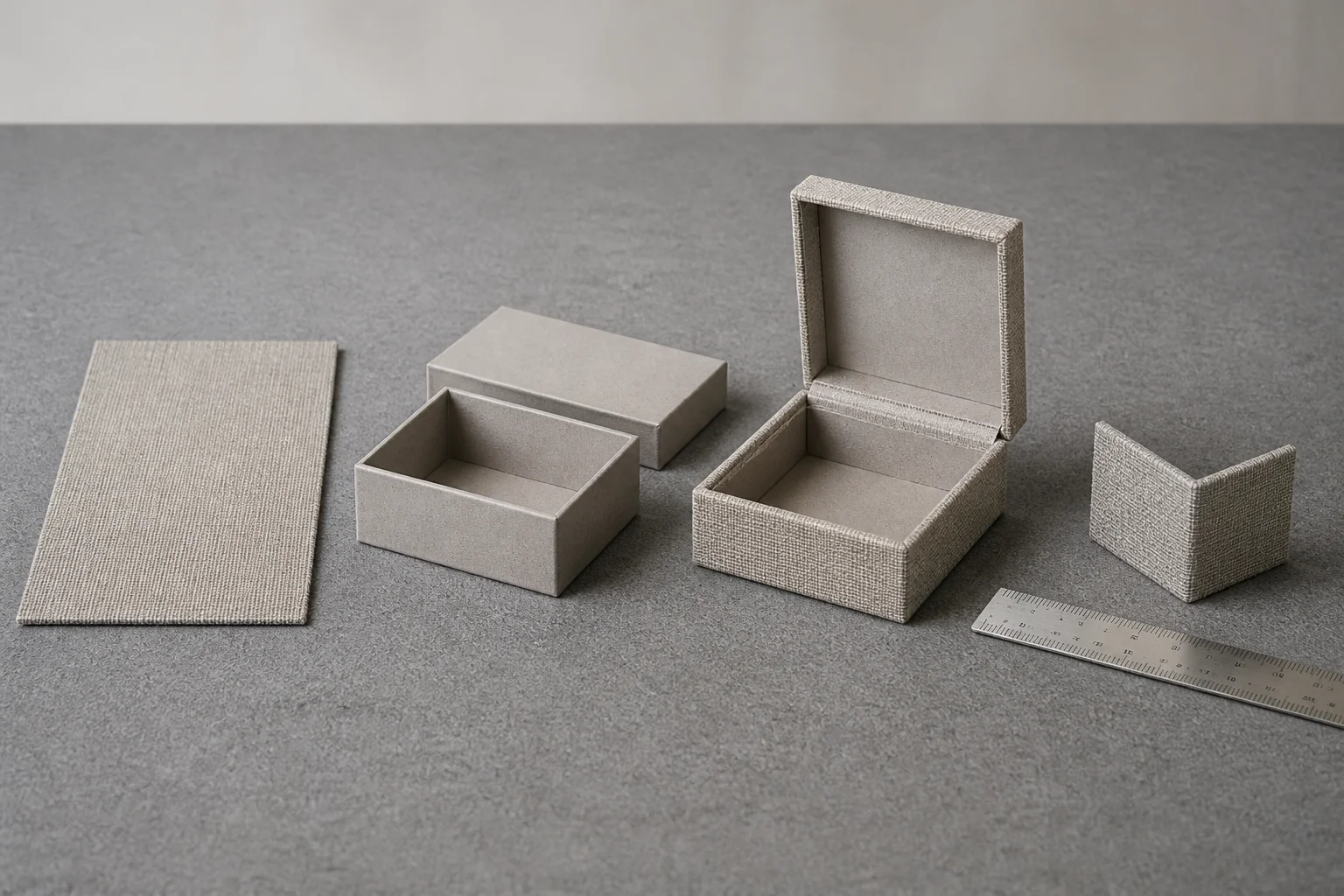
One covering job at four stages: a pre-cut facing, a bare board shell, a covered box, and a wrapped corner sample.
A fabric-covered jewelry box is built from a board shell, rigid or semi-rigid, whose outer surfaces carry a bonded textile facing. The facing is usually a woven cloth or twill, a satin-faced fabric, a knitted or non-woven microfibre, or a coated textile, applied over a board shell rather than printed onto it. It is a separate component with its own thickness and moisture behaviour, joined to the board by an adhesive layer along defined lines.
Quick Answer: What decides whether a covered box still looks new after a season is not the fibre name on the swatch. It is the thickness of the facing, the direction it is wrapped in, how the corners are trimmed, and whether the adhesive can hold a moving textile to a moving board.
One consequence follows immediately, and it belongs on the drawing. The covering adds thickness to every face it covers, so the outer dimension of a finished box is the board dimension plus the cover, measured under a specified pressure; ISO 5084, the textile method for determining the thickness of textiles and textile products, is why a cover specification should quote that pressure. Because the cover is a material rather than a surface treatment, what it does at a fold, a corner or a cut edge is a mechanical event.
The board's job is geometry and stiffness: the box's shape, the wall's resistance to pressure, the lid's fit. Almost none of that is visible once the box is closed.
The cover's job is the opposite. It carries every visual risk the box has: what a thumb leaves behind, what a shelf edge catches, what shows first after three months in a humid stockroom. A jeweller does not assess a box by the caliper of its wall; the outside is the cover.
There is a second, less obvious reason. A covered panel is not symmetric material. On most boxes the outer face carries a textile and the inner face a paper lining, and those two faces do not absorb moisture at the same rate. The panel therefore has a preferred way to bend when humidity changes, and the adhesive has to hold two materials that are each moving. Nothing in a covering catalogue warns a buyer, because the problem appears once the box leaves a conditioned room.
A covering job has a small number of junctions. Six of them decide most of the visible outcome.
Junction | What the cover must do | What goes wrong |
|---|---|---|
Outer face | Lie flat, with no trapped air or adhesive ridges | Shadowed high spots under raking light |
Fold line along an edge | Turn about 180 degrees without splitting the weave | A hairline crack, or shine where fibres stretched |
Corner | Absorb the excess material the turn produces | Bulk, softened definition, or a pleat on one face |
Cut edge | Be closed so yarn ends cannot escape | Fraying at the most-handled line |
Lid lip and inner return | Cross a short return without doubling thickness | A lid that fits on the sample, then binds |
Bottom panel | Survive the compression of packing and stacking | Edge lift at the base, seen first on returns |
Covering failures are rarely visible on the day of dispatch. They develop, and the appearance lags the cause by weeks, so they surface as a complaint about a delivered batch rather than in production.
Path | What is happening at the interface | What the buyer sees, later |
|---|---|---|
Interface release | The bond is weaker than the peel load the cover applies at a fold or lip | Lifting along one edge, then a bubble running inward |
Differential movement | Cover and board take up moisture at different rates, so the panel bends and shears its own bond | Shallow blisters, or a panel that curls once the lid is released |
Edge loss | The cut edge was never fully closed, so yarn ends work loose in handling | A lighter fuzzy line at the wear points, with fibre transfer onto the lining |
The three paths are fixed in three different places: interface release is an adhesive and pressure question, differential movement is a construction and conditioning question, and edge loss is a cutting and turning question. Raising bond strength to cure a fraying edge adds cost without removing the complaint.
A covering decision is an interface decision. It changes how the textile is cut, which direction runs around the box, how much material is allowed at a corner, how the cut edge is closed, and which adhesive is used at which coat weight — five levers acting on the bond between two materials.
It does not change the board's own chemistry, and it does not decide how a printed or stamped mark behaves, because a full-panel facing and a discrete applied mark fail for different reasons. It also does not rank materials: a satin, a canvas and a knit are not better or worse in the abstract, and each has to be wrapped as the material it is.
A thicker facing is not automatically safer, since thickness concentrates at the corner and the lip; nor is a softer cover more protective, since softness in the hand says nothing about how a weave bends around a board edge.
Where the published evidence sits. Nothing here was measured for a buyer; the figures come from a peer-reviewed, open-access review and are given only as that source states them. The review covers the dimensional behaviour of paper, published in the Journal of Materials Science (Lindner M., 2018, volume 53, doi:10.1007/s10853-017-1358-1). Its subject is paper rather than a textile-covered box, so the numbers are used only for the mechanism they demonstrate: what happens at an interface when a sheet is given a facing.
Three findings matter to anyone specifying a cover. The first is the failure mode: hygroexpansion, the dimensional change caused by changes in relative humidity, can make laminates and labels separate, wrinkle or curl. A cover bonded to a board is a laminate in that sense, and that separation is the event a buyer reports as a lifted edge.
The second finding is directional: paper sheets expand more in the cross direction than in the machine direction, because fibres lie predominantly along the machine direction and expand across their own axis. A board panel therefore grows as a rectangle with a preferred axis rather than as a square, and a cloth facing has a direction of its own, so the two must be arranged deliberately.
The third finding is quantified. The review reports a published case in which coating paper with polyethylene reduced machine-direction hygroexpansion from 0.0036 % per % relative humidity to 0.0023 % — a change, not an elimination. A covered panel therefore cannot be specified from board data alone, and a faced sheet still moves, now unequally on its two faces.
For scale, the review gives two background figures: hand sheets with fines added at 4.4 % and 9.6 % showed expansion coefficients of 0.13 and 0.165 % per % relative humidity, while sheets dried under restraint down to 90 %, 50 % and 16 % relative humidity showed approximately 0.3 %, 0.2 % and 0.15 %. The numbers are small, but comparable to the tolerances a box drawing is written to, and not symmetric between directions.
Most covering complaints trace back to a specification that was complete on colour and silent on construction.
Line | What it pins down | What is lost if it stays blank |
|---|---|---|
Facing composition and weave | The material, its weight per unit area, its weave structure | Substitution between batches, and an unmatched repeat order |
Facing thickness | Thickness at a stated pressure, per ISO 5084 | Drifting lid fit, outer dimension and corner bulk |
Wrap direction | Which direction runs around the box, and which over it | Panel bend and uneven texture on the long faces |
Adhesive and coat weight | What holds the facing to the board, and how much | A starved bond that lifts, or a flooded one that shows through |
Corner treatment | How excess material at each corner is reduced and turned | Soft corners on one batch, sharp on the next |
Cut-edge closure | Whether the raw edge is turned, bonded or bound | Fraying at the box's highest-wear line |
Conditioning before packing | The humidity boxes are held at before casing | The panel takes up moisture in transit and moves after dispatch |
First-article approval and re-check | Which sample was approved, and at what conditioning | No basis for judging a later batch, or closing a complaint |
Conditioning is the line most often left blank, and it has a published method behind it. ISO 187 specifies the standard atmospheres for conditioning and testing pulp, paper and board, with the procedure for monitoring that atmosphere and conditioning samples. A cover job approved in one atmosphere and shipped into another has no agreed reference point, and the interface is where the difference settles. Where the bond must be judged rather than inferred, ASTM D903 sets out the peel or stripping strength of adhesive bonds — the method for comparing how a flexible material separates from a rigid or flexible substrate at a controlled angle and rate.
The published case studies behind these projects are linked at the end, together with the questions buyers raise most often about how a specification is turned into a repeatable order.
Where it pays off | Where it loads the order |
|---|---|
A tactile exterior that reads as a material rather than a printed finish, and photographs well under raking retail light | A second component to specify, inspect and keep in matched lots for every repeat order |
For absorbing a slightly imperfect board surface, a textile spans a wider range of base quality than a printed face | Corner bulk, which must be trimmed and turned, and is the hardest part of the job to hold across a batch |
Directional control: one board can be given a different hand and look by changing the facing alone | Directional complexity: the facing has a grain that must be aligned to the panel on every face |
A covering layer chosen for thickness and construction independently of the box structure | A more sensitive interface, since cover and board move on different schedules when humidity changes |
Item | What to agree before approval |
|---|---|
Face drawing | Which material direction runs around each face, marked on the drawing rather than described in words |
Thickness reference | The facing thickness and the pressure it is measured at, so lid fit can be recomputed |
Corner standard | One accepted corner sample kept as the reference, photographed from two angles |
Edge standard | Whether the cut edge is turned, bonded or bound, and the acceptable fibre loss at the wear line |
Conditioning | The atmosphere the approved sample was held in, so a later batch is judged against the same reference |
What does wrap direction mean on a fabric-covered box? It means which direction of the covering material runs around a given face. A woven cloth has two directions with different stretch, and a board panel also expands differently in two directions. Aligning the two is what stops a long face from reading as uneven.
Can a textile cover go on any box shape? Most rigid shapes can be covered. What changes is the corner: the sharper the angle and the thicker the cover, the more material has to be absorbed there.
Is a heavier cover better? Not automatically. Thickness has to be turned somewhere and concentrates at corners and lips, so a heavier facing is chosen together with the corner treatment, not on its own.
Why do fabric corners look different from paper-covered corners? Paper can be creased sharply, so a paper cover folds to a defined edge. A textile cannot: the fibres have to be displaced, reduced or turned, and the resulting corner is a construction detail rather than a fold.
A fabric-covered jewelry box is a laminate, and the part of it that decides how it looks after a season is the interface between the covering and the board. The cover carries the wear, the finger marks and the light, adds thickness to every covered face, and has a direction of its own that has to be aligned with the direction the board moves in. Documented work on faced sheets supports the same mechanism: adding a layer to one face of a sheet changes how that sheet expands, laminates can separate, wrinkle or curl, and the movement remains after the layer is applied. Settle the wrap direction, the thickness reference, the corner and the conditioning before the first article is approved, and the adhesive layer is left with a job it can actually do.
Boxes, trays, cards and pouches, including textile-covered rigid boxes, are produced by Utouch Packaging. A covering job can be costed from a face drawing and a swatch through the contact page; covered box programmes are quoted at volume with Xiamen Yu Touch Imp. & Exp. Co., Ltd.
