
Views: 0 Author: Site Editor Publish Time: 2026-10-16 Origin: Site


Article Intro: Costume and fashion jewellery is sold on a finish, and that finish is a very thin deposit of metal over a much more reactive base. The packaging decision that matters is therefore not how soft the lining feels but how much of that deposit survives the trip from the bench to the counter. This guide follows the plating rather than the occasion: where a piece touches its packaging, which contacts remove metal, what a gap in the deposit lets through, and which lines belong on the order.
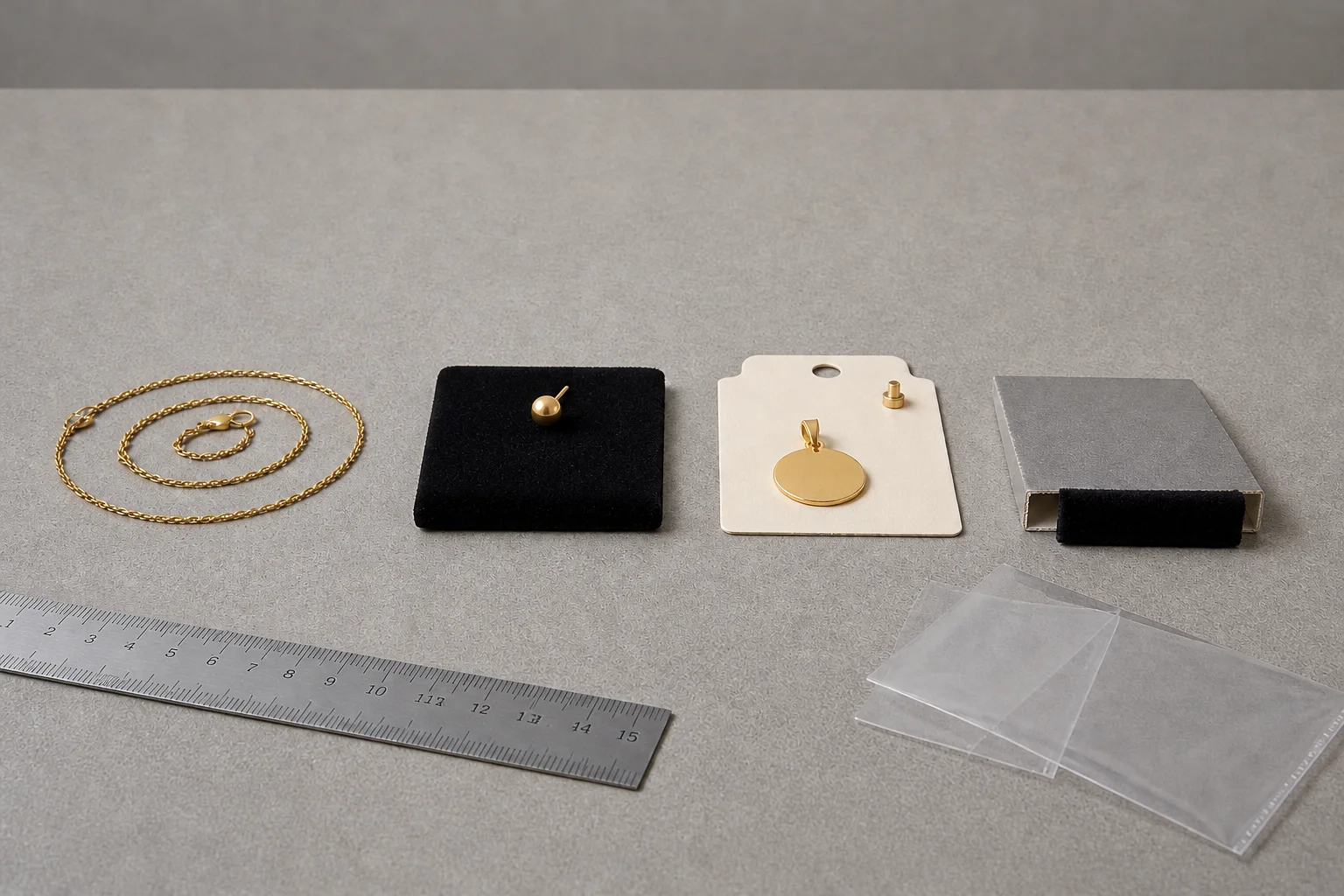
Four ways a plated piece meets its packaging: loose in a pouch, pressed into a pad, pinned to a card, and resting against a bare board edge.
Costume jewelry packaging covers the boxes, cards, trays and pouches specified for jewellery made on a base metal under a plated finish — brass, zinc alloy and copper alloys dressed in gold, rhodium, silver or black coatings. The pieces are light, the unit prices are low and the volumes are large, which pushes the packaging decision toward film bags, hang cards and small rigid boxes. What separates this category from fine jewellery is not the format but the asset being protected: the coating.
Three order shapes cover most of it. One pendant or a pair of studs travels in a small rigid box. A compartmented tray or a hang card carries a set. A pouch is the cheapest route and the one where a piece spends the longest in contact with a surface it did not choose.
Quick Answer: Protect the plating, not the piece. Plating is a deposit measured in microns on a base metal that corrodes readily once that deposit is interrupted, so the specification has to control three things: which packaging parts touch the metal, how much movement is allowed at those contacts, and what the piece is wrapped in.
A plated item is a laminate, and the two layers behave nothing alike. The coating is dense, hard and chemically calm. Underneath it sits an alloy that is soft, cheap and reactive — a typical fashion-jewellery brass runs roughly 70 percent copper and 30 percent zinc, and zinc in particular is the less noble of the two, so it will give up electrons to save the rest. Neither property is a defect. It is simply how the cost is held down, and it is why the packaging brief is written around the thin layer rather than the object.
That layer is thin in a way that is easy to underestimate. It is commonly thinner than the paper the piece is wrapped in, and the two ways of describing it are thickness and continuity. Thickness is measurable: ISO 1463 sets out a microscopical method for measuring the local thickness of a metallic coating by cross-section. Continuity is a separate question, and the fact that ISO 10308 reviews a family of porosity tests is telling: the industry accepts that electrodeposited coatings contain discontinuities, and has built methods for finding them.
This is a different mechanism from the sulfur-driven tarnish that dulls solid silver in storage, and different again from what a board emits into a closed box. Those are atmospheric questions about a bulk metal. Here the question is mechanical and local: has the deposit been worn through at a specific point, and what is underneath it once it has?
Contacts are few, and they are decided by how the piece is packed rather than by how the box is drawn. Each one concentrates load on a small area of coating.
Packaging part | How it reaches the coating | What it leaves behind |
|---|---|---|
Hang card pin or hook | A single point bearing the whole weight of the piece | A bright ring where the coating has gone |
Elastic band or cord | Sustained sideways pressure on a chain or band | A dull band, worst where the tension peaks |
Pouch seam and zip teeth | Rubbing each time the pouch is opened | Patchy sheen loss along the highest points |
Bare board or tray edge | A hard cut line against a soft coating | A straight scratch that reads as a defect |
Neighbouring piece | Metal on metal whenever the box is tipped | Matched wear on both items in the set |
Two conclusions follow. Movement matters more than softness, because a piece held still cannot abrade anything; and the contacts most likely to be overlooked are the ones added late — the band that keeps a card closed, the hook on the card itself, the board edge where an interior was die-cut.
Failure paths are worth separating because they need different fixes. Only the first is caused by the packaging; the other two are decided by the coating and by handling, and the packaging can either contain them or accelerate them.
Failure path | What drives it | How it shows up |
|---|---|---|
Wear-through | Repeated movement against a single bearing point | A polished or dulled patch with base metal showing |
Open pores | Discontinuities that were in the deposit from the start | Pinpoint darkening that grows into larger specks |
Trapped residue and moisture | Handling salts and adhesive or print residue held against the surface | Marks that follow a fingerprint or a taped area |
Wear-through is a packaging problem and can be designed out. Open pores cannot be designed out at the packing bench, but their consequences can be limited by keeping the piece dry and unwrapped in anything that holds residue against the surface. The third path is a discipline question: whether staff handle the metal or the packaging, and whether an adhesive ever meets a plated face.
Two levers are available, and they are not interchangeable. The mechanical lever is decided by the face in contact and the freedom to move: surface roughness, the hardness of the face relative to the coating, and whether the piece is restrained at all. A soft face with a deep pile and a restrained piece is a low-wear arrangement; a hard face with any freedom to slide is not, however luxurious it looks.
The chemical lever is narrower than it first appears. A plated surface is attacked through gaps, not across the whole face, so what matters is what is held against those gaps: moisture, handling salts, and residues from adhesive or print. Keeping a piece sealed and dry helps; that is the limit of what a film bag does for a coating.
What a material choice does not do is repair a thin or porous deposit, and few substitutions will move the visible outcome as much as removing movement at the three or four load-bearing points. The order of leverage is worth keeping in mind when a specification is drafted: first remove the contacts, then choose the face, then optimise the chemistry.
What the published work is. The figures in this section come from a peer-reviewed clinical study, not from a job run for a buyer, and they are reported here only as the study reports them.
Nixon and colleagues, publishing in Contact Dermatitis in 2018, needed test discs that behaved like fashion jewellery. They used a bright barrel nickel electrodeposit on brass at roughly 70 percent copper and 30 percent zinc, and they tested release with EN 1811:2011 + A1:2015 — the reference method that holds a sample in artificial sweat, in this case 0.5 percent sodium chloride with 0.1 percent lactic acid and 0.1 percent urea at a pH adjusted with sodium hydroxide, for 168 hours at 30 degrees Celsius. Before that step, coated items in the regulatory chain go through EN 12472:2020, the method that simulates accelerated wear and corrosion for the detection of nickel release from coated items. The wear step exists because the coating's integrity is the variable, not a constant.
Release from the coated brass discs averaged 8.44 micrograms per square centimetre per week, over a range of 6.35 to 10.31 across nine discs, against 6.77 for the solid nickel discs, over 6.04 to 7.54 across four. The regulatory limit for articles in direct and prolonged contact with the skin is 0.5 micrograms per square centimetre per week. The coating, in other words, did not insulate the substrate — the plated brass released measurably more than the solid metal it was plated with. The study also notes, in its own framing, that non-compliant inexpensive fashion and costume jewellery is a recognised cause of nickel allergic contact dermatitis.
The packaging lesson is general: a thin layer over a reactive substrate is most vulnerable where the layer is interrupted, and an interruption can be present from the moment the deposit forms or can be created later by contact. Neither is visible on a finish that reads as bright metal, which is why the specification describes the contacts rather than trusting appearance.
Four decisions account for most of the loss, and each one can be written as a line on the order. Full documentation of how a brief becomes a packed order, including the inspection steps at each stage, is set out in how orders are built and inspected on the factory floor.
Decision | What it spends | Line to add |
|---|---|---|
Card and pin choice | Point load on one earring post or pendant top | Pin gauge, and a card slot sized to the piece |
Restraint inside the pouch | Every open-close cycle, if the piece can move | Insert card or padded pad, not a loose drop |
Set separation | Metal against metal in the same compartment | One recess per piece, or a divider |
Handling and adhesives | Residue held against an interrupted deposit | Gloved handling, no adhesive against plated faces |
Where this approach pays | What it asks of the buyer |
|---|---|
Removing movement prevents the one failure a supplier can be blamed for | Restraint hardware adds a component and a few cents per unit |
A stated contact list makes an incoming inspection objective | More lines to agree before tooling starts |
Low-cost formats still work when the piece is held still | The cheapest film bag is often the wrong one for a set |
Gloved handling costs nothing and removes one whole failure path | Line discipline has to be re-taught for seasonal staff |
Most of the risk in this category sits on six lines of the order, and each one is there because leaving it out produces a failure nobody can attribute later.
Line on the order | What it says | What it protects |
|---|---|---|
Contact list | Every part that will touch the metal, named | Keeps late additions visible to both sides |
Restraint method | Slot, recess, pad or card, and the free play allowed | Stops the piece travelling inside the pack |
Face in contact | Pile height and face type where the metal rests | Sets the abrasiveness of the contact |
Coating thickness | The deposit the jewellery is bought to, and how it is verified | Connects the packaging budget to the coating budget |
Handling rule | Gloves for metal, no adhesive against a plated face | Removes the residue path entirely |
Retained sample | One packed piece held from each run | Gives the next complaint something to compare against |
Is a clear plastic bag safe for a gold-plated piece? For short transit, yes. It keeps dust and moisture off the surface cheaply. It does not restrain the piece, though, so the metal still moves against whatever it lies on, and nothing about the film repairs a coating that is already thin.
Does a softer lining stop plating wear? Not by itself. A soft face reduces scratching but does nothing about movement. A piece that is held still on a firm card usually keeps more coating than a loose piece on a deep pile.
Should plated pieces be separated inside one box? Yes, if they are in the same compartment. Metal against metal removes coating from both items, and the marks tend to match, which makes the cause obvious to the buyer and hard to argue about later.
Can a supplier guarantee that a coating will not wear? No. Coating thickness belongs to the jewellery, not the packaging. What a supplier can guarantee is the contact arrangement: which parts touch the metal and how much free play the piece has before it leaves the bench.
Costume and fashion jewellery is a laminate, and the packaging decision that decides its appearance at the counter is the one that controls contact. Plating is thin and not perfectly continuous, the base metal underneath it is eager to react once the deposit is interrupted, and the documented measurements point the same way as the physical reasoning: a coated brass surface can release more from its substrate than the solid metal it is plated with, which is why the deposit's integrity is worth protecting and impossible to inspect by eye. Design movement out first, choose the face second, and leave the chemistry as the last refinement rather than the main argument.
Boxes, cards, trays and pouches for plated and costume jewellery are produced by Utouch Packaging. An arrangement can be costed from a drawing and a sample piece on the contact page, and volume pricing for a box, card or pouch programme is published under the listings at Xiamen Yu Touch Imp. & Exp. Co., Ltd.
