
Views: 0 Author: Site Editor Publish Time: 2026-09-30 Origin: Site


Article Intro: A clear jewelry box hides nothing, and that is the difficulty. An opaque box absorbs a smudged liner or an insert sitting a millimetre off centre; a transparent one puts every surface under the light. This guide covers the two structures that dominate the category — the membrane box, in which film is tensioned across an aperture in a board frame, and the rigid box built from clear sheet. It then sets out the optical values that decide whether clear is clear, and why film tension does not last.
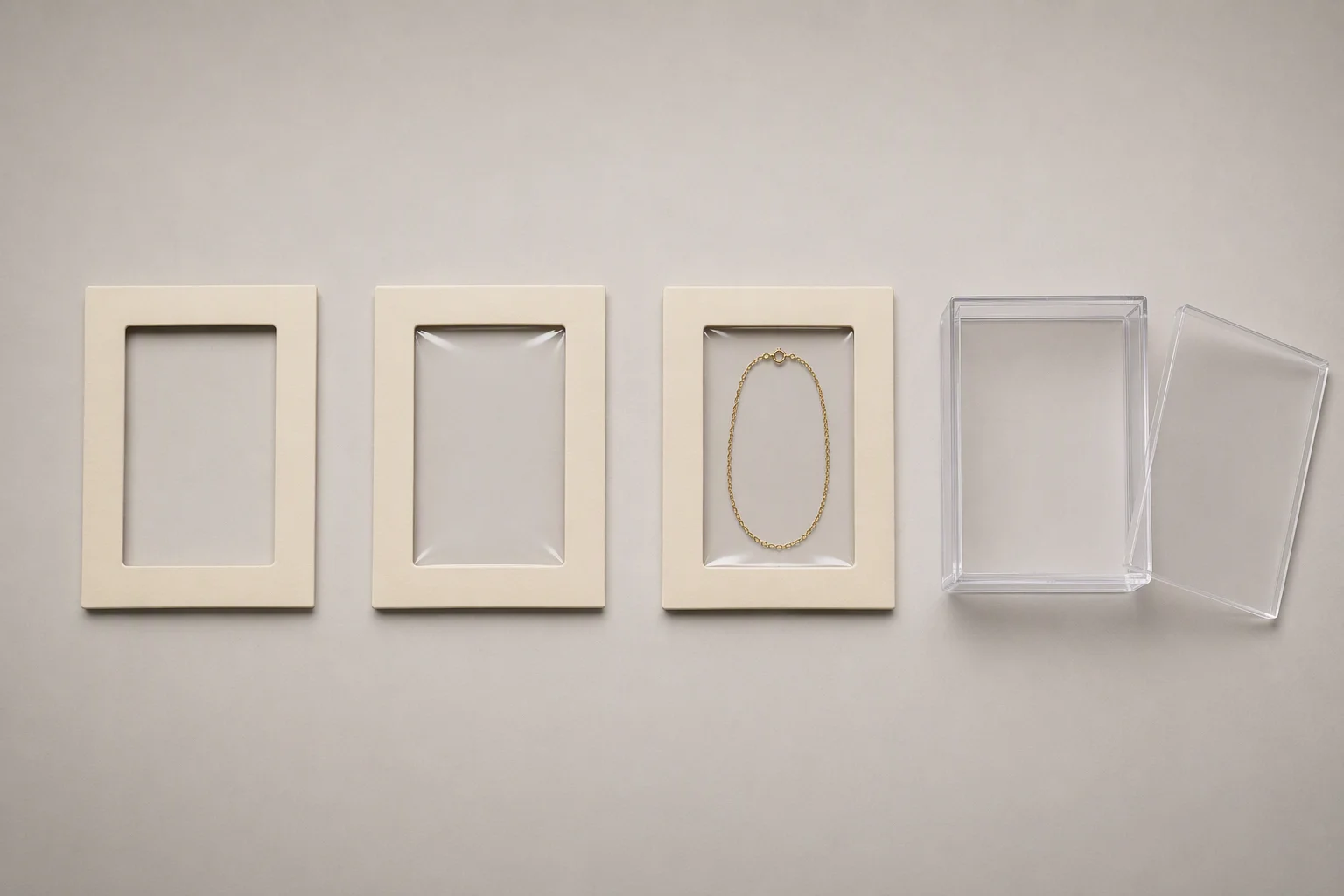
Frame, frame under tension, chain behind film, clear sheet box
A clear jewelry box is a box whose viewing surface is transparent, so the piece is seen before the box is opened. Two structures dominate the category. The membrane box is a board frame with an aperture cut through it, across which transparent film is stretched and anchored; the piece sits in the aperture, held flat against the film, so it appears suspended. The clear rigid box is built from transparent sheet — cut, creased and joined — and closed with a lid of the same material.
Neither is a window box, in which a clear panel sits in an otherwise opaque lid. A window box treats transparency as an opening in a solid structure; a clear or membrane box treats transparency as the structure itself.
Quick Answer: A clear jewelry box is either a board frame with film tensioned across an aperture, or a box built entirely from clear sheet. Both are judged on two measurable properties — luminous transmittance and haze — and the membrane version adds a third: film tension, fixed at assembly and settling over time.
Factor | Membrane box | Clear rigid sheet box | Opaque box with clear window |
|---|---|---|---|
Source of transparency | Film tensioned across an aperture | The sheet wall itself | A clear panel set in a lid |
What holds the piece | Film tension | An insert or tray | The interior insert |
Opaque branding surface | Frame border only | None; a card or seal is needed | The lid and body |
Main failure mode | Loss of film tension | Scratches and joint lines | Window haze and adhesive lines |
Typical use | Chains, pendants, studs | Sets, gift lines, retail stock | Retail shelf and gifts |
For clear plastic jewelry boxes, transparency is not a look; it is two measured properties. Total luminous transmittance is the share of incident light passing through. Haze is the share of that transmitted light scattered away from the main beam, which the eye reads as milkiness. The standard methods are ASTM D1003 for haze and luminous transmittance of transparent plastics, ISO 14782 for haze, and ISO 13468 for total luminous transmittance.
The figures are less absolute than buyers expect. A published study of crystallisation in biaxially oriented polyester reported transmittance below 89% for ordinary BOPET film, with haze between 2% and 4%. Film sold as clear therefore already scatters a measurable share of the light it transmits, and it is haze rather than transmittance that decides whether a box reads crisp or milky.
Three polymers dominate the transparent layer, and they are not interchangeable.
Property | PE film | PET film | PVC film or sheet |
|---|---|---|---|
Optical clarity | Lower; blown film carries haze | Highest of the three | High when new |
Stiffness | Soft and flexible | Stiff and crisp | Moderate to stiff |
Tension retention | Poorest; relaxes readily | Best; oriented grades hold longest | Good initially |
Cost position | Lowest | Highest | Low to moderate |
Watch-outs | Reads hazy at heavier gauges | A crease does not come out | Plasticiser changes the material over years |
The choice is a tension decision before it is a clarity decision. PE is the cheapest way to put film across an aperture and suits a box opened within a season.
Note on sourcing: What follows is documented third-party research rather than a transacted order. It draws on a 2018 study of crystallisation in biaxially oriented polyester film, a 2001 study of light transmission and haze in polyethylene blown thin films in Polymer Engineering & Science (volume 41, pages 358–372), and a 2020 creep study of polyamide film in the Journal of Elastomers & Plastics.
The question. A clear-box supplier is normally asked to stand behind two claims: that the box is clear, and that the piece stays floating. Both are measurable, and published work covers both.
What was measured. Transmittance and haze of oriented polyester and blown polyethylene films, and the time-dependent deformation of a stretched film under load.
What the studies found. For ordinary biaxially oriented polyester film, transmittance was reported below 89% with haze between 2% and 4%, so film sold as clear already scatters a measurable share of the light passing through it. On the mechanical side, the polyamide study found applied stress driving the film from viscoelastic deformation, which recovers, toward viscoplastic deformation, which does not, and found that higher temperature could activate the non-recovering state directly. A film held under tension therefore loses part of that tension over time, heat accelerates the loss, and part of the loss never returns.
What it means for a buyer. A float effect is a temporary condition, not a permanent property. State transmittance and haze as figures with the test method applied, and approve a sample of the actual gauge rather than a nominal clear. Then state the storage temperature the format must hold tension at.
Film and frame are one system: the film does nothing without an anchor, and the frame does nothing without the film.
The aperture is a mechanical decision. A stretched membrane deflects further as the span it crosses grows, so the same film at the same tension sags over a wide aperture where it would stay flat over a narrow one. The aperture is sized against the piece, not against the face of the box.
The anchor is the second decision, and the three common methods fail differently. Gluing the film to the reverse of the frame risks creep along the glue line. Heat-sealing depends on process control, because too much heat thins or burns the film. Mechanical fixing holds well but leaves visible hardware on the reverse.
The frame border is the third: a narrow border flexes, so film tension bows the frame itself, while a wider border stays flat and reduces the viewing area. Tension also cannot be adjusted after assembly — whatever the factory set is what the customer receives.
A tensioned film is a polymer held under sustained strain, and polymers under sustained strain move. Under constant strain the stress falls away over time — stress relaxation. Under constant load the material keeps extending — creep. A film across an aperture sits between the two.
The published record is consistent about direction. The polyamide study found stress pushing the material from recoverable deformation toward deformation that does not recover, with temperature able to trigger the second state directly. Heat is the common accelerator.
Two things follow. The piece sits less tightly against the film after months in storage than in the sample box, and soft waves can develop where the film relaxed unevenly. Choosing oriented polyester over polyethylene, keeping the aperture modest relative to the piece, and treating the format as a presentation pack with a service life rather than a permanent display are the available mitigations.
The clear rigid box is built from sheet rather than film, cut to the net, formed or creased at the corners and joined. Every step leaves something visible, because nothing is covered. Thickness is quoted in millimetres and is a trade rather than a target: thicker walls resist flexing, but they add weight and make the joint line more obvious.
The join is the clearest tell of process quality. Heat welding keeps a joint transparent but needs control — too much heat thins or scorches the sheet, and a scorched joint shows as a faint discoloured line. Solvent bonding is simpler, but the solvent attacks the sheet surface, and a joint that turns cloudy is a bonding problem, not a fault in the material. A clear lid has nowhere to hide: a lip that does not seat reads as an open gap from every angle at once.
Then the inspection list reverses. A clear box is checked for dust, fingerprints, a scratch across the viewing face and an insert sitting off centre — all of which the customer will also see, so masking film on the viewing faces and individual bagging after inspection are part of the product rather than packaging of the packaging. The factory's own account of how this discipline runs in practice is set out in how jewelry packaging is designed, produced and quality controlled.
Advantages | Trade-offs |
|---|---|
The piece is visible before the box is opened | Clear surfaces expose dust, fingerprints, scratches and any off-centre insert |
No printed surface competes with the piece | No opaque face for brand marks; branding moves to a card, seal or label |
One frame format can carry many pieces | Clarity is measured, so transmittance and haze must be specified |
Film tension holds a piece flat and firm | Tension relaxes over time and with heat, so the float is not permanent |
Clear formats photograph well for online listings | Glossy surfaces reflect the environment and can obscure the piece |
No wrap or lining materials are needed | Film cannot be re-tensioned once it is anchored |
Seven lines turn a quote into something that can be inspected.
Specification line | What to state |
|---|---|
Structure and material | Membrane, clear sheet or clear-lidded box; PE, PET or PVC named explicitly |
Optical target | Transmittance and haze figures, with the test method applied |
Thickness | Film gauge in microns, or sheet thickness in millimetres |
Aperture and tension | Aperture dimensions against piece size and weight; tension set at assembly |
Anchor method | Folded and glued, heat-sealed, or mechanically fixed |
Lid fit and protection | Maximum acceptable gap; masking film and individual bagging |
Service note | Maximum storage and display temperature the format must hold tension at |
Is a clear jewelry box the same as a membrane box? No. A membrane box is one type of clear jewelry box: a board frame with film tensioned across an aperture, where the film holds the piece. A clear rigid box is built from transparent sheet and holds the piece with an insert. The same format may be quoted as a transparent jewelry box, a plastic jewelry box or clear jewelry packaging; the structure, not the label, decides what is bought.
Can a clear jewelry box carry a logo? Only on the parts that are not transparent — on a membrane box the frame border, and on a clear sheet box a card, seal or label. Planning that surface at design stage is cheaper than discovering the omission at sample stage.
Why does the film in a membrane box go loose? Because a polymer held under sustained strain relaxes. The film loses part of its tension over time, heat accelerates the process, and the loss is partly permanent.
Is PET or PE film better for a membrane box? PE is cheaper and adequate for short-life presentation packaging. PET is clearer and holds tension substantially longer, which is why it is specified where the box must keep working after months on a shelf.
How is the clarity of a clear box verified? By measurement, not by eye. Transmittance and haze are reported to a standard method — ASTM D1003, ISO 14782 or ISO 13468 — and the sample tested must be the actual gauge being ordered.
Clear jewelry boxes and transparent jewelry packaging split into two structures engineered in different ways. The membrane box suspends a piece on film tensioned across an aperture in a board frame, so the frame, the aperture and the anchor decide the result, and the tension is fixed the moment the film is bonded. The clear rigid sheet box puts the transparency in the wall, which removes the hiding places an opaque box provides and reverses the inspection list toward dust, scratches and lid gaps. Neither format is judged well by appearance: transmittance and haze are measurable, tension loss is documented, and both belong in the specification rather than the conversation.
For reference on structures, materials and production, see Utouch Packaging. A specific clear or membrane programme can be discussed with the team through the contact page; wholesale enquiries go to the storefront, Xiamen Yu Touch Imp. & Exp. Co., Ltd.
